

California's Title 24 solar mandate now covers most new ADUs — but not all. Here's what homeowners need to know before breaking ground in 2026.
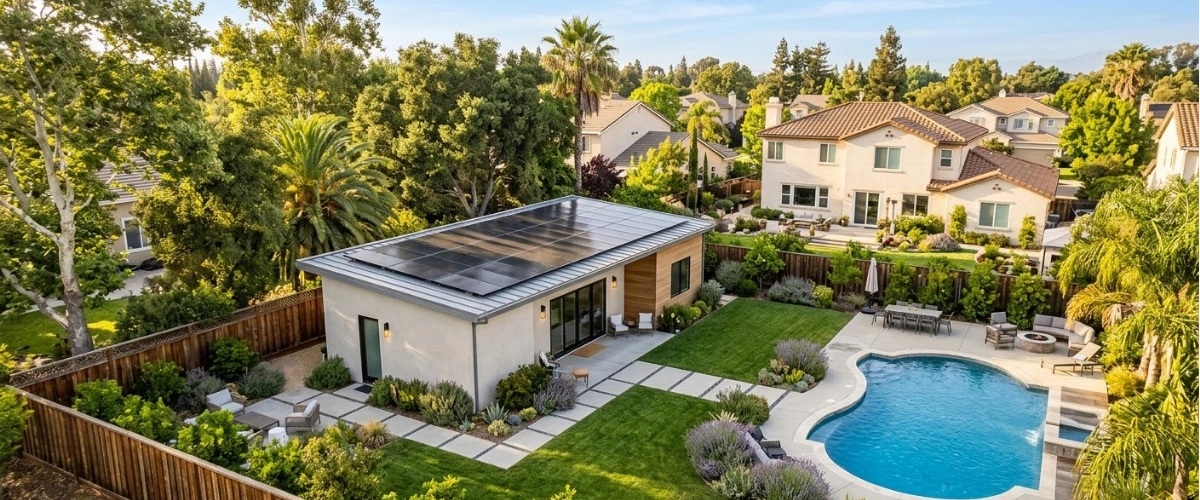
You're planning your ADU. You've mapped the footprint, talked to a contractor, maybe even picked a floor plan. Then someone mentions Title 24 and solar panels — and suddenly the project feels more complicated than you expected.
Here's the good news: California's solar rules for ADUs are actually straightforward once you understand them. Some ADUs require solar by law. Others are completely exempt. And knowing the difference upfront can save you thousands of dollars and prevent costly permit delays.
This guide breaks down exactly what California's solar panel mandate means for your ADU project in 2026 — including the exemptions most homeowners don't know about.
Title 24 is California's Building Energy Efficiency Standards — updated every three years by the California Energy Commission. Every new residential construction project must meet these standards before receiving a building permit.
Since January 2020, California's solar mandate has required solar panels on most new homes. In 2023, that mandate was formally extended to Accessory Dwelling Units.
If you're submitting a permit in 2026, you're under the 2025 Title 24 standards — which took effect January 1, 2026. Projects permitted before that date follow the 2022 code.
The 2025 update matters because it expands battery storage requirements for some multifamily ADU projects and tightens energy efficiency thresholds across the board.
An ADU is any secondary living unit added to a single-family or multifamily property. That includes detached backyard cottages, above-garage units, and new standalone structures. It does not automatically include conversions of existing structures — which have their own rules under Title 24.
Not every ADU triggers the solar mandate. The requirement depends on three things: the type of ADU, its size, and whether any exemptions apply to your specific project.
If you're building a brand-new detached structure from the ground up, solar is required — unless one of the exemptions below applies. This is the most common scenario for homeowners adding a backyard cottage or standalone guest unit.
Garage conversions, basement conversions, and interior ADUs are classified as alterations under Title 24 — not new construction. Alterations are not subject to the solar mandate. The same applies to attached ADUs that are treated as additions to the existing home.
This is one of the most common exemptions in California, and it catches a lot of homeowners by surprise — in a good way
When solar is required, the system must be sized to meet your ADU's expected energy use. Title 24 uses a specific formula — Equation 150.1-C — that accounts for your conditioned floor area and your California climate zone.
The calculation looks like this:
Required kW = (Conditioned Floor Area × Climate Zone Factor A) ÷ 1,000 + (Number of Units × Climate Zone Factor B)
The specific factors come from Table 7-A of the energy code and vary by climate zone. A licensed installer can run this calculation for free as part of a consultation. You can also explore how to size your solar system to get familiar with the numbers before your consultation.
Most ADUs between 600 and 1,200 square feet require between 1.8 kW and 3.5 kW of solar — typically 4 to 8 panels, depending on panel wattage.
Using high-efficiency panels like QCells Q.TRON (440W) means fewer panels on the roof while still hitting the required output.
If the formula calculates a required system smaller than 1.8 kW, the solar mandate is waived entirely. For most climate zones, this applies to ADUs under roughly 600–700 square feet. A Title 24 solar compliance check with a licensed consultant will tell you definitively whether your project falls below this threshold.
Beyond the ADU type rules, Title 24 includes four official exemptions that can eliminate the solar requirement for eligible projects.
Converting an existing garage, basement, or standalone building into an ADU is classified as an alteration — not new construction. Alterations fall outside the solar mandate. This is the most widely used exemption in California.
If the Title 24 sizing formula produces a requirement below 1.8 kW for your specific ADU and climate zone, the solar requirement is waived automatically.
If your ADU's roof has fewer than 80 contiguous square feet of viable solar area — due to permanent shading from trees, adjacent structures, or hillsides — the requirement can be waived. The shading must come from fixed, external obstructions and must be documented in the permit application.
Factory-built ADUs placed on a foundation are regulated separately from site-built construction and are generally exempt from the PV mandate under Title 24.
Battery storage is not yet mandated for most single-family ADUs — but the 2025 code introduced a key requirement: battery-ready pre-wiring.
Your ADU must now include a dedicated 240V circuit and panel space reserved for a future battery system. This doesn't mean you have to install a battery now — but the infrastructure must be there.
California's NEM 3.0 billing structure significantly reduced export credits for solar energy sent back to the grid. That shift makes storing your solar energy — and using it when rates are highest — far more valuable than simply exporting it.
Understanding whether battery storage is worth it in California for your specific usage pattern is a smart conversation to have before installation. Retrofitting a battery after the fact costs significantly more than installing one alongside your original solar system.
Even when solar isn't legally required for your ADU, adding panels makes financial sense in California's current energy environment.
California homeowners pay some of the highest electricity rates in the country — and rates have climbed consistently year over year. An ADU adds load to your property. Sizing your solar system to cover both your main home and the ADU from the start means you're generating more of what you consume, rather than buying it from the grid at peak rates.
Pairing solar with battery storage lets you maximize your home's value with solar while keeping utility costs predictable for future tenants or buyers who factor energy bills into their housing decisions.
Homes with solar command measurable premiums at resale in California. An income-producing ADU paired with an energy-efficient solar setup is a genuine selling point — especially as renters increasingly factor utility costs into housing decisions.
Getting your ADU solar-ready doesn't have to be complicated. Here's how the process works from start to finish.
Determine whether your project is new construction, a conversion, or an addition. This single step determines whether solar is required at all. If you're unsure, a licensed Title 24 consultant or your city's planning department can clarify.
Use Equation 150.1-C with your ADU's floor area and climate zone to find the minimum kW requirement. A solar installer will do this as part of a free consultation.
Your permit application requires a Title 24 energy report generated by a certified consultant using approved software (EnergyPro or CBECC-Res). This report typically costs $300–$800 and is required before permit approval.
Work with a licensed installer familiar with Title 24. The system must be included in your permit application, properly sized per the formula, and installed before final inspection. Knowing how to get a solar permit in California before you start keeps the process moving smoothly.
Once the system is installed and inspected, your ADU can receive its certificate of occupancy. Without final inspection approval, you cannot legally occupy or rent the unit — so compliance isn't optional. You can learn more about how long solar installation takes in California so you can plan your project timeline accordingly.
In most cases, no. Garage conversions are classified as alterations rather than new construction, so the solar mandate does not apply. However, any new energy systems — HVAC, water heaters — must still meet current efficiency standards.
Yes, but you don't need a completely separate system. You can expand your existing system by adding new panels, as long as they're included in the ADU's permit application and installed on the same lot. The 2025 code does not require the panels to physically serve the ADU's meter.
Battery storage is not currently required for single-family ADUs — but the 2025 code mandates battery-ready pre-wiring. Installing a battery at the same time as solar is significantly more cost-effective than retrofitting later.
Most ADUs between 600 and 1,200 square feet need 4 to 8 panels, depending on climate zone and panel wattage. High-efficiency panels like QCells Q.TRON (440W) can reduce that number while still meeting the kW threshold.
Non-compliance results in permit denial or a failed final inspection. Without final inspection approval, you cannot legally occupy or rent the ADU. There is no option to waive Title 24 compliance — it is mandatory for all permitted ADU projects in California.
Title 24 compliance doesn't have to be a roadblock — it's a framework. Once you know which rules apply to your project and where the exemptions are, the path forward is clear.
California's electricity rates aren't getting cheaper. Building an ADU with proper solar from the start means lower operating costs, stronger rental appeal, and a property that holds its value long-term.
US Power Solar works with California homeowners throughout the permitting and installation process — with American-made QCells panels, factory-direct pricing 15–20% below market, and a 25-year comprehensive warranty. Talk to a licensed consultant today and get your ADU project on the right track from day one.



Homeowner's solar system generates 659 kWh in January during winter in California.
Qcells solar systems make home charging cleaner, faster, and more affordable.
Your solar installer said it's ready, but your monitoring app shows zero production.









Copyright © 2026 US Power - Axia by QCells. All Rights Reserved.
Get an instant solar estimate using satellite!