
Panels are a commodity, but your solar PV installer is not. The crew you hire decides whether your system produces for 25 years or becomes a warranty headache. This guide shows homeowners in California, Texas, Florida, and Illinois how to choose a solar PV installer you can trust, covering state licensing, NABCEP and manufacturer certifications, in-house crews, warranty backing, and the installation-quality signals to verify before you ever sign a contract.
Panels have become a commodity, but the crew bolting them to your roof and wiring them into your home has not. A solar pv installer is the single biggest variable in whether your system quietly produces for 25 years or turns into a warranty headache. Two homes can get identical Qcells panels and the same inverter yet end up with completely different results, because one team knew exactly what it was doing and the other did not. Rising utility rates across California, Texas, Florida, and Illinois are pushing homeowners to sign fast, and that urgency is exactly when the wrong installer slips through. This guide shows you how to choose a solar pv installer you can actually trust, using credentials you can verify and quality signals you can check before you ever sign a contract.
Most shoppers spend their energy comparing panel brands and price per watt, then treat the installer as an afterthought. That order is backwards. The hardware is standardized, but the workmanship, the design, and the follow-through are entirely down to the company you hire.
Give two crews the same equipment and you can still get two very different systems. One lays out the array for real sun exposure, seals every roof penetration, and sizes the wiring correctly. The other rushes the job and leaves you chasing production shortfalls for years. The solar pv installer, not the panel logo, decides which house you end up living in.
Electricity costs keep climbing in all four states US Power serves, and that pressure makes the first quote promising relief look irresistible. Urgency is legitimate, but it is also the exact moment a weak installer counts on. A trustworthy company welcomes a careful vetting process. A shaky one tries to rush you past it.
Before you can trust an installer, you need to know what qualification even looks like. A photovoltaic system ties into your home's electrical service and your utility's grid, so this is skilled electrical work, not a handyman job. The right credentials separate professionals from opportunists.
Every state regulates who can legally install solar. California requires a CSLB license, typically a C-46 solar or C-10 electrical classification. Texas requires a licensed electrician or electrical contractor for the interconnection. Florida uses state-certified solar or electrical contractor licenses, and Illinois requires a Distributed Generation Installer certification plus local electrical licensing. A license is the minimum, so treat it as the starting line rather than proof of a great solar pv installer. Plenty of licensed companies still do mediocre work, and a lapsed or borrowed license is a common trick, which is why you confirm the number against the state board yourself rather than taking a business card at face value.
Above the legal floor sit credentials that show genuine expertise. NABCEP certification is the recognized standard for photovoltaic professionals, and manufacturer certifications show the crew is trained on the specific panels they install. Understanding why professional installation matters for safety and savings makes it clear why these certifications are worth confirming before you hire anyone.
Once you know what qualification looks like, verification is straightforward. Trust is not a feeling you get from a smooth presentation. It is a set of facts you can confirm with documents and public records.
Ask a question most homeowners forget: who actually performs the install? Some companies subcontract every job to rotating crews they have never trained, which makes a workmanship warranty hard to honor. A dependable solar pv installer uses consistent, in-house teams and can tell you exactly who will be on your roof and who to call if something needs fixing later.
Solar carries three separate warranties: the panel from the manufacturer, the workmanship from the installer, and the performance guarantee. Ask who backs each one and for how long, because a 25-year number means little from a company that has been in business for two. Seeing what real coverage looks like, such as the 25-year Qcells warranty, gives you a benchmark to hold every quote against.
Volume and longevity matter more than a perfect score from last month. Look for years of completed installs and ask for references from jobs finished two or three years ago, since that is when workmanship problems tend to surface. A company with something to prove, like US Power's 200+ five-star reviews built over time, will point you to them without hesitation.
Run every check in this guide against US Power and each one clears. That is the entire point of building the company this way, and it is why homeowners across four states keep choosing it over the fly-by-night operators the industry is known for.
US Power's consultants are CSLB-licensed professionals, not commission-only closers hired for the season. Installations are handled by trained teams held to a consistent standard, so the workmanship warranty actually means something. When you look up the license and confirm the credentials, everything a trustworthy solar pv installer should have is right there in the open.
As an exclusive Qcells partner, US Power installs American-made Qcells panels at factory-direct pricing that typically lands 15 to 20 percent below market. That exclusive Qcells partnership puts a Tier 1 American manufacturer behind the equipment, and the savings come from cutting the middleman rather than cutting the corners that get other installers in trouble.
Credentials get an installer in the door, but the work on your roof is where trust is either earned or lost. A clean, code-correct installation is the difference between a system that performs and one that generates service calls.
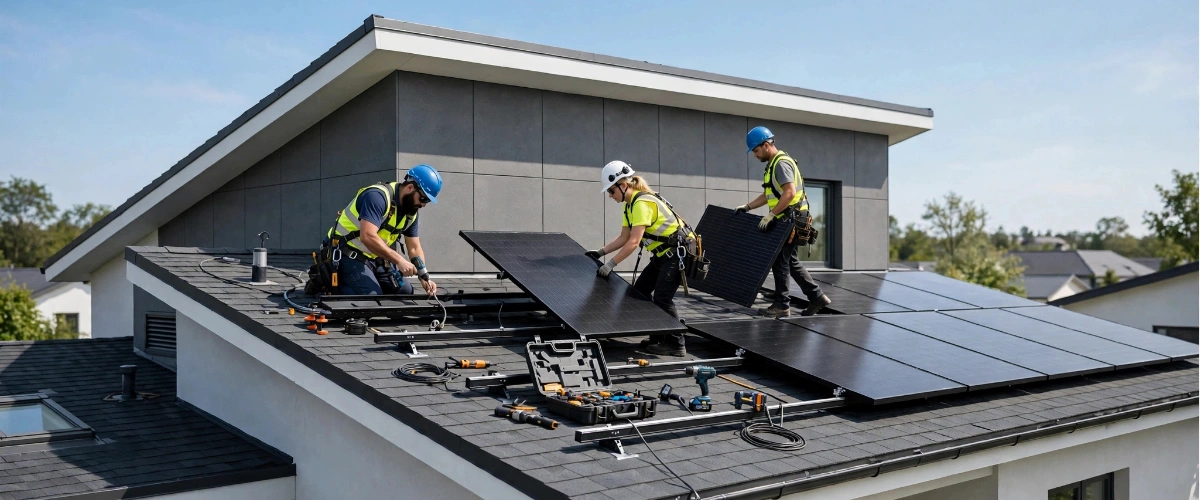
Good work shows in the details: flashed and sealed penetrations, tidy conduit runs, an array positioned for real sunlight, and wiring sized to code. Sloppy shortcuts here lead to leaks, underproduction, and safety risks, which is why installation quality is worth scrutinizing closely before and during the job. Ask to see photos of recent installs, and pay attention to how the crew treats your roof, since a company that documents its own workmanship is one that expects you to look. The best installers are proud of the parts of the job you never see from the street.
The vetting process itself is a test. An installer who answers credential questions plainly is showing you how they will handle a service call in year seven. One who deflects is telling you the same thing. Learning to spot solar installer red flags early keeps a smooth sales pitch from hiding a weak operation.
The cheapest quote from an unproven crew is rarely the cheapest system over 25 years. Confirm the state license and manufacturer certifications, ask who is really on your roof, and learn who backs each warranty. A solar pv installer that clears every one of those checks is the one still answering the phone when you actually need it. The homework takes an afternoon and protects a decision that shapes your energy bills for decades, so do it before you sign, not after.


Discover how solar plus batteries keep California homes safe during outages.
Your home solar project delayed? Here's what to do before the deadline passes.
Where a home battery earns its keep, where it doesn't, and how to size one right.



Copyright © 2026 US Power - Axia by QCells. All Rights Reserved.
Get an instant solar estimate using satellite!