

Wondering how fast Qcells solar panels degrade? On its premium lines Qcells guarantees about 98 percent output after year one, then under half a percent loss per year, leaving roughly 90 percent or more at year 25. That beats the industry average and it is written right into the performance warranty. Learn what drives degradation, how heat and soiling differ, and how US Power's American-made panels and 25 year warranty protect your output for decades.
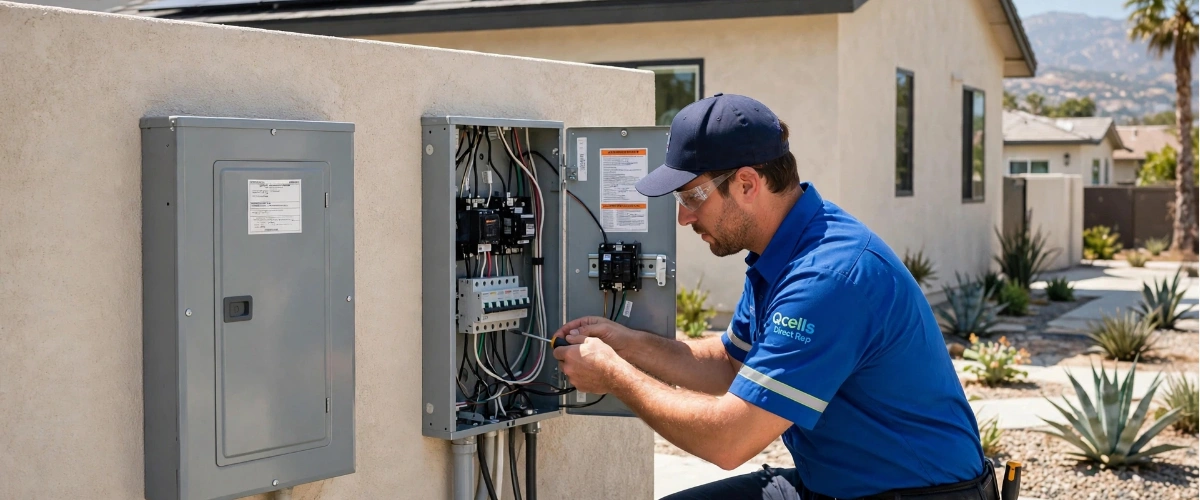
Every solar panel loses a little power as it ages, which is completely normal. But when you are about to invest in a system meant to last decades, "a little" is not a good enough answer. You want to know exactly how fast Qcells panels degrade, what that means for your electric bill in year 15 or year 25, and whether the panels US Power installs will still be pulling their weight long after you have paid them off. The honest news is that Qcells panels degrade slowly and predictably, and the numbers are written right into the warranty. This guide breaks down the real degradation rate, what causes it, and how to protect your output for the long haul.
The wattage printed on a panel is its output on day one, not its output for life. Understanding how that number shrinks over time is the difference between a smart solar investment and a disappointing one.
Degradation is the slow, permanent decline in how much electricity a panel produces as its materials age under sunlight and heat. A 400 watt panel that degrades will still work fine in 20 years, it will simply produce slightly less than 400 watts. This is different from a sudden fault or damage, and it happens to every panel from every brand, so the real question is how much and how fast.
Most panels experience a small, one time dip in their first year of exposure, often called light induced degradation. After that initial settling, the yearly decline becomes very gradual and steady. That is why performance warranties usually quote one number for year one and a separate, much smaller number for every year after.
Here is the answer you came for, in plain numbers. Qcells publishes its degradation figures in the performance warranty, so you are not relying on marketing claims.
On most of its premium residential lines, Qcells guarantees roughly 98 percent of rated output after the first year, then no more than about 0.5 percent loss each year after that. Do the math and your panels are still guaranteed to produce around 90 percent or more of their original power at year 25. In real world conditions, many panels degrade even slower than that guaranteed floor, which means the warranty is a worst case promise, not a best case hope.
The typical solar panel degrades at about 0.5 to 0.8 percent per year, and older or budget panels can run higher. Qcells sits at the better end of that range, which is one reason it earns top tier durability ratings in independent testing. Over 25 years, the gap between a 0.5 percent and a 0.8 percent yearly decline adds up to thousands of kilowatt hours, so a slower rate directly protects your savings. You can read more about what to expect from Qcells panel performance over the life of a system.
Degradation is not random. A handful of physical stresses drive it, and knowing them helps you understand why panel quality and climate both matter.
Sunlight is what powers your panels, but constant ultraviolet exposure and heat cycling slowly wear on the cells and materials inside. Panels in hot climates tend to degrade a bit faster, which is exactly why build quality matters in places like California, Texas, Florida, and Illinois. Qcells engineers its panels to handle this stress well, and you can see how they hold up in our look at why Qcells panels suit California's climate. For homeowners in hotter regions, our guide on how solar panels perform in hot weather explains what to expect.
Dust, pollen, and grime can cut your output temporarily, but that is soiling, not degradation. The key difference is that soiling losses wash away, while true degradation is permanent. Many homeowners think their panels have aged when they are simply dirty, so it helps to know when professional cleaning is worth it before assuming the worst.
A low degradation rate only matters if it is backed in writing. This is where the warranty does the heavy lifting, and where Qcells stands out.
The Qcells performance warranty guarantees a minimum output level for each year of the panel's life, tracing a gentle downward curve from that first year figure to roughly 90 percent or more at year 25 on its premium lines. If your panels ever dip below the guaranteed line, the warranty covers it. Our Qcells solar warranty guide walks through exactly what is covered and for how long.
Not all warranties are equal, so check three things: the year one output figure, the yearly degradation rate after that, and the final guaranteed percentage at year 25. A strong panel pairs a high starting point with a low annual rate. Just as important is who honors the warranty, since a guarantee only helps if the company behind it is still around to stand by it.
The panel is only half the equation. Who installs and stands behind it decides whether that 25 year curve actually plays out in your favor.
As an exclusive Qcells partner, US Power installs American-made Qcells solar panels built to hold their output for decades. These panels are engineered and tested for real durability, and you can read why they are built to outlast standard systems. Pairing a slow degrading panel with a quality install is how you protect your production year after year.
Because US Power handles the panels, the installation, and the paperwork under one roof, there is a single team accountable if performance ever falls short. Our 25 year comprehensive warranty covers panels, workmanship, and performance together, and our CSLB-licensed consultants make sure your system is sized and installed to hold up. That accountability is a big reason we have earned 200 plus five-star Google reviews.
You cannot stop degradation entirely, but a few simple habits keep it from costing you more than it should. Small steps protect the output you paid for.
Keeping panels reasonably clean and free of shade from growing trees preserves the output your system was designed to deliver. Since soiling and shading are reversible, staying on top of them means the only decline you see is the slow, expected kind. A quick seasonal check goes a long way toward keeping production high.
Modern systems let you track production in real time, so a sudden drop that is not normal degradation gets flagged fast. Catching a shaded panel, a wiring issue, or dirt buildup early keeps small problems from quietly draining your savings. Monitoring turns your warranty into something you can actually verify year over year.
Qcells panels degrade slowly, typically losing well under one percent of output per year after a small first year settling, and they are guaranteed to still deliver around 90 percent or more at year 25 on premium lines. That predictability is exactly what you want from a decades long investment. Pair that with American-made quality and US Power's 25 year comprehensive warranty, and you get a system built to keep paying you back as utility rates keep rising. The sooner you start, the sooner that slow, reliable curve begins working in your favor.


The real 30% Federal Solar Tax Credit deadline isn't what most people think.
Pennsylvania stumbled on renewables—California’s solar surge must stay strong.

Stay updated on NEM 3 changes and what it means for California solar owners.








Copyright © 2026 US Power - Axia by QCells. All Rights Reserved.
Get an instant solar estimate using satellite!