
Most California homeowners are surprised to learn that solar panels alone won't keep your lights on during a grid outage. Here's what actually happens — and what you need for real energy security.
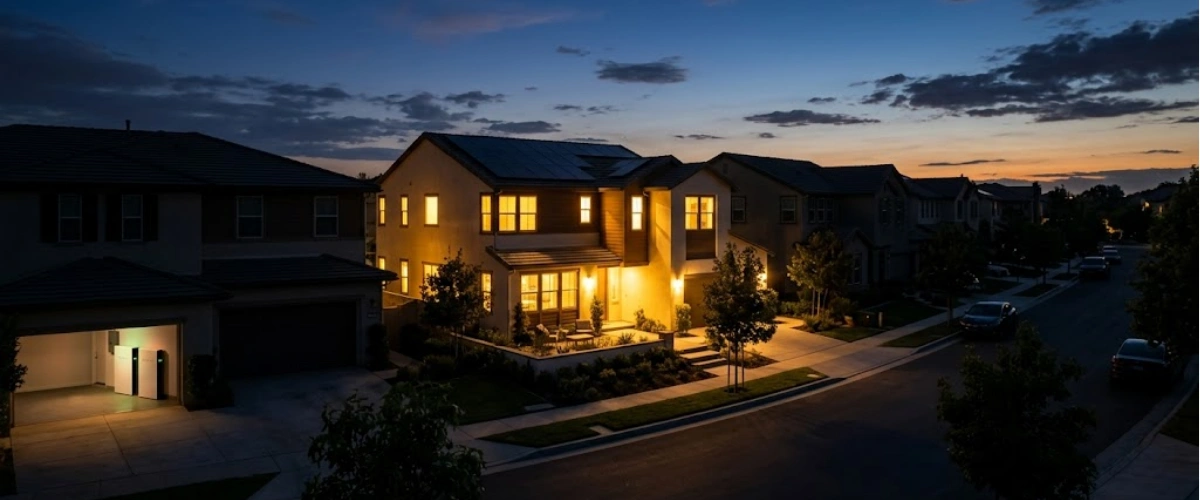
Only if you have a battery with island-mode capability. Standard grid-tied solar shuts off during outages to protect utility workers, while a battery disconnects from the grid and powers your home from stored energy.
You went solar to be more independent. So when the lights go out in your neighborhood, you naturally expect your panels to keep humming. Most homeowners are stunned when they don't.
This isn't a flaw or an installation error. It's actually a required safety feature — and understanding it is the first step to building a home that truly stays powered no matter what.
If you've been researching how solar and battery systems work together, you've probably hit a wall of technical jargon. This post cuts through all of that with plain-language answers to the questions California homeowners ask most.
When SCE, PG&E, or SDG&E cuts power to your neighborhood — whether from a wildfire PSPS event, equipment failure, or a heat wave overload — your solar system detects the grid going down and automatically shuts off.
This isn't a mistake. It's the law. Lineworkers need to repair downed lines safely, and without this shutoff, your panels could send live electricity back into those wires and put workers in danger.
If you have solar-only (no battery), your home goes dark along with everyone else's. Your panels are producing energy you can't use.
If you have solar plus a battery, your system switches to "island mode" — disconnecting from the grid and powering your home from stored solar energy instead. Most homeowners with a well-sized battery don't even notice the transition. Lights stay on. The fridge keeps running.
Think of your battery as a bucket. Your solar panels fill it during the day. Your home draws from it when the sun goes down — or when the grid goes down.
Understanding solar panels during a power outage comes down to one key question: how full is your bucket when the outage hits?
A homeowner in Southern California shared a story that perfectly illustrates this. Her system had a default battery minimum of 20% when a morning outage hit. She had about two hours of backup power. Fortunately, the sun came up quickly and the panels started refilling the battery.
But if that same outage had started at 10 PM with a depleted battery? She would have run out of power overnight.
The fix is simple: raise your battery minimum reserve to 30–50% so you always have a meaningful cushion. In California, where PSPS events from wildfires can last 12–48 hours, that reserve is the difference between managing comfortably and scrambling for extension cords.
This surprises a lot of people. When your battery hits 100% and your panels are still producing more than your home is using, the solar system doesn't waste energy or dump it into the ground. It throttles down — like a valve — producing only what your home needs in that moment.
So during a clear afternoon outage, your home can actually run entirely on live solar production, with the battery sitting full and ready for evening.
How long a solar battery can power your home depends on your usage and battery size. A typical California home using 30–40 kWh per day with a single 13.5 kWh battery can expect roughly 8–12 hours of backup on moderate usage — longer if you're mindful of what you're running.
For Southern California homeowners who face multi-day PSPS events, pairing two batteries or choosing a higher-capacity system is worth every penny.
Let's talk about what happens when the grid is up and your system is exporting energy.
This is where a lot of homeowners feel misled — not because they were lied to, but because the rules changed significantly in 2023.
California's Net Energy Metering 3.0 (also called the Solar Billing Plan) replaced the older 1:1 credit system for new installations after April 15, 2023. Under net energy metering NEM 3.0 in California, the credits you earn for exporting solar to the grid during midday are now much lower — as little as $0.05–$0.08 per kWh.
But here's the important flip side: export credits during peak evening hours (4–9 PM) can reach $0.40–$0.52 per kWh or more during summer months. That's a 5–8x difference.
This is exactly why a battery is no longer optional for most California homeowners. Without storage, you're exporting your cheapest solar energy during the day and buying back the most expensive grid power at night. A battery flips that equation entirely.
Under NEM 3.0, your unused credits roll over month to month and are paid out annually at wholesale rates. Unlike the older system, your utility doesn't reset your balance to zero partway through the year — but the credits are worth significantly less than what you'd save by storing and using that energy yourself.
The practical takeaway: keep more energy at home. A properly sized battery means you rely on the grid less and save more on every kWh.
Yes — but the case is stronger now than it's ever been. And are solar batteries worth it in California is no longer a niche question. It's what most homeowners ask before signing anything.
Before NEM 3.0, the grid essentially acted as a free, unlimited battery. You exported excess energy and pulled it back at roughly the same price. That's gone for new installations.
Today, a solar + battery system under NEM 3.0 typically achieves payback in 5–6 years, compared to 7–8 years for solar-only. The battery actually shortens your payback period because you're capturing far more value from the energy you produce.
SCE customers in 2026 are already seeing a 12.9% rate increase, adding roughly $25–30 per month to the average household bill. PG&E customers face similar trajectories. Every rate hike makes your stored solar energy worth more.
Southern California has lived through some of the most damaging PSPS events in the country. Wildfire seasons are getting longer. Grid infrastructure is aging. Flex Alert days — when the state asks residents to reduce usage — are becoming routine.
A battery isn't just a financial tool. It's the reason your family has lights, a working refrigerator, and a charged phone when the neighborhood goes dark.
Most solar companies sell you a system. US Power engineers one — sized to your actual usage, your rate plan, and your backup needs.
As California's exclusive QCells partner, US Power sources American-made panels at factory-direct pricing — typically 15–20% below what you'd pay through other installers. That's not a marketing line. It means the same high-performance panel for significantly less money.
Our 180+ five-star Google reviews reflect what happens when pricing is transparent and installation is done right by CSLB-licensed consultants.
US Power's comprehensive warranty covers panels, workmanship, and performance for 25 years. Not 10. Not 15. Twenty-five. When you're comparing quotes, ask every company what their warranty actually covers — the fine print matters.
Choosing the right backup power for Southern California starts with choosing the right installer. A system that fails or underperforms isn't a bargain at any price.
From permit approval to Permission to Operate (PTO), most US Power customers are live in 3–4 weeks. California utilities are notorious for slow interconnection timelines — US Power's process is built to move through that efficiently so you're not waiting months.
If you're still on the fence about timing, consider what's happening to utility rates.
Rising electricity costs in Southern California aren't a news cycle. They're a structural trend. The CPUC has forecasted 6–7% average annual rate increases through 2028 for PG&E, SCE, and SDG&E customers. Wildfire mitigation, grid upgrades, and infrastructure debt are all costs that flow directly to your bill.
Every rate hike accelerates your return on a solar + battery investment. The energy you store and use yourself isn't subject to whatever SCE or PG&E decides to charge next year. Your solar payment is fixed. Their rates are not.
California isn't alone. Texas homeowners on ERCOT saw the cost of grid instability firsthand during Winter Storm Uri — and battery backup has surged in demand ever since. Florida homeowners dealing with hurricane seasons increasingly rely on solar + battery to bridge multi-day outages when generators aren't practical.
The math is similar across all four states US Power serves: rising rates plus unreliable grids make solar + battery the smartest long-term decision most homeowners can make.
The grid goes down. Rates go up. Wildfire seasons get longer. These aren't predictions — they're the pattern California homeowners have lived for the past decade.
Solar + battery storage doesn't just lower your bill. It gives you energy that's yours — stored, controlled, and ready when you need it most.
US Power's team of CSLB-licensed consultants will walk you through exactly what your home needs, what it will cost, and what you'll save — with no pressure and no hidden fees. Over 180 five-star Google reviews say we deliver on that promise.
The next outage won't wait for you to be ready. Get your free consultation and make sure you are.


Your 2025 guide to solar panels, inverters, and batteries for a SoCal home.
What changed, what to check and what to ask before you sign a solar contract.
Stop paying SCE $0.52/kWh to charge your Tesla this 2026. Switch to solar, go solar!







Copyright © 2026 US Power - Axia by QCells. All Rights Reserved.
Get an instant solar estimate using satellite!