

A solar battery costs about $13,000 to $18,000 installed in 2026 for 13 to 15 kWh of storage, and it can keep your essentials running for a day or more. With NEM 3.0 and steep evening rates, the wrong size wastes money. Here is the cost, sizing and payback math, state by state.
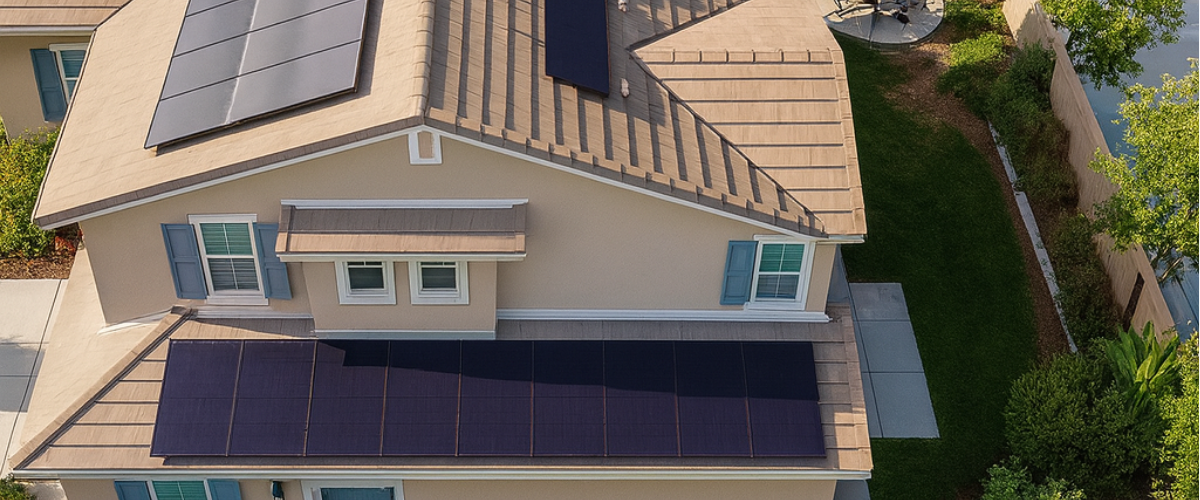
A solar battery stores extra solar power for evenings and outages. In 2026, a typical 13 to 15 kWh home battery costs about $13,000 to $18,000 installed before incentives and lasts 10 to 15 years.
Your solar panels make the most power at noon, but your utility charges the most from 4 to 9 PM. Then a storm or a wildfire shutoff hits, and your rooftop system shuts down with the grid. A solar battery fixes both problems by saving daytime solar for the evening and keeping your essentials running when the lights go out.
This guide covers what a solar battery costs in 2026, how to size one, how long it lasts, and where it pays off. You'll also see how the leading home batteries compare and how the value changes across California, Texas, Florida, Illinois, Connecticut, New Jersey and Pennsylvania.
Jump to:
A solar battery is a rechargeable lithium battery, usually 10 to 15 kWh per unit, that stores the extra electricity your panels make so you can use it later. Most home models in 2026 use lithium iron phosphate (LFP) cells, which handle daily cycling well and run cooler than older chemistries.
During the day, your panels power the house first. Any surplus charges the battery instead of flowing to the grid at a low credit. In the evening, the battery discharges to cover your usage during expensive peak hours, and if the grid goes down, it can switch your home to backup power in a fraction of a second.
People search for "solar batteries" and "battery backup for solar panels" as if they were different products, but they are usually the same box doing two jobs. The difference is in the setup. A battery tied to a backup gateway or transfer switch can island your home during an outage, while a battery installed only for bill savings may not back up anything.
That distinction matters because a grid-tied solar system without storage turns off during an outage for lineworker safety. If backup is part of your goal, make sure your quote includes the transfer hardware and a defined list of backed-up circuits.
A typical 13 to 15 kWh solar battery costs about $13,000 to $18,000 installed before incentives in 2026. EnergySage's first-half 2026 quote data puts the typical 13.5 kWh battery at about $15,647, while its October 2026 state pages show averages of about $1,037 per kWh in California and $1,074 per kWh in New Jersey.
Price per kWh shrinks as you add capacity because labor, permits and the gateway are mostly fixed costs. A second battery in the same install often costs noticeably less than the first. Whole-home backup with two or three units commonly runs $25,000 to $40,000.
For a deeper line-item breakdown and brand-by-brand pricing, see our guide to how much a solar battery costs. Remember that the federal 30% residential clean energy credit (Section 25D) ended for homeowner-owned systems on December 31, 2025, so 2026 cash and loan prices no longer drop by 30% at tax time.
The four batteries US Power homeowners ask about most store between 10 and 15 kWh per unit and carry 10- to 15-year warranties. The table below uses manufacturer datasheets for specs and 2026 quote data for typical installed prices before incentives.
| Battery | Capacity and power (per unit) | Warranty and typical installed cost |
|---|---|---|
| Tesla Powerwall 3 | 13.5 kWh; 11.5 kW continuous; built-in solar inverter (up to 20 kW DC of panels); expands to 4 units | 10 years; about $13,500 to $16,500 |
| Qcells Q.HOME CORE G3 | 12.46 kWh usable; 7.6 kW backup output; two units reach 24.92 kWh (15.2 kW) | 15 years / 68 MWh throughput; about $12,500 to $16,500 (estimate) |
| Enphase IQ Battery 10C | 10 kWh; 7.08 kW continuous (14.16 kW peak); AC-coupled, pairs with IQ8 microinverters | 15 years; about $11,500 to $14,000 |
| FranklinWH aPower 2 | 15 kWh; 10 kW continuous; AC-coupled; up to 15 units per system | 15 years / 60 MWh throughput; about $16,000 to $19,000 |
Sources: Tesla Powerwall 3 North America datasheet, Qcells Q.HOME CORE G3 specifications announced August 2026, Enphase IQ Battery 10C datasheet (July 2025), FranklinWH aPower 2 product page, and EnergySage 2026 installed-price data. Your price depends on site conditions, electrical upgrades and how many units you install.
Capacity (kWh) tells you how long a battery can run your loads. Continuous power (kW) tells you how many loads it can run at once, which matters for central air conditioners and well pumps. A 13.5 kWh battery with 11.5 kW of output can start more appliances at once than a 10 kWh unit rated at 7 kW.
Warranty terms also differ in ways that matter. A 15-year warranty with a throughput cap, like Qcells' 68 MWh, covers roughly 5,400 full cycles, which is about one cycle a day for 15 years. For a closer look at the Qcells option, read our Q.HOME CORE G3 review, and for a head-to-head on two AC-coupled systems, see Enphase vs. FranklinWH.
Most homes need 10 to 15 kWh of storage to cover essential circuits overnight, and 25 to 40 kWh to back up a whole home with central air. The right number comes from two questions: how many kWh you use during the hours the battery must cover, and how many kW you need at the same moment.
List the circuits you would want running during an outage or the 4 to 9 PM peak window. Multiply each appliance's watts by the hours it runs, then add a 20% buffer for inverter losses and reserve. Your 12 months of utility bills, or our solar calculator, will show your average daily kWh.
| Backup goal | What stays on | Typical battery size |
|---|---|---|
| Essentials | Refrigerator, lights, Wi-Fi, phone charging, garage door, gas furnace fan (about 6 to 9 kWh per day) | One 10 to 15 kWh battery |
| Partial home | Essentials plus microwave, washer, one mini-split or window AC, well pump (about 12 to 20 kWh per day) | Two batteries, 20 to 30 kWh |
| Whole home | Everything, including central AC, electric range and EV charging at a reduced rate (25 to 40+ kWh per day) | Two to three batteries, 25 to 45 kWh, plus enough solar to recharge |
A 3-ton central air conditioner can draw 3 to 4 kW while running and several times that for a split second at startup. If your battery's continuous output is lower than the sum of the loads that run together, the system will trip. That's why whole-home designs often stack two batteries even when one has enough kWh.
Say your home uses 24 kWh a day, and about 10 kWh of that falls between 4 and 9 PM on SCE's time-of-use plan. One 13.5 kWh battery covers that evening block with about 3.5 kWh left for overnight use and outage reserve. During an outage, if you trim usage to 8 kWh of essentials, the same battery lasts about 1.5 days without sun, and indefinitely in clear weather because the panels recharge it each morning.
For more run-time scenarios, including medical devices and well pumps, see how long a solar battery can power a house.
One 13.5 kWh battery typically runs essential circuits for 12 to 36 hours on its own, and much longer when your panels can recharge it during the day. How long you actually get depends on what's backed up, the season, and how much charge you keep in reserve.
Outages are getting longer. According to the EIA, the average US electricity customer went without power for about 11 hours in 2024, nearly twice the prior decade's average, and major storms caused about 80% of those hours (EIA, December 2025). Hurricane Beryl alone cut power to about 2.6 million Texas customers, and Hurricane Milton to about 3.4 million in Florida.
Partial backup moves your key circuits to a protected subpanel, which stretches one battery much further. Whole-home backup puts every circuit behind the battery, which is more convenient but drains storage faster if you don't manage big loads. For a walkthrough of what really happens when the grid drops, read what happens to solar and a battery during a power outage.
The hardware that isolates your home decides how smooth the switchover is. Tesla, for example, offers both a Backup Switch and Gateway 3, and the right choice depends on your panel and how much of the house you want covered. Our explainer on the Powerwall 3 Backup Switch vs. Gateway 3 breaks down the differences.
Set a backup reserve of 20% to 30% year-round and raise it to 100% when a storm or Public Safety Power Shutoff is forecast. If your battery keeps running low when you need it, these solar battery reserve settings will help.
Most solar batteries last 10 to 15 years, which matches the warranties on the leading 2026 models. Tesla warrants Powerwall 3 for 10 years, while Qcells, Enphase and FranklinWH offer 15 years on their current batteries.
A warranty typically guarantees the battery will hold about 70% of its original capacity at the end of the term or at a set energy throughput, whichever comes first. FranklinWH caps aPower 2 at 60 MWh, or about 4,000 full cycles of a 15 kWh battery. Qcells' 68 MWh on a 12.46 kWh unit works out to about 5,450 cycles.
Panels often outlast batteries by a decade or more, so plan on one battery replacement over a 25- to 30-year solar life. The good news is that battery prices per kWh have fallen steadily, so the replacement is likely to cost less than the original. Ask your installer whether labor for warranty replacements is included, not just the hardware.
A DC-coupled battery is usually 2% to 4% more efficient because solar power charges it directly, while an AC-coupled battery is easier to add to a solar system you already own. Neither is better everywhere; the right choice depends on whether you're installing new or retrofitting.
In a DC-coupled design, panels feed a hybrid inverter that charges the battery without converting to AC first. That saves one conversion step. It works best when you buy panels, inverter and battery together, because the inverter must be sized for both.
An AC-coupled battery has its own inverter and connects on the AC side of your home, so your existing solar inverter stays in place. Enphase IQ batteries and FranklinWH aPower 2 are AC-coupled, and Powerwall 3 can AC-couple with an existing system while also accepting new panels directly. For the full efficiency math, see DC vs. AC coupled battery storage, and for retrofit specifics read AC coupling explained.
Yes, you can add a solar battery to most existing systems, and in California adding storage alone does not move you off NEM 2.0. Under CPUC Decision D.22-12-056, existing NEM 1.0 and NEM 2.0 customers can add batteries without a tariff change, and they keep their legacy plan for 20 years from their original interconnection date.
Adding a battery doesn't, but adding panels can. You may expand solar by up to 1 kW or 10% of your original system size, whichever is larger, before the utility moves you to the Net Billing Tariff. For the specific limits, read how to add solar panels to a NEM 2.0 system without losing your status.
Metering rules also apply. Under PG&E's NEM-paired storage rules, batteries up to 10 kW (AC) use an estimation method, while larger systems need a Net Generation Output Meter so the utility can confirm exported energy came from solar, not the grid. Your installer handles this paperwork, but ask about it upfront.
On NEM 2.0, your exports still earn close to retail value, so a battery's bill savings are smaller than under NEM 3.0. The main reasons to add one are outage protection, time-of-use arbitrage on newer rate plans, and paid grid programs. Our guide to adding batteries to solar panels later covers compatibility, permits and what to ask if your system is leased.
For most new California solar customers, yes. Under NEM 3.0, exported solar often earns single-digit cents per kWh, while evening grid power costs several times more, so storing your surplus is worth far more than selling it. EIA data put California's average residential rate at 33.35 cents per kWh in March 2026, more than 1.8 times the national average of 18.56 cents.
The Net Billing Tariff pays export credits based on the CPUC's Avoided Cost Calculator, which varies by hour and month. In one SDG&E example modeled by Aurora Solar, exports earned about 8.8 cents per kWh on a day when grid power averaged 44 cents. Export values spike only in a few late-summer evening hours, when your panels are barely producing.
That gap is why a solar-only system sized for NEM 2.0 economics underperforms today. Some utilities also limit how batteries charge and export, as we explain in why PG&E won't let you charge and export your battery at the same time.
Suppose your 13.5 kWh battery stores 10 kWh of midday surplus that would have earned about 8 cents. After 89% round-trip efficiency, you get back about 8.9 kWh during the 4 to 9 PM peak, where you'd otherwise pay roughly 45 cents. That's about $3.20 a day, or roughly $1,100 to $1,200 a year.
At $13,500 installed, simple payback lands around 11 to 12 years before any rebate, and shorter with SGIP or a paid grid program. Payback improves when the battery is bundled with new solar, because one crew, one permit and one inspection cover both. To compare plans side by side, see NEM 2.0 vs. NEM 3.0 battery payback and whether battery storage is worth it in California.
A solar battery delivers the most bill savings in states with low export credits or high peak rates, and the most peace of mind in states with long storm outages. Here's how the seven states US Power serves compare in 2026, using EIA's March 2026 average residential rates.
| State (avg. rate) | What drives battery value | 2026 incentives to check |
|---|---|---|
| California (33.35¢) | NEM 3.0 low export credits, 4 to 9 PM TOU peaks, wildfire shutoffs | SGIP; LADWP, Burbank and Glendale programs; utility VPPs |
| Texas (16.39¢) | No statewide net metering; ERCOT grid stress, hurricanes and winter storms | Retail-provider battery and VPP credits; some local utility rebates |
| Florida (14.86¢) | 1:1 net metering at FPL, Duke and TECO, so value is mostly hurricane backup | Property tax and sales tax exemptions that include batteries |
| Illinois (18.86¢) | Since 2025, new solar earns supply-only net metering credits | ComEd and Ameren $300 per kWh storage rebate (requires hourly or peak pricing) |
| Connecticut (30.47¢) | High rates and storm outages | Energy Storage Solutions: $30 to $130 per kWh enrollment plus 10 years of performance pay |
| New Jersey (23.49¢) | Rising PJM capacity costs; retail net metering limits pure bill savings | Garden State Energy Storage Program residential incentive (proposed August 2026) |
| Pennsylvania (20.92¢) | Retail net metering up to annual use; value is mainly backup | No statewide battery rebate; SRECs for solar output |
California is the strongest battery market in the country because NEM 3.0 makes self-consumption the main way to save. Add frequent Public Safety Power Shutoffs in high-fire areas, and a battery covers both money and resilience. That's why a 2026 California solar quote should include a battery option from day one.
In Texas, there's no statewide net metering, so retail electric providers set what they pay for exports, and many pay well below what they charge. That makes self-consumption and provider-run battery programs valuable, as covered in do Texas homeowners need a solar battery. In Florida, 1:1 net metering at the big utilities means the grid already acts like a free battery for bills, so the case rests on hurricane backup; see solar plus battery for Florida storms.
Illinois pairs supply-only net metering for new systems with a $300 per kWh ComEd and Ameren storage rebate, which can cover about $4,050 of a 13.5 kWh battery; read more in solar battery storage in Illinois. Connecticut's program shifted on April 1, 2026, to a smaller enrollment payment plus performance pay of $300 to $550 per kW-year for 10 years, according to the Connecticut Green Bank. New Jersey and Pennsylvania still credit exports near retail value, so batteries there are mostly a backup and grid-program play for now.
California's Self-Generation Incentive Program (SGIP) pays from about $150 per kWh for general-market customers up to $1,000 to $1,100 per kWh for qualifying low-income or high-fire-risk households. On a 13.5 kWh battery, that ranges from about $2,000 to nearly $15,000.
According to the CPUC's SGIP page, the Residential Solar and Storage Equity budget opened June 2, 2025, with $1,100 per kWh for storage and $3,100 per kW for solar for income-qualified customers. The Equity Resiliency budget pays $1.00 per watt-hour to households in High Fire-Threat Districts or those hit by two or more Public Safety Power Shutoffs, plus another qualifying factor such as medical baseline. General-market funds step down as each tier fills, so check current availability before you count on them.
SGIP covers PG&E, SCE, SDG&E and SoCalGas customers. LADWP, Burbank Water and Power and Glendale Water and Power run their own programs. For eligibility steps and timelines, see our California SGIP guide for 2026.
The 30% residential clean energy credit for homeowner-owned batteries ended on December 31, 2025, and it is not available for systems installed in 2026. Third-party owned systems are different. Leasing companies can still claim the commercial investment credit on batteries they own, which helps keep lease pricing competitive.
That's one reason US Power offers the Propel prepaid lease through SolSource. You pay upfront at a lower price, the lease provider owns and services the equipment, and you still get the backup and bill savings.
Virtual power plant programs pay you to let the utility or provider draw on your battery during grid emergencies. Options in 2026 include California utility and Qcells VPP programs, Connecticut's Energy Storage Solutions, and retail-provider programs in Texas. Payments can shorten payback by several years if you keep enough reserve for your own outages.
A 2026 solar battery costs about $13,000 to $18,000 installed for 13 to 15 kWh, lasts 10 to 15 years, and pays off fastest in California under NEM 3.0, in Illinois with its storage rebate, and anywhere long outages are common. Use these three tips to avoid the most common mistakes.
Your evening usage and outage priorities set the battery size. Every US Power consultation starts with a real 12-month bill analysis, so you see exactly how many kWh fall in your peak window before you pick one battery or three.
If you're buying new solar, a DC-coupled or integrated-inverter battery is usually the most efficient. If you already have panels, an AC-coupled battery protects your existing warranty and NEM status. Either way, pairing storage with American-made Qcells panels from Dalton, Georgia, at factory-direct Qcells pricing 15% to 20% below market keeps the whole system cost down.
Look at warranty years, throughput caps and who pays labor on a replacement. US Power backs installations with a 25-year comprehensive warranty, and most projects move from contract to permission to operate in 3 to 4 weeks.
If you want to know exactly what a solar battery would save on your bill, book your free 12-month bill analysis with a CSLB-licensed US Power consultant.
Store your sunshine, and spend it when power costs the most.


A complete guide to solar panels and batteries for Southern California homeowners.

"top rated" should show up when you're comparing US Power with other installers.

Electrify older SoCal homes smartly with US Power—skip huge upfront panel upgrades.









Copyright © 2026 US Power - Axia by Qcells. All Rights Reserved.
Get an instant solar estimate using satellite!