

NEM 2.0 and NEM 3.0 do not just change your solar credits, they change how fast a home battery pays for itself. Under NEM 2.0, generous export credits mean a battery earns its keep slowly and mostly adds backup value. Under NEM 3.0, low export rates make stored energy far more valuable, so a well sized battery can pay back years sooner. This guide compares battery payback under both California tariffs and shows how US Power sizes Qcells systems to shorten your timeline.
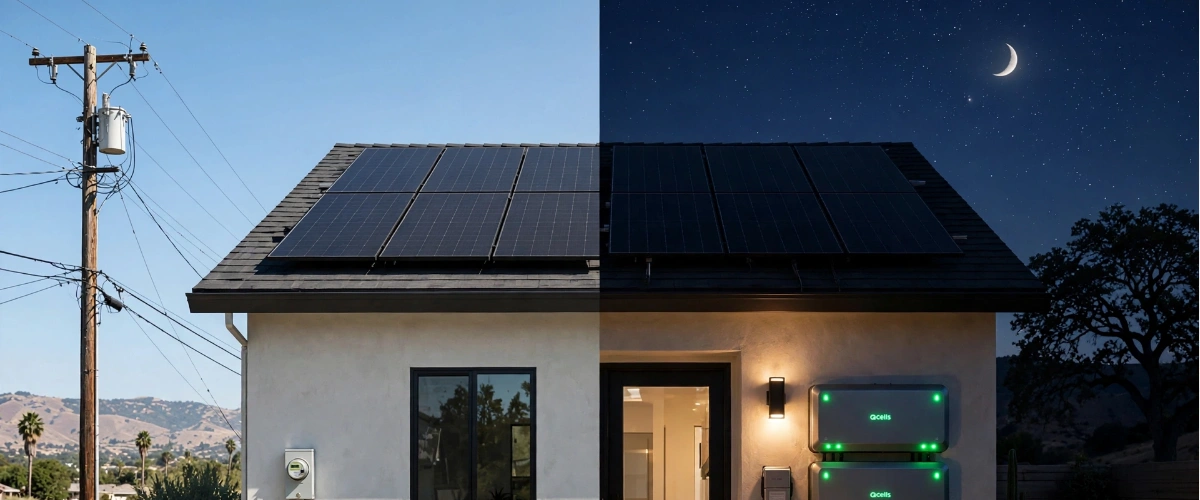
If you are shopping for solar in California, you have probably heard that the rules changed. What most homeowners do not realize is that the version of net metering on your bill quietly decides how fast a home battery pays for itself. Under NEM 2.0, a battery earns its keep slowly and mostly adds backup value. Under NEM 3.0, the same battery can pay back noticeably faster because stored power is suddenly worth far more than exported power. This guide breaks down battery payback under both tariffs in plain numbers, explains the counterintuitive answer to which one is faster, and shows how US Power sizes each system so your timeline is as short as possible.
Two identical homes with identical batteries can have very different payback timelines depending on their net metering tariff. The tariff sets the price of every kilowatt hour you export, and that price is the whole game.
Battery payback is the number of years it takes for the savings a battery creates to equal what you paid for it. Those savings come from storing your own solar power and using it later instead of buying expensive grid power at night. The higher the value of that stored energy, the faster the battery pays for itself, which is exactly where the two tariffs split apart.
California moved from NEM 2.0 to NEM 3.0, officially the Net Billing Tariff, in April 2023. The change slashed the credit you earn for exporting extra solar to the grid, in many hours by roughly 75 percent. If you want the full mechanics, our guide on how NEM 2.0 and NEM 3.0 billing differs walks through it step by step. For batteries, that single change flipped the math on its head.
If you locked in NEM 2.0 before the deadline, you are in a rare and valuable position. That status also changes what a battery does for your wallet.
Under NEM 2.0, the grid acts almost like a free battery. You export daytime solar at nearly full retail value and pull that credit back at night, so storing your own energy saves only a little more than simply exporting it. Because the financial gap between exporting and storing is small, a battery bought purely for savings pays back slowly, often stretching well past a decade on economics alone.
For NEM 2.0 homes, the strongest reason to add a battery is resilience, not arbitrage. A battery keeps your lights, fridge, and medical devices running through rolling blackouts and wildfire shutoffs, which is real value that never shows up in a simple payback formula. If you are on NEM 2.0 and thinking about growth, be careful, since adding panels the wrong way can cost you your grandfathered status. Our guide on adding panels to a NEM 2.0 system without losing your status explains how to protect it.
Here is where the surprise lives. The tariff that made solar exports less rewarding is the same one that makes a battery pay for itself faster.
Under NEM 3.0, exported solar earns very little, but grid power in the evening is expensive. A battery lets you charge on cheap midday sunshine and discharge during the pricey evening peak, capturing a spread the grid no longer hands you for free. That daily spread is real money, and it is why a well sized battery under NEM 3.0 can pay back years sooner than the same battery under NEM 2.0. You can see the storage strategy in detail in our overview of NEM 3.0 solar and battery storage.
State and local incentives make the timeline even shorter. California's Self Generation Incentive Program can knock a meaningful chunk off the upfront cost of a home battery, and several utilities layer their own rebates on top. Our breakdown of California SGIP rebates for home batteries shows who qualifies and how much they can save, all of which pulls your payback date closer.
Now that both sides are on the table, the direct comparison is easier to make. The answer depends on what question you are really asking.
For the battery itself, NEM 3.0 delivers the faster payback. Because stored energy is so much more valuable than exported energy under NEM 3.0, the battery does more work every single day and earns its cost back sooner. Under NEM 2.0, a battery is mostly an insurance policy, so its pure savings payback is slower even though the home overall enjoys richer solar credits. If you are still weighing the decision, our guide on whether batteries are worth it for solar in California puts real numbers to it.
This does not mean NEM 3.0 is the better deal all around. NEM 2.0 homes still enjoy stronger export credits and better whole system economics, so their total solar savings are usually higher. The nuance is simple. NEM 2.0 wins on overall solar value, while NEM 3.0 wins on how quickly a battery specifically earns its keep. Knowing which lever you are pulling is what leads to a smart system design.
The tariff sets the rules, but design decides how well you play them. This is where the right installer makes a measurable difference in your timeline.
As an exclusive Qcells partner, US Power installs American-made Qcells panels and home batteries at factory-direct pricing, often 15 to 20 percent below market. A lower upfront cost is the most direct way to shorten payback, since you have less to earn back in the first place. Pairing efficient panels with a right sized battery like the Qcells Q.HOME Core storage system means your system captures the evening peak spread without paying for capacity you will never use.
Because US Power handles the design, the panels, the battery, and the install under one roof, there is a single team accountable for hitting the payback we project. Our CSLB-licensed consultants size your battery to your actual usage and tariff, not a generic template, and our 25-year comprehensive warranty protects the system that produces those savings. That accountability is a big reason we have earned 200 plus five-star Google reviews.
Whichever tariff you are on, a few habits protect and even improve your payback. Small adjustments keep your battery working hard for you.
Modern batteries can be scheduled to charge and discharge around your utility's time-of-use windows automatically. Setting them to discharge during the most expensive evening hours squeezes the most value from every stored kilowatt hour. On NEM 3.0 especially, smart scheduling is the difference between an average payback and a strong one.
Every California utility rate increase makes stored power more valuable and shortens your payback further. Sizing your battery with future rate hikes in mind, rather than just today's bill, protects your investment for the long haul. If you are still deciding, our look at whether home battery backup is worth it in 2026 helps frame the choice.
The tariff on your bill is not just a billing detail, it is the single biggest factor in how fast a home battery pays for itself. NEM 3.0 rewards storage and delivers the faster battery payback, while NEM 2.0 rewards exports and treats a battery mostly as backup. Neither is simply better, they just reward different strategies. With factory-direct Qcells equipment and a design matched to your exact tariff, US Power builds the system that reaches your payback date sooner. As rates keep climbing, the best time to start that clock is now.


Efficiency, warranty, and manufacturing stack up so you can choose with confidence.

Compare QCells and REC panels to pick the right solar option for your home.
Can solar companies change your panel layout after signing? Here's the truth.








Copyright © 2026 US Power - Axia by QCells. All Rights Reserved.
Get an instant solar estimate using satellite!