

If you have solar panels on your Florida roof, you might assume you're covered when the next hurricane knocks out the grid. Most grid-tied systems shut down automatically during an outage, leaving solar homes just as dark as everyone else's. This guide explains why that happens, how a battery retrofit changes it, what the process and timeline actually look like, and how to size backup for the loads that matter most during a multi-day outage.
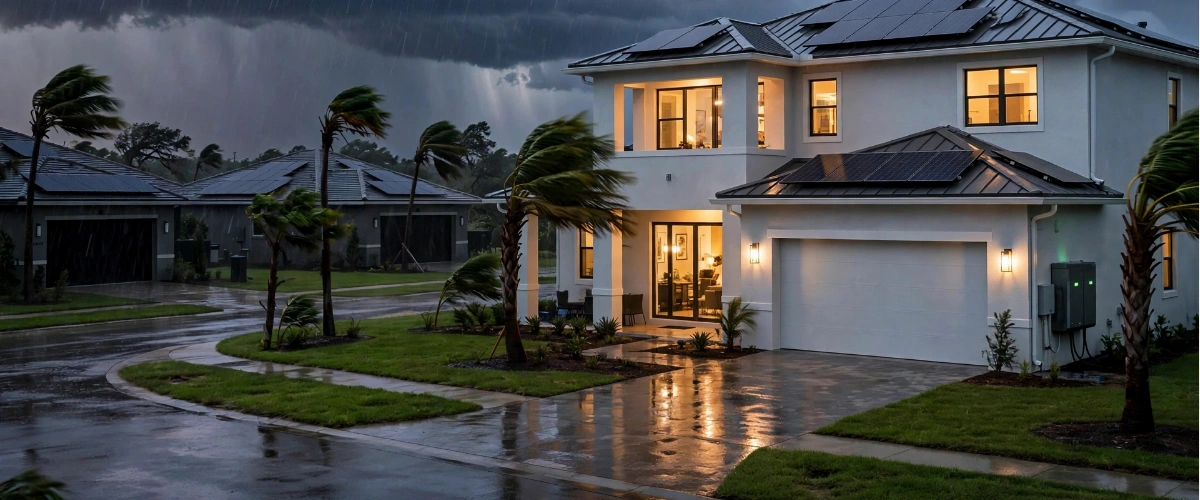
Not unless it includes a battery. Standard grid-tied solar shuts off automatically when utility power drops, so panels stop producing during a hurricane outage until the grid returns, even in full sun.
If you already have solar panels on your Florida roof, you might assume you are covered the next time a hurricane knocks out the grid. Most solar-only systems shut down automatically during an outage, leaving your home just as dark as your neighbor's. That safety feature protects utility line workers, but it also means your rooftop investment stops producing exactly when you need it most. A battery is the missing piece that turns a grid-tied solar system into real storm backup. With hurricane season already active and FPL and Duke Energy both reporting longer multi-day restoration windows after major storms, more Florida solar owners are retrofitting battery storage now rather than waiting for the next outage to force the decision.
Standard grid-tied inverters are required to stop sending power the moment utility service drops. This "anti-islanding" shutdown prevents your system from backfeeding electricity into lines that crews may be repairing. It is a critical safety rule, but it means your panels sit idle during the exact hours a storm knocks out your neighborhood.
Florida utilities have reported outages lasting several days after major hurricanes, and rural or heavily wooded service areas often wait longer for restoration than urban ones. Refrigerated food, medical equipment, and home cooling all become urgent problems well before day two. Solar panels without a battery cannot bridge that gap, no matter how many kilowatts they produce on a sunny afternoon.
Downed lines, flooded substations, and debris-blocked access roads all add time to restoration, and a storm that tracks across multiple counties spreads repair crews thin. Homeowners who lived through a recent multi-day outage often describe the same realization: the panels were fine the whole time, they simply had nowhere to send their power once the grid dropped.
A battery paired with an automatic transfer switch isolates your home from the grid the instant power drops, then keeps your panels charging the battery and your essential circuits running. The switch happens in milliseconds, often before you notice the lights flicker. Your solar array keeps working for you instead of shutting down with the rest of the grid, drawing daylight sun to recharge the battery for the next overnight stretch without power.
Most home batteries let you set an outage reserve, a percentage of stored capacity held back specifically for emergencies instead of daily bill savings. Florida homeowners typically raise that reserve as storm season approaches, trading a little day-to-day export credit for guaranteed backup capacity. If you want the full walkthrough on choosing the right percentage, see our guide on setting your battery's outage reserve.
Homeowners sometimes worry that hurricane winds threaten their panels more than their power supply. In most cases the opposite is true: modern racking and hurricane-rated solar panels hold up far better than homeowners expect, while the real vulnerability is simply the lack of stored energy once the grid goes down. Ready to close that gap before the next storm forms? Get a free battery retrofit quote from US Power.
Florida utility rates have climbed steadily, and that trend alone makes stored solar power worth more than it used to be. Instead of weighing a battery against a shrinking incentive window, the real comparison for existing solar owners is now the cost of a retrofit against the cost of a multi-day outage, spoiled groceries, a hotel stay, or a medical device with nowhere to plug in.
Newer net metering structures pay less for power you export back to the grid than older plans did, which means the same kilowatt hour is often worth more to you stored in a battery than sold back at a reduced export rate. That change has pushed many solar-only homeowners who once saw batteries as optional to reconsider, especially in a state where the next outage is a matter of when, not if. State and local incentive programs in Florida can also offset part of a retrofit's cost, and a US Power consultation will walk through what currently applies to your address.
Retrofitting a battery onto an existing solar system does not mean starting over. A licensed crew evaluates your current inverter, confirms compatibility, and in most cases completes the physical installation and inspection well inside a normal hurricane season timeline. The process is faster than a full new solar install because your panels, wiring, and permitting groundwork are already in place.
A typical retrofit starts with a site visit to confirm your inverter can pair with a battery, or to identify whether an inverter swap is needed first. From there, most crews handle permitting, the electrical work, and the utility interconnection paperwork in sequence, with the physical install itself often finished in a single day. Homeowners who start the process early in the season avoid the scheduling crunch that hits installers once storm watches start appearing on the forecast.
The right battery size depends on what you need to keep running, not on maximizing capacity for its own sake. A refrigerator, a few lights, phone charging, and a medical device draw far less power than central air conditioning, so most Florida retrofits start with a critical-loads panel that covers the essentials for several days rather than the whole house indefinitely. That focused approach keeps the retrofit affordable while still solving the actual problem.
Whole-home backup is possible for homeowners who want central air and every outlet covered, but it requires a larger battery, and sometimes more than one unit paired together. A US Power consultant can walk through your last twelve months of usage and help you decide whether a single critical-loads battery or a larger whole-home setup makes more sense for your household and budget.
As an exclusive Qcells partner, US Power offers factory-direct Florida solar pricing that typically runs 15 to 20 percent below market rate, backed by a 25-year comprehensive warranty covering the battery, workmanship, and performance. American-made Qcells equipment means shorter lead times too, which matters when you are racing a storm forecast instead of a calendar.
Because US Power installs and services solar across California, Texas, Florida, and Illinois, the same licensed, insured crews who might have installed your original panels are the ones handling your battery retrofit. Over 200 five-star Google reviews reflect a company that treats a retrofit with the same transparent, no-hidden-fee pricing as a first-time installation.
That consistency matters when a retrofit touches equipment someone else may have installed years earlier. Instead of guessing at compatibility over the phone, US Power sends a consultant to see your existing system in person, confirm what will and won't work with it, and put the full retrofit cost in writing before any work begins.
A battery solves the power problem, but it works best as part of a broader plan. Our full hurricane season prep checklist covers the pre-storm, 48-hour, and post-storm steps that pair naturally with a fresh battery retrofit.
Not every battery and switch combination behaves the same way during an outage. If you are comparing hardware options, our breakdown of the Powerwall backup switch vs. gateway walks through how each handles the transfer and what to ask your installer before you sign a contract. Explore the full lineup of solar battery systems available for retrofit through US Power.
You already made the harder decision when you went solar. Adding a battery now is the smaller, faster step that actually keeps your lights, refrigerator, and phone chargers running when the grid goes down. With hurricane season already underway, a retrofit completed today is one you will not be racing to schedule during a storm watch. Every week you wait is a week closer to the next named storm, and installers book up fast once one starts tracking toward Florida. Talk to US Power about a battery retrofit for your existing solar system before the next named storm forms.


The tariff on your solar bill decides how fast a home battery pays for itself.
Solar panels or battery? Learn which saves you the most money with the right setup.
Your solar panels can't protect you from BWP's 9.9% rate hike but a battery can.








Copyright © 2026 US Power - Axia by QCells. All Rights Reserved.
Get an instant solar estimate using satellite!