
Are solar panels hurricane proof? Not quite, and no reputable installer will tell you otherwise. This guide covers what Florida's building codes require for wind and impact resistance, what really happens to your system during a storm, and why automatic safety shutoffs matter more than most homeowners realize. You will also find the Miami-Dade NOA approval process, Citizens Insurance wind mitigation credits, and the documentation that makes a storm claim easier to file.
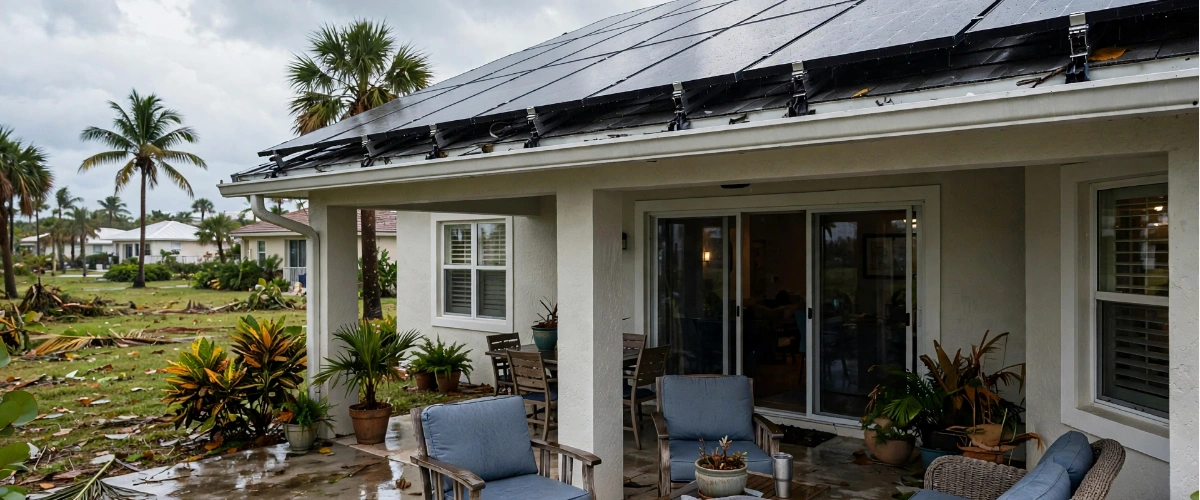
No system is truly hurricane proof. Quality panels are tested to specific wind and impact standards, and a properly engineered mounting system determines whether that rating holds. Automatic safety shutoffs also matter during storms.
Every June, a familiar question shows up in Florida homeowner group chats: are solar panels actually hurricane proof? The honest answer is more useful than any marketing headline. No rooftop system, solar or otherwise, is fully immune to a direct hit from a major storm, and any installer who tells you otherwise is not being straight with you. What actually matters is how your panels are engineered, how your mounting system is rated for Florida's wind zones, and what genuinely happens to your system before, during, and after landfall. This guide breaks down the real wind and impact standards behind residential solar, walks through what to expect if a storm hits your home directly, and explains the Florida-specific building codes and insurance rules most installers never mention.
Search "hurricane proof solar panels" and you will find plenty of marketing copy promising panels that shrug off any storm. That phrase does not hold up to scrutiny, and no manufacturer will put it in writing on a warranty document. What you actually want to know is a different question: how much wind and impact your specific system can handle, and what happens if that threshold gets exceeded.
Every solar panel sold in the United States carries a wind and impact rating, tested under recognized standards, not a blanket hurricane proof label. Those ratings describe a threshold your system is engineered to handle, not a guarantee against every possible outcome. Understanding that distinction is the single most useful thing you can do before storm season, whether you already have panels or are still comparing quotes.
Homeowners across Tampa, Orlando, Miami, and the Gulf Coast are asking this question for a good reason: Florida takes more direct hurricane strikes than almost any other state. Rising utility rates make solar attractive at the same time storm risk makes homeowners cautious about adding anything new to the roof. Both concerns are valid, and both deserve a straight answer instead of a sales pitch.
Florida does not leave wind resistance up to individual installers to decide. The Florida Building Code sets minimum wind design requirements by region, and solar mounting systems have to meet those requirements just like roofing materials do. That framework is exactly why the installer you choose matters as much as the panel brand on the spec sheet.
Wind design requirements vary by county and by how close a property sits to the coast, with inland areas generally facing lower minimum thresholds than coastal ones. A system permitted and engineered correctly accounts for your specific address, not a statewide average. Ask any installer to show you the wind load calculation for your roof before you sign a contract.
Miami-Dade and Broward counties fall under Florida's High-Velocity Hurricane Zone, which carries the strictest wind and impact testing requirements in the state. Products used in these counties typically need additional approval beyond what is required elsewhere in Florida. If you live in this zone, confirm your installer routinely works under these rules rather than treating your project as an exception.
Products installed in the High-Velocity Hurricane Zone generally need a Miami-Dade County Notice of Acceptance or an equivalent Florida Product Approval on file. That paperwork proves the racking and mounting hardware, not just the panel, was tested for your specific wind zone. A reputable installer can produce this documentation on request, and you should ask for it before, not after, installation.
Most homeowners picture their panels ripping off the roof mid-storm, but that is rarely how solar systems actually fail during a hurricane. The more common issues involve automatic safety systems doing exactly what they are designed to do, and the occasional piece of wind-driven debris causing localized damage.
Modern solar inverters and automatic transfer switches disconnect from the grid the moment utility power drops, which is a safety feature, not a malfunction. Your system does not need to be manually shut off before a storm in most cases, since this happens automatically. Homeowners who worry about needing to climb onto the roof before landfall can rest easier once they understand this part of the system.
When solar systems do sustain storm damage, the cause is usually flying debris striking a panel or water intrusion at a poorly sealed roof penetration, not the panel itself failing under wind load. That is why the quality of the mounting installation matters more than the panel's marketing claims. A properly flashed, properly torqued racking system is your real defense against a direct hit.
A well-engineered system surviving a hurricane does not mean walking away completely unscathed. It means the system holds together, the roof stays watertight, and any damage that does occur is minor and easy to document for a claim.
Realistic survival looks like a system that stays mounted, keeps producing power once the grid comes back, and shows no signs of water intrusion at the roof. It does not mean zero scuffed glass or a guarantee that not a single fastener needed retightening afterward. Setting that expectation upfront avoids disappointment and helps you spot genuine problems instead of cosmetic ones.
A brief production dip in the days after a storm is common and usually traces back to debris or dust on the panels rather than damage. A professional post-storm inspection confirms whether what you are seeing is cosmetic or something that needs a repair. Skipping that inspection is the most common mistake homeowners make after a storm passes.
Not every installer treats Florida's wind requirements as more than a permitting checkbox, and that gap becomes obvious the first time a real storm tests the work. US Power engineers every Florida installation around the wind zone for your specific address, not a generic statewide standard.
Every system is installed by CSLB-licensed consultants and backed by a 25-year comprehensive warranty covering panels, workmanship, and performance, so storm-related defects are never something you pay to fix alone. As an exclusive Qcells partner offering factory-direct pricing across Florida roughly 15 to 20 percent below market, you get American-made panels without the markup other installers charge for the same protection.
Hurricane season regularly knocks out grid power for days at a time, which is why whole-home battery backup built for Florida homes matters as much as the panels themselves. Properly sized systems keep refrigeration, medical equipment, and connectivity running through extended outages instead of the few hours a portable generator can manage. Homeowners who have been through a storm season with a system installed are a big part of why US Power has earned 200+ five-star Google reviews.
Florida's property insurance market is uniquely strained, and homeowners with solar need to understand how that affects a storm damage claim. Documentation done before a storm ever forms is what makes the claims process fast instead of frustrating.
Many Florida homeowners carry coverage through Citizens Property Insurance Corporation, the state's insurer of last resort, and Florida law requires insurers to offer premium credits for verified wind mitigation features. A properly engineered, code-compliant solar mount can support that documentation rather than working against it. Ask your installer whether their installation paperwork is structured to support a wind mitigation inspection.
Photograph your panels, racking, and any visible serial numbers before hurricane season starts each year, and store that documentation with your policy paperwork. A professional installation that keeps your roof warranty intact also strengthens your position if you ever need to file a claim. The same applies to confirming your roof was sealed correctly against leaks at every penetration point, since that is often where storm damage actually starts.
Nothing is 100% hurricane-proof — and any installer claiming otherwise isn't being straight with you. What matters is a system built to Florida's wind zone requirements, installed by licensed pros who stand behind it with a real warranty. Hasn't your setup been checked against those standards yet? Get a free consultation before storm season catches you off guard.


Your solar company just removed your original inverter without asking. Concerned?

Your residential solar system was supposed to help so why is your home humming?

Is Your Solar Battery Failing? See what are the signs to recognize and how to act.






Copyright © 2026 US Power - Axia by QCells. All Rights Reserved.
Get an instant solar estimate using satellite!