

Solar + battery backup can power your Florida home through outages — sized right.
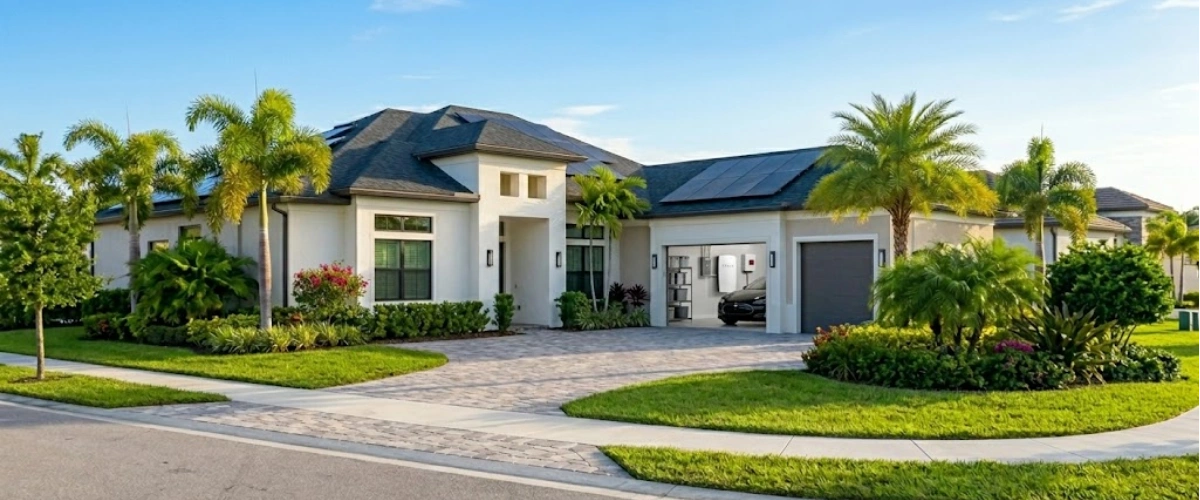
If you've lived through a hurricane season in Florida, you already know the drill. The storm passes, the grid goes down, and then comes the waiting — sometimes for days. Neighbors fire up noisy generators. Food spoils. The heat becomes unbearable.
Florida homeowners are asking a smarter question now: Can solar panels with battery backup actually power a whole house through a multi-day outage? The answer is yes — but the details matter. This guide breaks down exactly how these systems work, how much storage you actually need, and why more Florida families are choosing solar over the traditional generator approach.
Florida leads the nation in hurricane exposure — and in 2024, that came with a painful price tag. After hurricanes Helene and Milton tore through the state, 3.4 million Florida customers lost power from Milton alone. According to the U.S. Energy Information Administration, major storm-related outages averaged nearly nine hours nationally in 2024 — more than double the 10-year average. In Florida, outages routinely stretch far longer.
The average Florida family spends $800–$1,200 managing a single extended power outage — spoiled groceries, hotel stays, and emergency generator fuel that's often impossible to find after a storm. That's before you factor in the health risks from heat, or the stress of not knowing when the grid comes back.
And it's not just storm season putting pressure on your wallet. In November 2025, the Florida Public Service Commission approved what's been called the largest utility rate hike in U.S. history for FPL customers — a four-year agreement adding $945 million in new charges in 2026 alone. FPL's typical 1,000 kWh residential bill will climb from $134.14 to $148.15 by 2029. TECO customers also saw an $8.88 per 1,000 kWh increase take effect in early 2026.
The pattern is clear. Florida homeowners are paying more for less reliable power. That's exactly why solar with battery backup is gaining serious traction across the Sunshine State.
Before sizing a system, it helps to understand what happens under the hood. Most Florida homeowners assume their solar panels will automatically keep their home powered during an outage. They won't — not without a battery.
Grid-tied solar systems are required by law to shut down when the grid fails. This protects utility line workers from accidentally being electrocuted by power feeding back into the lines from your roof. So if you only have solar panels and no storage, your system goes completely dark the moment the neighborhood loses power.
This is one of the most important things to understand about everything about solar and battery storage before you invest. The panels and the battery work as a team — one generates the power, the other stores it and keeps your home running independently of the grid.
When you add a battery system, the solar panels charge the batteries during the day. When the grid fails, your system automatically switches to battery power — often in milliseconds. Most Florida homeowners report they didn't even notice the switchover until they checked their monitoring app.
During daylight hours, your panels continue generating power and simultaneously recharging the batteries. This is the key advantage over a gas generator: as long as the sun comes up, your system keeps refilling itself. After a hurricane passes, Florida typically returns to sunny skies quickly — exactly when utility crews are still working on repairs and the grid is still down.
This is the question that trips up most homeowners, and the answer depends entirely on your home's usage. Understanding how long a solar battery can power your house comes down to two things: how much energy you use and how much you can store.
The average Florida home uses significantly more electricity than the national average — roughly 30% more — because of year-round air conditioning demands. A typical Florida household uses 1,100–1,400 kWh per month, which translates to about 35–47 kWh per day.
A single battery unit typically stores 10–13 kWh. That means one battery covers roughly a quarter to a third of your daily needs under normal usage. For true whole-home backup through the night, most Florida homeowners need 20–30 kWh of storage minimum — and more if they want to run the AC freely.
There's a practical middle ground most solar installers recommend: instead of trying to power every circuit simultaneously, you identify your essential loads and prioritize them during an outage. This typically includes your refrigerator, lights, fans, phone and laptop charging, internet router, and — critically in Florida — at least one AC zone.
For a deeper look at how to size the right system for your home, this guide on how to size your solar system correctly walks through the math. You can also explore whole house battery storage for long-term blackouts for extended outage scenarios.
This is the big one for Florida. Air conditioning is a heavy load — a standard 3-ton central AC unit draws 3,500–5,000 watts. Running AC continuously overnight can drain 30–40 kWh of storage quickly.
The practical answer: most Florida homeowners with a properly sized battery system can run their AC during an outage, but with some mindfulness. Setting the thermostat to 78°F instead of 72°F dramatically reduces the draw and extends battery life. Many homeowners also add a mini-split for key rooms, which is far more efficient and easier to run on stored power.
Many Florida homeowners have already priced out a whole-home propane or natural gas generator. It's a fair comparison. Before you decide, here's what which backup power option is right for you actually looks like side by side.
A whole-home standby generator runs on propane or natural gas and kicks on automatically during an outage. It's reliable, proven technology. But there are real drawbacks Florida homeowners often overlook.
After a major hurricane, propane delivery and gas supply chains break down fast. Fuel that's available in normal times can disappear quickly when every neighbor needs it simultaneously. Generators also require annual maintenance, produce carbon monoxide (making placement critical), and run loud — a real issue if you're sheltering through a multi-day storm.
A well-designed solar + battery system is completely silent. There's no fuel to source, no exhaust fumes, and no maintenance calls. Switchover happens automatically in milliseconds — not the 10–30 seconds a generator typically needs. And unlike a generator that burns through fuel, your solar panels recharge your battery every sunny day the grid stays down.
For a thorough comparison of costs and long-term value, this solar generator vs gas generator breakdown covers exactly what you need to know. And if you're still on the fence, exploring whether solar batteries are worth the investment often surprises homeowners with the real math.
Solar + battery systems cost more upfront than a standby generator. A whole-home generator with installation typically runs $10,000–$20,000. A solar + battery system starts around $25,000–$40,000 depending on size — though monthly savings on your FPL or Duke Energy bill help offset that every month for decades. A generator saves you nothing on your utility bill. It only matters when the grid fails.
Not all solar companies are created equal. Florida has seen its share of installers who disappear after the job is done — leaving homeowners with warranty questions and no one to call. US Power was built on a different model.
US Power is an exclusive QCells partner, delivering American-made QCells panels at factory-direct pricing — 15–20% below what most competitors charge. No middlemen markups, no inflated quotes. QCells panels are engineered to handle Florida's heat, humidity, and wind loads, and every system is backed by a 25-year comprehensive warranty covering panels, workmanship, and performance.
For a full picture of what a properly designed system looks like, explore home solar battery systems for homeowners and how US Power approaches every installation from design to activation.
One of the biggest frustrations Florida homeowners have with solar companies is the installation timeline. Permits, inspections, and utility interconnection can drag for months with the wrong company. US Power's process is built for speed — most homeowners are up and running in 3–4 weeks after approval.
That matters in Florida, where the next hurricane season is never far away.
US Power's 200+ five-star Google reviews reflect one consistent theme: homeowners appreciate the honesty. Licensed consultants walk you through every line of your quote — no hidden fees, no high-pressure tactics, no lease agreements that extract value for decades. You own your system from day one.
The 30% federal solar tax credit expired on December 31, 2025. But Florida homeowners still have meaningful financial advantages worth knowing.
Florida exempts solar energy systems from the state's 6% sales tax. On a $30,000 system, that's $1,800 in immediate savings — automatic, no application required, no income limits.
Solar panels increase your home's value, but Florida law ensures that added value won't increase your property tax bill. The state's property tax exemption for renewable energy systems excludes the full appraised value of your solar installation from your property assessment. Higher home value, same tax bill.
Florida utilities are still required to offer net metering, crediting you for excess solar energy sent back to the grid. FPL, Duke Energy, and TECO each have their own rate structures. Sizing your system correctly ensures you maximize those credits while keeping your monthly bills as low as possible.
Florida's combination of punishing utility rate hikes and year-round hurricane risk makes the case for solar + battery backup clearer than almost anywhere else in the country. The technology works — and Florida homeowners who went through Helene and Milton with battery-backed systems know it firsthand.
The question isn't whether a solar + battery system can power your whole home. It can. The question is getting the sizing right for your usage and your budget. That's where US Power's factory-direct QCells systems, licensed consultants, and transparent pricing make the difference. With a 25-year comprehensive warranty and a 3–4 week installation timeline, there's no reason to be waiting in the dark when the next storm rolls in.


Experience faster, high-quality solar installations backed by QCells reliability.

Take a closer look at the precise manufacturing process behind QCells panels.

Learn how US Power installs solar efficiently without compromising quality.









Copyright © 2026 US Power - Axia by QCells. All Rights Reserved.
Get an instant solar estimate using satellite!