

US Power is the #1 QCELLS installer in California. Our factory-direct partnership eliminates middleman costs, delivering premium German-engineered solar panels at prices other companies can't match.
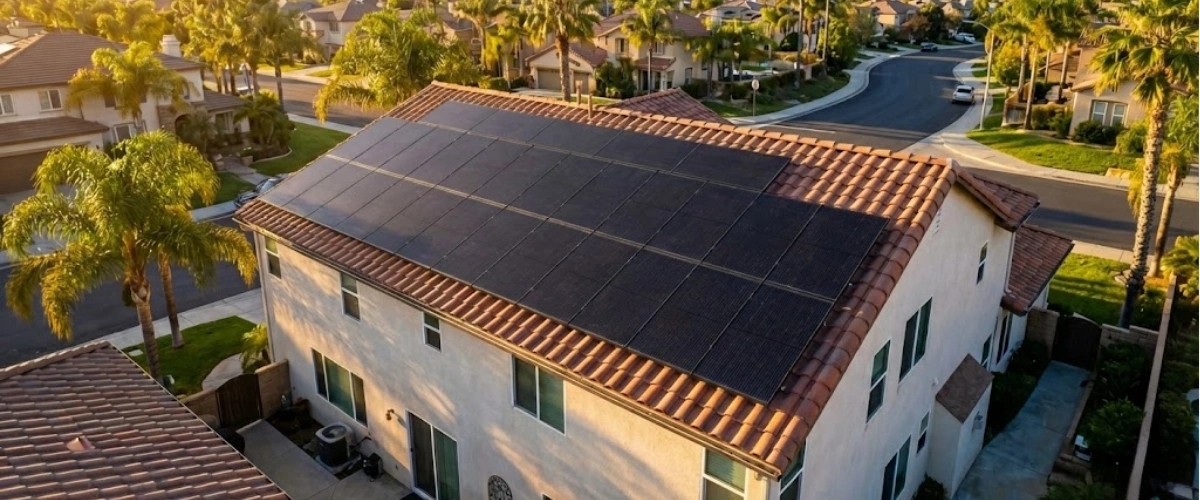
Calculate size from peak monthly usage: divide by 30 for daily kWh, divide by your area's peak sun hours, then multiply by a 1.2 buffer. Size for peak consumption, not average usage.
Sizing a solar system correctly is one of the most critical decisions you'll make when going solar. Get it wrong, and you could end up with a system that doesn't cover your energy needs—or one that costs thousands more than necessary. With NEM 3.0 dramatically changing how solar credits work in California, proper system sizing has never been more important.
Many Southern California homeowners struggle with the same question: how many solar panels do I actually need? The answer isn't as simple as looking at your average monthly bill. In this comprehensive guide, we'll walk you through the exact process to calculate your ideal system size, avoid common sizing mistakes, and understand how battery storage factors into the equation.
Under California's NEM 3.0 policy, the value of excess solar energy you send back to the grid has dropped by approximately 75% compared to the old NEM 2.0 rates. This means that oversizing your system—producing way more energy than you actually use—no longer makes financial sense like it did in the past.
On the flip side, undersizing your system leaves you buying expensive electricity from SCE or PG&E during peak hours when rates can exceed $0.50 per kWh. The goal in 2026 is precise sizing: generating enough solar power to cover your actual consumption, with battery backup sizing to store excess daytime production for evening use.
Here's where most homeowners—and unfortunately, some installers—make a critical mistake: sizing the system based on average monthly or annual consumption rather than peak usage. If your average monthly usage is 725 kWh but your peak summer months hit 1,250 kWh, sizing for the average means you'll be drawing heavily from the grid during your most expensive months.
Many Southern California homes experience dramatic seasonal variation. Air conditioning in summer, pool pumps running longer, and increased appliance use can nearly double your electricity consumption compared to mild winter months. A system sized for average use will leave you exposed to high utility bills exactly when you need solar protection most.
Before calculating system size, you need to understand your electricity usage patterns throughout the year. Pull your last 12 months of utility bills and identify:
For accurate solar sizing, always design for your peak consumption, not your average. This ensures your system performs when you need it most and minimizes costly grid dependence during high-rate periods.
Now let's get into the actual calculation. Here's the formula professional installers use to size solar systems for Southern California homes:
Take your highest monthly consumption and divide by 30 days. For example, if your peak month is 1,250 kWh, your peak daily usage is approximately 42 kWh per day.
Peak Daily kWh = Peak Month kWh ÷ 30
Southern California enjoys excellent solar conditions, but peak sun hours vary by location and season. Most of the Los Angeles area averages 4.5-5.5 peak sun hours daily. Coastal areas may see slightly less (4.2-4.5 hours), while inland valleys can reach 5.5-6.0 hours.
Peak sun hours represent the equivalent hours per day when solar irradiance averages 1,000 watts per square meter—essentially, the hours when your panels produce at or near their rated capacity. Understanding seasonal production variations helps you set realistic expectations for year-round performance.
System Size (kW) = Daily Peak kWh ÷ Peak Sun Hours
Using our 42 kWh example with 4.5 peak sun hours: 42 ÷ 4.5 = 9.3 kW
Solar systems don't operate at 100% efficiency. Real-world losses include:
Industry standard is to multiply by 1.15-1.25 to account for these losses. Conservative sizing uses 1.2:
Final System Size = Base Size × 1.2 efficiency buffer
9.3 kW × 1.2 = 11.2 kW recommended system size
Under NEM 3.0, battery storage has shifted from optional to essential for maximizing solar savings. While your solar panels generate electricity during the day, your highest consumption often occurs in the evening when you're home—exactly when solar production drops to zero.
Without batteries, excess daytime solar production gets exported to the grid at NEM 3.0's drastically reduced rates (often $0.05-0.08 per kWh). Then in the evening, you buy power back at peak rates ($0.40-0.55 per kWh for SCE and PG&E customers). This defeats the entire purpose of going solar.
With battery storage, you capture excess daytime production and deploy it during expensive evening hours—keeping your money instead of enriching the utility company.
Battery sizing depends on several factors that many homeowners overlook:
Evening and overnight consumption: How much energy do you use from 4 PM to 8 AM? Most Southern California homes consume 15-25 kWh during this window. A single 13.5 kWh battery (like the Tesla Powerwall or Q CELLS Q.HOME CORE) covers moderate evening use, but families with high consumption may need 20-27 kWh of storage.
Backup power goals: Do you want the battery solely for cost savings, or also for backup during outages? For backup, consider which critical loads you need powered (refrigerator, internet, lights, medical devices) and for how long. Most homeowners find that 2-3 days of backup provides adequate security without overinvesting in rarely-used capacity.
Solar production patterns: If your solar system produces 50-60 kWh on a sunny summer day but you only use 35 kWh total, you have 15-25 kWh of excess available for storage. This excess should match your battery capacity to avoid wasting production.
A practical approach: size your battery bank to cover your evening consumption plus a buffer for cloudy days. For a home using 42 kWh daily with 20 kWh consumed from 4 PM-8 AM, target 20-27 kWh of battery storage (roughly 2 Powerwalls or equivalent).
This provides nightly self-sufficiency while maintaining 1-2 days of backup power for outages—a sweet spot between cost and performance for most Southern California homeowners.
After analyzing hundreds of solar quotes, we've identified the most expensive mistakes homeowners make when sizing their systems:
Some installers pitch systems that promise to eliminate your electric bill entirely. Under NEM 3.0, this requires massive oversizing and battery capacity—often costing $15,000-25,000 more than a properly-sized system. Unless you're willing to pay a premium for energy independence, aim for 85-95% offset instead. You'll still slash your bills while keeping project costs reasonable.
Planning to buy an EV in the next 2-3 years? That adds 300-500 kWh monthly to your consumption—roughly a 40% increase for average households. Failing to account for this means you'll either need a costly system expansion later or remain dependent on expensive grid power for vehicle charging.
Similarly, installing a heat pump, adding a pool, or building an ADU substantially increases electricity needs. Size your system for your 5-year consumption forecast, not just today's usage.
We regularly see homeowners who invest $25,000 in solar panels but skip batteries to save $10,000. Under NEM 3.0, this decision undermines your entire solar investment. Without storage, you're forced to export daytime production at pennies and buy evening power at peak rates.
The math is brutal: exporting 15 kWh daily at $0.06 earns you $0.90, while buying back 15 kWh at $0.45 costs you $6.75. You're losing $5.85 daily—over $2,100 annually—by not having batteries. A $10,000 battery investment pays for itself in 5 years just from avoided export losses, not even counting backup power value.
Lower-tier solar panels (typically offshore brands with minimal US presence) may appear to save $3,000-5,000 on system costs. However, these panels often carry inferior warranties, higher degradation rates, and questionable long-term support.
Premium panels from manufacturers like Q CELLS deliver 25-year performance warranties, slower degradation (0.5% annually vs 0.7-1.0% for budget panels), and better production efficiency. Over 25 years, this translates to 12-18% more energy production—easily worth the modest upfront premium.
Every Southern California home has unique energy needs. Here's how system sizing varies by consumption profile:
Smaller homes benefit from high-efficiency panels to maximize limited roof space. Even compact systems deliver substantial utility bill reductions when properly sized with battery storage.
This represents the sweet spot for most Southern California homeowners. Systems in this range deliver excellent ROI, typically paying for themselves in 6-8 years through utility savings.
Larger homes with pools, multiple EVs, or all-electric appliances require robust solar and storage systems. The investment is substantial, but so are the savings—often $300-500 monthly in avoided utility costs.
When evaluating solar proposals, don't just accept the installer's recommended system size at face value. Ask these critical questions:
The production ratio compares your annual consumption to projected annual solar production. Under NEM 3.0 with batteries, aim for 95-105% ratio. Systems below 85% leave you grid-dependent; systems above 120% waste money on excess production you can't store or use.
Quality panels degrade about 0.5% annually. After 25 years, they're producing at roughly 88% of original capacity. Verify that production estimates account for this decline—not just year-1 output.
Be skeptical of proposals using 5.5+ peak sun hours unless you're in an inland desert location. Coastal LA, Orange County, and Ventura areas typically see 4.2-4.8 hours. Inflated sun hour assumptions make systems appear smaller (and cheaper) than they should be.
If the proposal includes minimal or zero battery storage, it's designed for old NEM 2.0 economics—not today's reality. Push back and ask for proper battery sizing to maximize your solar investment under current policies.
At US Power, we don't use one-size-fits-all calculators or cookie-cutter system designs. Every proposal includes:
Our factory-direct relationship with Q CELLS—the world's 4th largest solar manufacturer—means you get premium German-engineered panels without the distributor markup. Better equipment, better pricing, better long-term performance.
Sizing your solar system correctly is the foundation of a successful solar investment. Under NEM 3.0, the old "bigger is better" approach no longer applies—precision matters more than ever.
By sizing for peak consumption rather than averages, incorporating adequate battery storage, and planning for future needs, you'll build a system that delivers maximum savings for 25+ years. The difference between a properly-sized system and a poorly-sized one can easily exceed $20,000 in lifetime value.
Don't leave this critical decision to guesswork or sales tactics. Partner with an experienced installer who understands NEM 3.0 economics, Southern California's unique solar conditions, and your family's specific energy needs.
US Power has designed and installed thousands of solar systems across Southern California. Our engineering-first approach ensures your system is sized perfectly—not too big, not too small, but optimized for your maximum return on investment. Ready to see what a precisely-sized solar system can do for your utility bills? Get your free custom solar design today.


Understand HOA rules and your rights when planning to install solar in California.

Learn how solar panels generate savings even when skies are gray and cloudy.
You have solar panels. Now you need a battery. But which type actually saves money?









Copyright © 2026 US Power - Axia by QCells. All Rights Reserved.
Get an instant solar estimate using satellite!