

US Power es el instalador número 1 de QCELLS en California. Nuestra asociación directa de fábrica elimina los costos de intermediarios, ofreciendo paneles solares de ingeniería alemana de primera calidad a precios que otras empresas no pueden igualar.
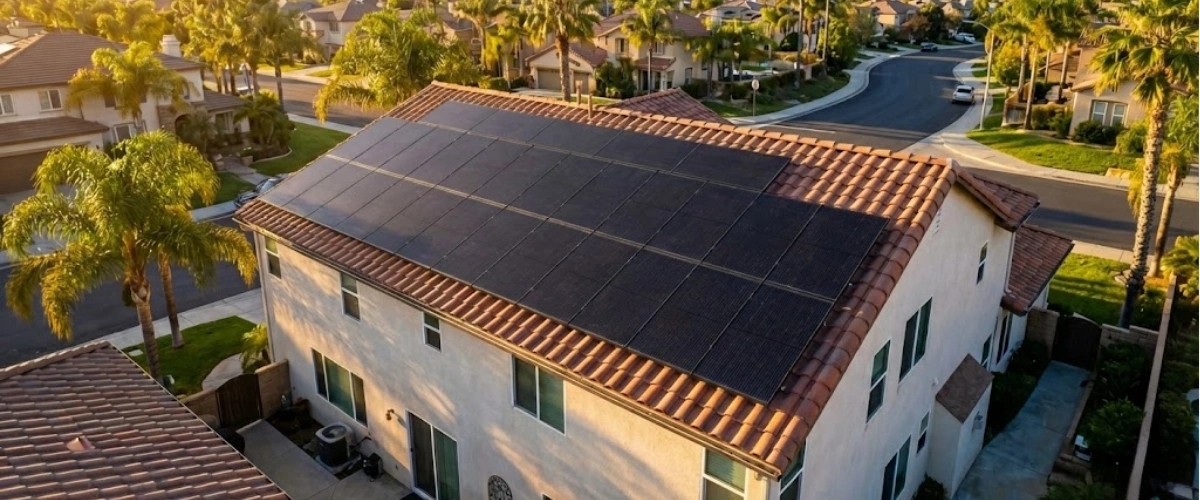
Calcule el tamaño a partir del consumo mensual máximo: divida entre 30 para obtener los kWh diarios, divida entre las horas pico de sol de su zona y luego multiplique por un margen de 1.2. Ajuste el tamaño según el consumo máximo, no según el uso promedio.
Dimensionar correctamente un sistema solar es una de las decisiones más críticas que tomará al pasarse a la energía solar. Si se equivoca, podría terminar con un sistema que no cubra sus necesidades energéticas o uno que cueste miles más de lo necesario. Con NEM 3.0 cambiando drásticamente cómo funcionan los créditos solares en California, un dimensionamiento adecuado del sistema nunca ha sido tan importante.
Muchos propietarios en el sur de California se enfrentan a la misma pregunta: ¿cuántos paneles solares necesito realmente? La respuesta no es tan simple como mirar su factura mensual promedio. En esta guía completa, le guiaremos a través del proceso exacto para calcular el tamaño ideal de su sistema, evitar errores comunes de dimensionamiento y comprender cómo influye el almacenamiento en baterías en la ecuación.
Bajo la política NEM 3.0 de California, el valor del exceso de energía solar que usted envía a la red ha disminuido aproximadamente un 75% en comparación con las antiguas tarifas NEM 2.0. Esto significa que sobredimensionar su sistema (producir mucha más energía de la que realmente consume) ya no tiene sentido financiero como lo tenía en el pasado.
Por otro lado, un sistema demasiado pequeño le obligará a comprar electricidad costosa de SCE o PG&E durante las horas pico, cuando las tarifas pueden superar los $0.50 por kWh. El objetivo en 2026 es un dimensionamiento preciso: generar suficiente energía solar para cubrir su consumo real, con un dimensionamiento de respaldo de baterías para almacenar el exceso de producción diurna para su uso nocturno.
Aquí es donde la mayoría de los propietarios, y lamentablemente algunos instaladores, cometen un error crítico: dimensionar el sistema basándose en el consumo mensual o anual promedio en lugar del uso máximo. Si su consumo mensual promedio es de 725 kWh pero sus meses pico de verano alcanzan los 1,250 kWh, dimensionar para el promedio significa que dependerá fuertemente de la red durante sus meses más costosos.
Muchos hogares en el sur de California experimentan una variación estacional drástica. El aire acondicionado en verano, las bombas de piscina funcionando por más tiempo y el mayor uso de electrodomésticos pueden casi duplicar su consumo de electricidad en comparación con los meses templados de invierno. Un sistema dimensionado para el uso promedio lo dejará expuesto a facturas de servicios públicos elevadas justo cuando más necesita la protección solar.
Antes de calcular el tamaño del sistema, necesita entender sus patrones de consumo eléctrico a lo largo del año. Tome sus facturas de servicios públicos de los últimos 12 meses e identifique:
Para un dimensionamiento solar preciso, diseñe siempre pensando en su consumo máximo, no en su promedio. Esto garantiza que su sistema funcione cuando más lo necesita y minimiza la costosa dependencia de la red durante los períodos de tarifas altas.
Ahora entremos en el cálculo real. Esta es la fórmula que utilizan los instaladores profesionales para dimensionar sistemas solares para hogares en el sur de California:
Tome su consumo mensual más alto y divídalo entre 30 días. Por ejemplo, si su mes pico es de 1,250 kWh, su uso diario máximo es de aproximadamente 42 kWh por día.
kWh diarios pico = kWh del mes pico ÷ 30
El sur de California goza de excelentes condiciones solares, pero las horas pico de sol varían según la ubicación y la estación. La mayor parte del área de Los Ángeles tiene un promedio de 4.5 a 5.5 horas pico de sol al día. Las zonas costeras pueden recibir un poco menos (4.2-4.5 horas), mientras que los valles interiores pueden alcanzar de 5.5 a 6.0 horas.
Las horas pico de sol representan el equivalente diario de horas en las que la irradiancia solar promedia 1,000 vatios por metro cuadrado; esencialmente, las horas en las que sus paneles producen a su capacidad nominal o cerca de ella. Comprender las variaciones estacionales de producción le ayuda a establecer expectativas realistas sobre el rendimiento durante todo el año.
Tamaño del sistema (kW) = kWh diarios pico ÷ horas pico de sol
Usando nuestro ejemplo de 42 kWh con 4.5 horas pico de sol: 42 ÷ 4.5 = 9.3 kW
Los sistemas solares no funcionan al 100% de su eficiencia. Las pérdidas en condiciones reales incluyen:
El estándar de la industria es multiplicar por 1.15-1.25 para compensar estas pérdidas. Un dimensionamiento conservador utiliza 1.2:
Tamaño final del sistema = Tamaño base × 1.2 de margen de eficiencia
9.3 kW × 1.2 = 11.2 kW de tamaño de sistema recomendado
Bajo NEM 3.0, el almacenamiento en baterías ha pasado de ser opcional a esencial para maximizar el ahorro solar. Aunque sus paneles solares generan electricidad durante el día, su mayor consumo suele ocurrir por la noche cuando está en casa, justo cuando la producción solar cae a cero.
Sin baterías, el exceso de producción solar diurna se exporta a la red a las tarifas drásticamente reducidas de NEM 3.0 (a menudo $0.05-0.08 por kWh). Luego, por la noche, usted vuelve a comprar energía a tarifas pico ($0.40-0.55 por kWh para clientes de SCE y PG&E). Esto anula el propósito mismo de instalar energía solar.
Con el almacenamiento en baterías, usted captura el exceso de producción diurna y lo utiliza durante las costosas horas nocturnas, conservando su dinero en lugar de enriquecer a la compañía eléctrica.
El dimensionamiento de las baterías depende de varios factores que muchos propietarios pasan por alto:
Consumo durante la tarde y la noche: ¿Cuánta energía utiliza entre las 4 p. m. y las 8 a. m.? La mayoría de los hogares en el sur de California consumen entre 15 y 25 kWh durante este periodo. Una sola batería de 13.5 kWh (como la Tesla Powerwall o la Q CELLS Q.HOME CORE) cubre un consumo moderado por la noche, pero las familias con un consumo elevado podrían necesitar entre 20 y 27 kWh de almacenamiento.
Objetivos de energía de respaldo: ¿Desea la batería solo para ahorrar costos o también como respaldo durante los cortes de energía? Para el respaldo, considere qué cargas críticas necesita mantener encendidas (refrigerador, internet, luces, dispositivos médicos) y por cuánto tiempo. La mayoría de los propietarios consideran que 2 o 3 días de respaldo ofrecen la seguridad adecuada sin invertir de más en una capacidad que rara vez se utiliza.
Patrones de producción solar: Si su sistema solar produce entre 50 y 60 kWh en un día soleado de verano, pero usted solo consume 35 kWh en total, le quedan entre 15 y 25 kWh de excedente disponibles para el almacenamiento. Este excedente debe coincidir con la capacidad de su batería para evitar desperdiciar la producción.
Un enfoque práctico: dimensione su banco de baterías para cubrir su consumo nocturno más un margen para los días nublados. Para un hogar que consume 42 kWh al día, con 20 kWh utilizados entre las 4 p. m. y las 8 a. m., apunte a una capacidad de almacenamiento de 20 a 27 kWh (aproximadamente 2 Powerwalls o su equivalente).
Esto proporciona autosuficiencia nocturna y, al mismo tiempo, mantiene de 1 a 2 días de energía de respaldo para cortes, un punto ideal entre costo y rendimiento para la mayoría de los propietarios en el sur de California.
Tras analizar cientos de presupuestos solares, hemos identificado los errores más costosos que cometen los propietarios al dimensionar sus sistemas:
Algunos instaladores ofrecen sistemas que prometen eliminar su factura eléctrica por completo. Bajo NEM 3.0, esto requiere un sobredimensionamiento masivo y una gran capacidad de batería, lo que suele costar entre $15,000 y $25,000 más que un sistema bien dimensionado. A menos que esté dispuesto a pagar un sobreprecio por la independencia energética, apunte a una compensación del 85-95%. Seguirá reduciendo sus facturas drásticamente mientras mantiene los costos del proyecto en un nivel razonable.
¿Planea comprar un vehículo eléctrico en los próximos 2 o 3 años? Eso añade entre 300 y 500 kWh mensuales a su consumo, aproximadamente un aumento del 40% para los hogares promedio. No tener esto en cuenta significa que, más adelante, tendrá que realizar una costosa ampliación del sistema o seguir dependiendo de la costosa energía de la red para cargar su vehículo.
Del mismo modo, instalar una bomba de calor, añadir una piscina o construir una unidad de vivienda accesoria (ADU) aumenta considerablemente las necesidades eléctricas. Dimensione su sistema según su previsión de consumo a 5 años, no solo según su uso actual.
Vemos con frecuencia propietarios que invierten $25,000 en paneles solares pero omiten las baterías para ahorrar $10,000. Bajo NEM 3.0, esta decisión socava toda su inversión solar. Sin almacenamiento, se ve obligado a exportar la producción diurna a precios irrisorios y comprar energía por la noche a tarifas pico.
Las matemáticas son implacables: exportar 15 kWh diarios a $0.06 le genera $0.90, mientras que recomprar 15 kWh a $0.45 le cuesta $6.75. Está perdiendo $5.85 al día (más de $2,100 al año) por no tener baterías. Una inversión de $10,000 en baterías se paga sola en 5 años solo con las pérdidas de exportación evitadas, sin contar el valor de la energía de respaldo.
Los paneles solares de gama baja (normalmente marcas extranjeras con mínima presencia en EE. UU.) pueden parecer un ahorro de $3,000 a $5,000 en los costos del sistema. Sin embargo, estos paneles suelen tener garantías inferiores, tasas de degradación más altas y un soporte a largo plazo cuestionable.
Los paneles premium de fabricantes como Q CELLS ofrecen garantías de rendimiento de 25 años, una degradación más lenta (0.5% anual frente al 0.7-1.0% de los paneles económicos) y una mejor eficiencia de producción. A lo largo de 25 años, esto se traduce en un 12-18% más de producción de energía, lo que compensa fácilmente el modesto costo inicial adicional.
Cada hogar en el sur de California tiene necesidades energéticas únicas. Así es como varía el dimensionamiento del sistema según el perfil de consumo:
Las viviendas pequeñas se benefician de paneles de alta eficiencia para aprovechar al máximo el espacio limitado del techo. Incluso los sistemas compactos ofrecen reducciones sustanciales en la factura de servicios públicos cuando se dimensionan correctamente con almacenamiento en baterías.
Este es el punto ideal para la mayoría de los propietarios en el sur de California. Los sistemas en este rango ofrecen un excelente retorno de inversión, pagándose generalmente en 6-8 años gracias al ahorro en la factura eléctrica.
Las casas grandes con piscina, varios vehículos eléctricos o electrodomésticos totalmente eléctricos requieren sistemas solares y de almacenamiento robustos. La inversión es considerable, pero también lo es el ahorro: a menudo entre $300 y $500 mensuales en costos de servicios públicos evitados.
Al evaluar propuestas solares, no acepte simplemente el tamaño de sistema recomendado por el instalador. Haga estas preguntas críticas:
La relación de producción compara su consumo anual con la producción solar anual proyectada. Bajo NEM 3.0 con baterías, busque una relación del 95-105%. Los sistemas por debajo del 85% lo dejan dependiente de la red; los sistemas por encima del 120% desperdician dinero en exceso de producción que no puede almacenar ni utilizar.
Los paneles de calidad se degradan aproximadamente un 0.5% anual. Después de 25 años, producen aproximadamente el 88% de su capacidad original. Verifique que las estimaciones de producción tengan en cuenta esta disminución, no solo la producción del primer año.
Sea escéptico ante las propuestas que utilizan más de 5.5 horas pico de sol, a menos que se encuentre en una zona desértica interior. Las áreas costeras de Los Ángeles, el condado de Orange y Ventura suelen tener entre 4.2 y 4.8 horas. Las suposiciones infladas de horas de sol hacen que los sistemas parezcan más pequeños (y más baratos) de lo que deberían ser.
Si la propuesta incluye poca o ninguna capacidad de almacenamiento en baterías, está diseñada para la economía del antiguo NEM 2.0, no para la realidad actual. Exija un dimensionamiento adecuado de las baterías para maximizar su inversión solar bajo las políticas vigentes.
En US Power, no utilizamos calculadoras genéricas ni diseños de sistemas estandarizados. Cada propuesta incluye:
Nuestra relación directa de fábrica con Q CELLS, el cuarto fabricante de energía solar más grande del mundo, significa que usted obtiene paneles premium de ingeniería alemana sin el sobreprecio de los distribuidores. Mejores equipos, mejores precios, mejor rendimiento a largo plazo.
Dimensionar correctamente su sistema solar es la base de una inversión exitosa. Bajo NEM 3.0, el antiguo enfoque de "cuanto más grande, mejor" ya no aplica; la precisión es más importante que nunca.
Al dimensionar según el consumo máximo en lugar de los promedios, incorporar un almacenamiento adecuado en baterías y planificar las necesidades futuras, usted construirá un sistema que genere el máximo ahorro durante más de 25 años. La diferencia entre un sistema bien dimensionado y uno mal dimensionado puede superar fácilmente los $20,000 en valor a lo largo de su vida útil.
No deje esta decisión crítica al azar ni a tácticas de venta. Asóciese con un instalador experimentado que comprenda la economía de NEM 3.0, las condiciones solares únicas del sur de California y las necesidades energéticas específicas de su familia.
US Power ha diseñado e instalado miles de sistemas solares en todo el sur de California. Nuestro enfoque centrado en la ingeniería garantiza que su sistema esté perfectamente dimensionado: ni demasiado grande, ni demasiado pequeño, sino optimizado para obtener el máximo retorno de su inversión. ¿Listo para ver lo que un sistema solar dimensionado con precisión puede hacer por sus facturas de energía? Obtenga hoy mismo su diseño solar personalizado gratuito.


Siete razones reales para instalar paneles solares en 2026 y cuánto vale cada una.

Guía 2025: conectores solares seguros y eficientes. ¡Energía solar más inteligente!

Antes de elegir su sistema solar, compare las marcas líderes frente a frente.









¿Listo para tomar el control de tu energía? ¡Llámanos hoy!
818-650-8010Licencia de contratista n.º: 1144368

Copyright © 2026 US Power - Axia by QCells. Todos los derechos reservados.
¡Obtenga un presupuesto solar al instante mediante satélite!