
Choosing between QCells' Q.PEAK DUO and Q.TRON panels? The $1,500 price gap isn't just about watts—it's about technology that matches Southern California's unique solar landscape.
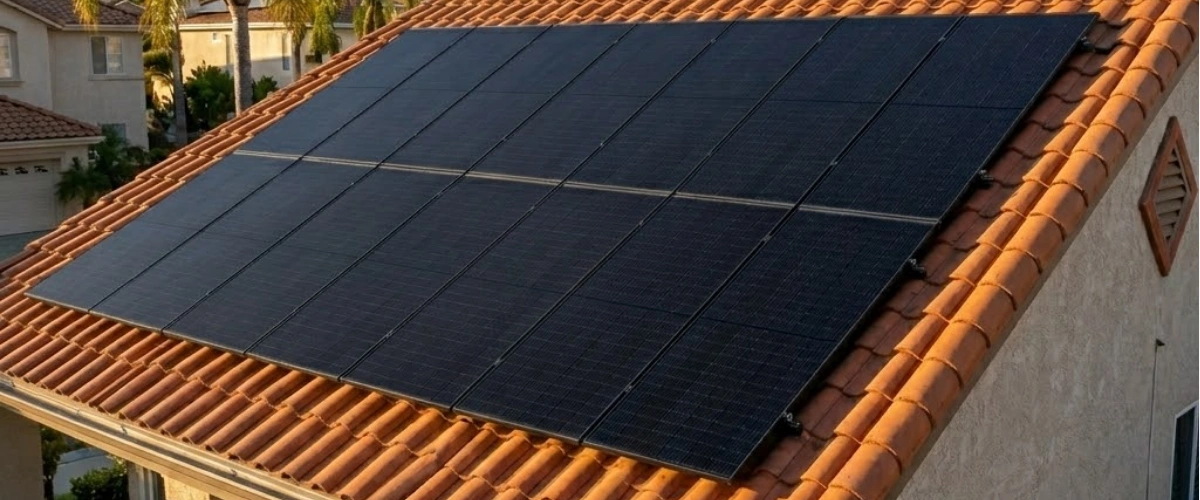
For many Southern California homeowners, yes, especially under NEM 3.0. Q.TRON's higher efficiency and slower degradation can pay off over 25 years, though the roughly $1,500 price gap is worth weighing against your usage.
You're comparing solar quotes and notice something confusing. One installer quotes 14 Q.PEAK DUO BLK ML-G10+ panels, while another recommends 13 Q.TRON BLK M-G2+ panels for $1,500 more. Both are QCells. Both seem similar on paper. So where's the $1,500 going?
This exact scenario plays out daily for Southern California homeowners evaluating solar options. With SCE rates averaging 34.5 cents per kWh in 2026—and climbing—choosing the right panel matters more than ever. But decoding technical specs shouldn't require an engineering degree.
Here's what you need to know about these two QCells models, why the price differs, and which one actually makes sense for rising Southern California electricity rates.
Let's cut through the marketing jargon and look at real numbers.
This is QCells' proven residential workhorse. It uses PERC technology—the same cell design that's powered millions of homes since 2015.
Key specifications:
This is QCells' newer N-type panel using TOPCon technology. It's what happens when solar manufacturers push efficiency boundaries.
Key specifications:
The numbers tell part of the story. But here's what they mean for your Southern California home.
The $1,500 difference isn't arbitrary. You're paying for three meaningful upgrades.
The Q.TRON produces 440W versus the Q.PEAK's 415W maximum. That 25-watt difference might seem small, but it compounds across your entire system.
For a typical 5.7 kW system, you'd need 14 Q.PEAK panels (5,810W) versus 13 Q.TRON panels (5,720W). That's one less panel taking up roof space—critical if you have a smaller roof or significant shading issues.
Here's where Southern California's climate becomes relevant. Solar panels lose efficiency as temperatures rise above 77°F. The Q.TRON's temperature coefficient of -0.29%/°C beats the Q.PEAK's -0.347%/°C.
When your roof hits 113°F on a July afternoon in the San Fernando Valley, the Q.TRON loses about 6.4% of its output compared to the Q.PEAK's 7.3% loss. Over 25 years of hot summers, that gap adds up.
Solar panels don't break—they just gradually produce less electricity. The Q.TRON degrades at 0.33% per year compared to the Q.PEAK's 0.5% annual decline.
After 25 years, your Q.TRON system still produces 90.58% of its original output. The Q.PEAK drops to 86%. For a 5.7 kW system, that's roughly 260 extra watts of production when you're in your 50s or 60s.
This is why QCells is the smartest solar choice for homeowners planning to stay in their homes long-term.
Before we dive deeper into the G10+ versus G2+ decision, let's address why both panels outperform budget alternatives.
QCells isn't just another solar manufacturer. They pioneered PERC technology in the early 2000s and hold over 1,400 patents. Both the Q.PEAK and Q.TRON lines pass TÜV Rheinland's "Quality Controlled PV" certification—the industry's most rigorous testing program.
Every panel includes Anti-PID (potential-induced degradation) and Anti-LeTID (light and elevated temperature-induced degradation) protection. These aren't marketing buzzwords—they're real technologies that prevent the premature failures common in cheaper panels.
You can explore the full technical details in our comprehensive guide to QCells solar panels.
This is where things get technical, but stay with me—it matters.
PERC stands for Passivated Emitter Rear Cell. It adds a reflective layer on the back of each solar cell that bounces unused light back through the cell for a second chance at conversion.
Think of it like adding mirrors to a greenhouse. More light gets utilized instead of absorbed as waste heat. PERC technology has dominated residential solar since 2015 because it's reliable, proven, and cost-effective.
N-type refers to the way silicon is chemically treated during manufacturing. TOPCon (Tunnel Oxide Passivated Contact) adds an ultra-thin oxide layer that reduces electron recombination—basically, fewer electrons get "lost" during electricity generation.
The result? Higher efficiency, better heat tolerance, and slower degradation. It's newer technology that's gradually replacing PERC across the industry.
For American-made QCells panels assembled in Georgia, this represents the cutting edge of domestic solar manufacturing.
California's Net Energy Metering 3.0 policy changed the solar economics in April 2023. Unlike NEM 2.0, which credited exported solar at retail rates, NEM 3.0 pays just 5-10 cents per kWh for electricity sent back to the grid.
This makes self-consumption critical. The more solar energy you use directly instead of exporting, the better your economics.
Higher-efficiency panels produce more power during the same hours you're actually home using electricity. The Q.TRON's 22.5% efficiency means it generates more usable power during morning and evening hours when the sun angle is less optimal.
During peak electricity hours (4-9 PM for most SCE customers), every extra watt counts. Premium panels maximize production during these expensive time windows.
Most solar installers now recommend pairing panels with battery storage under NEM 3.0. Batteries store your excess daytime solar production for use during expensive evening hours.
The Q.TRON's higher output means you fill your battery faster and have more leftover for immediate consumption. Over 25 years, this compounds into thousands of dollars in avoided peak-rate purchases.
Learn more about how solar batteries maximize your savings under California's current policies.
Here's where the conversation shifts from "which panel is better" to "which panel offers better value."
US Power is QCells' exclusive factory-direct partner in Southern California. We don't buy panels through distributors or middlemen—we get them straight from QCells' Georgia facility at wholesale cost.
That $1,500 premium for Q.TRON panels? At typical retail markup, it might be $2,200-2,800 at other installers. Our factory-direct pricing narrows the gap considerably.
We also don't charge dealer fees, coordination fees, or other hidden costs. Our quotes include everything: permits, equipment, installation, inspection, and activation. No surprises on installation day.
Compare our approach to QCells vs other premium brands to see how pricing differs across the market.
After installing over 2,000 solar systems across Los Angeles, Orange County, Ventura, San Bernardino, and Riverside, we've learned what actually works.
The premium Q.TRON panels deliver the best value if you:
Have limited roof space. Fewer high-wattage panels means you maximize production without covering every available square foot. This matters for homes with complex rooflines, chimneys, or skylights.
Plan to stay in your home 15+ years. The slower degradation and better heat performance compound over decades. You're not just buying panels—you're buying consistent electricity production into your 60s and 70s.
Live in consistently hot areas. Homes in the Inland Empire, San Fernando Valley, or desert communities see temperatures above 100°F for months each year. The Q.TRON's superior temperature coefficient protects your production.
Want maximum future-proofing. N-type TOPCon is the industry's direction. In 10 years, if you need to expand your system, finding compatible PERC panels might be harder.
The standard Q.PEAK panels remain an excellent choice if:
You have ample roof space. If you can fit 16-18 panels without issue, an extra panel or two costs less than upgrading to Q.TRON across your entire system.
You're prioritizing lower upfront cost. If your budget is tight or you're financing the system, the Q.PEAK offers proven performance at a lower monthly payment.
You live in milder coastal areas. Homes in Santa Monica, Malibu, or coastal Orange County rarely see extreme heat. The temperature coefficient difference becomes less meaningful.
Both panels come with identical 25-year warranties covering product defects and performance guarantees. You can read the details in our guide to solar panel warranties for Southern California.
Specifications matter, but how do these panels actually perform on Southern California roofs?
We track production data from over 2,000 installed systems. Here's what we've observed:
The Q.TRON systems consistently produce 3-5% more electricity than comparably sized Q.PEAK systems in the same neighborhoods. That gap widens during summer months when temperatures exceed 95°F.
One Los Angeles homeowner with a 14-panel Q.TRON system (6.16 kW) generated 9,847 kWh in their first year. A neighbor with a similar roof orientation using 15 Q.PEAK panels (6.225 kW) produced 9,523 kWh. The Q.TRON system produced more total energy despite being slightly smaller.
This tracks with what to expect from QCells panel performance based on thousands of real installations.
The Q.PEAK versus Q.TRON decision isn't about finding the "best" panel—it's about finding the right panel for your specific situation.
Both options deliver exceptional quality, proven reliability, and comprehensive warranty protection. The Q.PEAK offers proven PERC technology at a lower upfront cost. The Q.TRON provides cutting-edge N-type efficiency with better long-term performance.
At US Power, we don't push premium panels to inflate our margins. We're QCells' exclusive factory-direct partner because we believe in transparent pricing and honest recommendations. Our consultations start with your roof, your budget, and your goals—not our sales quotas.
We'll show you production estimates for both panel options based on your actual roof layout. You'll see itemized pricing with no hidden fees. And you'll get our 25-year comprehensive warranty covering panels, inverters, batteries, and workmanship—everything under one guarantee.
The solar industry has enough confusing jargon and pushy salespeople. Let's have a straightforward conversation about what actually makes sense for your home.


The 30% solar credit didn't disappear. It just moved to a different kind of contract.

What TOU-D-PRIME actually means and how to choose the best TOU rate for you.
Act now as Arizona electric rates rise fast—why solar is the smarter choice.








Copyright © 2026 US Power - Axia by QCells. All Rights Reserved.
Get an instant solar estimate using satellite!