
SCE offers three time of use rate plans, and picking wrong can cost you hundreds a year. Here's what TOU-D-PRIME actually means and how to choose.
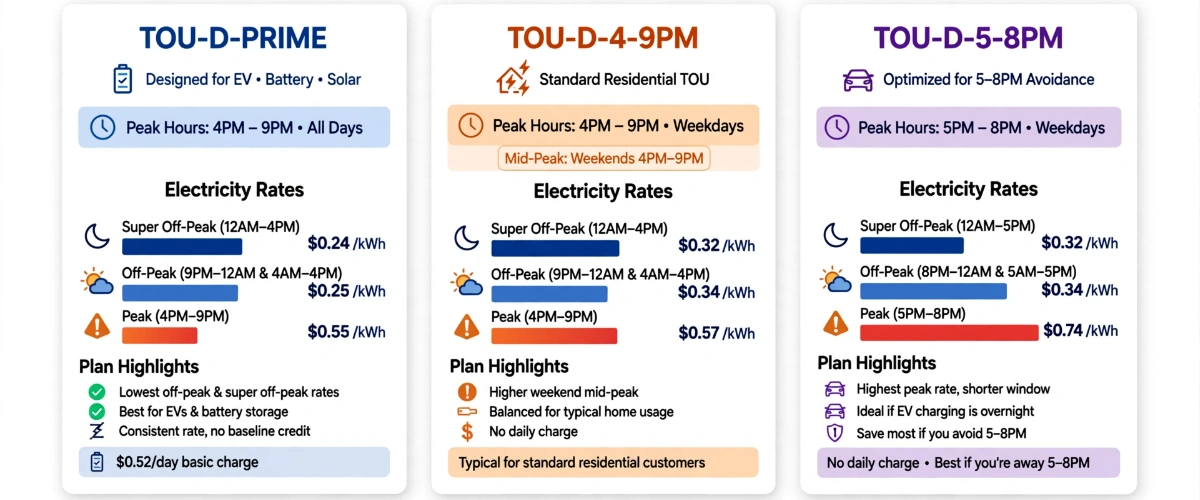
TOU-D-PRIME is SCE's residential time-of-use plan built for customers with an EV, battery, or electric heat pump. Picking the wrong plan can cost you, so compare it with the other options.
You open your SCE account to switch rate plans and see three unfamiliar names: TOU-D-4-9PM, TOU-D-5-8PM, and TOU-D-PRIME. No explanation of which one fits your household, just a dropdown menu and a decision that affects your bill for the next year. If you picked the wrong one, you could be paying peak rates during hours you never even use much power. This guide breaks down what each plan actually means, who qualifies for TOU-D-PRIME, and how to find your cheapest hours.
SCE has moved almost every residential customer onto some form of time of use billing, where your rate depends on when you use electricity rather than how much. Rates have climbed sharply over the past decade, and the plan names don't explain themselves. Homeowners are left guessing whether a 4pm peak window or a 5pm one actually matters for their household.
Most residential customers can choose between TOU-D-4-9PM, TOU-D-5-8PM, and TOU-D-PRIME. All three charge more during a defined peak window and less overnight and midday. The difference is the length of that peak window, the size of the daily fixed charge, and whether you get a baseline usage credit.
If you installed solar after April 2023, you're likely on the Solar Billing Plan rather than legacy NEM 2.0. Solar Billing Plan customers are required to be on TOU-D-PRIME specifically, not the other two plans. That single rule explains a lot of the confusion homeowners run into after adding solar to an existing NEM 2.0 system or installing for the first time in 2026.
These two plans share the same basic structure. Rates run highest during a defined peak window on weekdays, drop during a shorter mid-peak stretch, and fall to their lowest point overnight and in the early morning. The number in the plan name tells you exactly when the expensive hours start and end.
TOU-D-4-9PM sets peak pricing from 4pm to 9pm every day. It's the plan most non-solar SCE customers land on by default, and it includes a baseline credit: a per-kilowatt-hour discount applied to usage that falls within your home's monthly baseline allocation. That credit can meaningfully soften your bill if your household stays close to its allotted usage.
TOU-D-5-8PM narrows the peak window to just five to eight in the evening, but the tradeoff is a noticeably higher summer weekday peak rate to compensate for the shorter window. This plan tends to work best for households that can genuinely avoid using major appliances between 5 and 8pm. If dinner, laundry, and AC use regularly overlap with that window, the standard 4-9PM plan is usually the safer bet.
TOU-D-PRIME uses the same 4pm to 9pm peak window as TOU-D-4-9PM, but the pricing structure is built differently. It drops the baseline credit entirely, charges a higher daily basic service fee, and in exchange offers lower per-kilowatt-hour rates across the board.
Losing the baseline credit sounds like a downside, and for very low-usage households it can be. But the lower per-kWh pricing tends to win out for homes that use more electricity than average, which includes most solar and EV households pulling power outside their peak-avoidance hours.
TOU-D-PRIME isn't open to everyone. SCE requires an attestation confirming you have an electric vehicle, a residential battery, or an electric heat pump system before you can enroll. That's by design: SCE built this plan around households that can shift meaningful load away from the 4-9pm window, which is exactly what EVs and batteries are good at.
Regardless of which plan you're on, the pattern is the same: rates are lowest overnight and in the middle of the day, and highest during the evening peak window specific to your plan.
Under TOU-D-PRIME, the cheapest hours fall in the late morning through mid-afternoon during winter months, and overnight year-round. This is the window solar production and grid demand overlap least, so SCE prices it lowest to encourage usage there. Running your dishwasher, EV charger, or pool pump during these hours can meaningfully cut your bill without any behavior changes beyond timing.
You don't need a battery to benefit from off-peak pricing, but you do need discipline. Setting your dishwasher, washing machine, and EV charger on delayed-start timers is a simple way to move usage into cheaper hours without changing your daily routine much. A battery removes the guesswork entirely by automating the shift, charging during cheap hours and discharging during the peak window, which is why battery-equipped households consistently outperform solar-only households on SCE's time of use plans. Solar-only households can still benefit, but they're limited to whatever they can consume or export in real time during daylight hours, which rarely lines up with the evening peak window these plans are built around.
Picking a rate plan shouldn't be a guessing game, and it shouldn't be an afterthought tacked onto a solar quote either.
US Power's CSLB-licensed consultants review your actual usage history before recommending a system size or a rate plan. That means you're not choosing blind between TOU-D-4-9PM, TOU-D-5-8PM, or TOU-D-PRIME. You're choosing based on your household's real numbers, not a generic recommendation that ignores how your family actually uses electricity throughout the day. This same review process applies whether you're a new solar customer or a homeowner simply trying to make sense of a plan SCE already switched you into.
Every system US Power installs uses American-made, factory-direct Qcells panels backed by a 25-year comprehensive warranty, sized specifically to perform well under whichever SCE plan fits your home. That's part of why US Power has earned 200+ five-star Google reviews across Southern California.
Once you're on TOU-D-PRIME, the plan practically rewards you for owning a battery.
A properly sized battery discharges through the entire evening peak window, so the highest-priced hours on your SCE bill never actually touch your grid usage. Combined with solar panels and battery storage sized for California homes, this can turn TOU-D-PRIME's lower baseline-free rates into a real savings advantage rather than a tradeoff.
Beyond bill savings, enrolling your battery in a virtual power plant program can generate additional income by letting SCE draw on your stored power during grid stress events, on top of whatever TOU-D-PRIME already saves you.
The best SCE rate plan for your home depends on how much you use, when you use it, and whether a battery is part of the picture. Understanding your real solar payback period means factoring in your rate plan from day one, not adjusting after the fact. With SCE rates showing no sign of slowing down, getting this decision right now protects your bill for years to come.



Your PWP bill keeps rising. Here's how Pasadena homeowners are fighting back.
Compare Maxeon 425 Black and QCells panels for optimal SoCal solar performance.
Your neighbor paid $8,500 for a smart panel. Was it worth it for your own home?









Copyright © 2026 US Power - Axia by QCells. All Rights Reserved.
Get an instant solar estimate using satellite!