

Texas homeowners face rising electricity rates and an unreliable grid. Find out why solar panels alone aren't enough in 2026—and how adding battery storage changes everything.
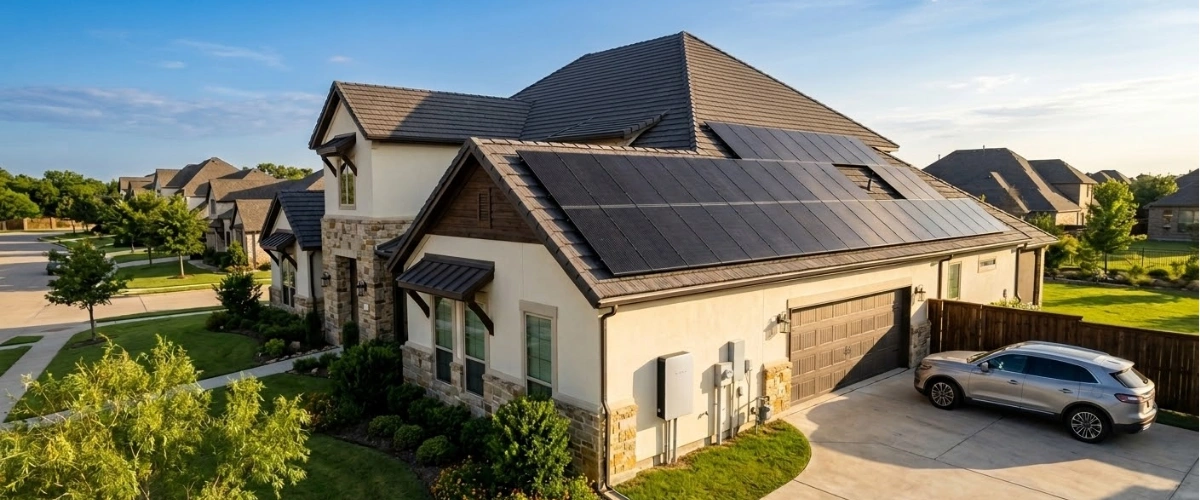
You've probably noticed it already. Your electricity bill is higher than it was two years ago—and it's not just because of the summer heat.
Texas electricity demand has grown by 30% since 2020, driven by AI data centers, cryptocurrency mining, and industrial expansion. That surge in demand is putting pressure on the grid—and on your wallet.
If you're in the Dallas–Fort Worth area, you're in ONCOR's service territory. ONCOR has filed for a rate increase that, if approved, would add approximately $7 per month for a residential customer using 1,000 kWh—a roughly 4.7% increase to the total monthly energy bill.
And that's likely just the beginning. Texas residential electricity rates are expected to average 14–19 cents per kWh in 2026 including delivery costs, with a modest 3–5% projected rise from 2025. Winter peak rates are trending upward through 2029, reflecting the grid risks inherent to Texas cold snaps.
Many Texas homeowners sign up for "free nights" plans thinking they've cracked the code. But solar energy gets produced during the day—when rates are highest and your plan offers zero benefit.
Without battery storage, that daytime solar energy gets pushed back to the grid at low buyback rates. Your nights stay free, but you're still paying during peak hours when you need power most.
Here's something most solar companies won't tell you upfront: Texas has no mandatory net metering.
In California, excess solar energy is credited back at near-retail rates. In Texas, it's a different story. You can shop for a solar buyback plan through a retail electric provider (REP), but buyback rates vary wildly—and in most cases, you're selling energy back at a fraction of what you pay to buy it.
That's why solar panels alone aren't enough for most Texas homeowners to see maximum savings.
A real DFW homeowner in Plano recently had a 10kW solar system installed on their home. In January alone, the system produced 200 kWh—even in winter. But their household uses around 2,000 kWh per month on average. Solar alone covers a portion of that. Storage is what makes the difference.
Without a battery, energy produced at noon gets exported to the grid at low buyback rates. With a battery, that same energy powers your home at 6 PM—when rates are at their peak.
Winter Storm Uri left millions of Texans without power for days. Since then, extreme weather events—both summer heat waves and winter freezes—have continued to stress the ERCOT grid.
A solar battery doesn't just save you money. It keeps your lights on when the grid can't. Learn everything about solar and battery storage to understand how these systems work together.
A home battery is essentially a large rechargeable unit that stores the energy your solar panels produce during the day.
When the sun goes down—or when the grid goes out—your battery takes over. Your lights, HVAC, refrigerator, and other essentials keep running without interruption.
Most Texas homeowners are on time-of-use plans. That means electricity costs more in the evening than in the middle of the day. Your battery charges up during off-peak solar hours, then powers your home during expensive peak periods.
That shift alone can dramatically reduce what you owe each month. Curious about how long a solar battery can power your home? It depends on system size and usage, but most properly sized batteries carry a home through the night comfortably.
Pools are common in Texas homes—and pool pumps are one of the biggest energy drains. Running your pool pump on solar-stored energy instead of grid power is one of the fastest ways to see real savings on your bill.
Cost is always the first question—and it's a fair one. But the better question is: what does it cost not to go solar?
At current rates, a Texas homeowner spending $200–$300 per month on electricity will spend $60,000–$90,000 over 25 years. A properly sized solar + battery system eliminates most of that.
Even without the federal tax credit, Texas homeowners in ONCOR's territory have access to meaningful incentives in 2026.
The ONCOR residential solar rebate program in 2026 requires that installations include a battery energy storage system. Maximum incentives can reach up to $9,000 for qualifying solar-plus-storage systems.
That requirement is important: battery storage is now the key to unlocking ONCOR's rebate. Solar only? No rebate. Solar plus battery? You qualify.
Additionally, Texas offers two permanent protections that add long-term value. Your property taxes won't increase when you install solar—the added home value is fully exempt. And solar equipment is exempt from Texas state sales tax, reducing your upfront cost at purchase.
Wondering about how much solar batteries actually cost before rebates? US Power's factory-direct pricing on QCells panels—American-made and typically 15–20% below market—makes it easier to stay within budget.
For most Texas homeowners, yes. When you combine the ONCOR rebate, the property tax exemption, and monthly bill savings, the math starts to work quickly. If you're still on the fence, this guide on whether batteries are worth it for solar breaks down the numbers clearly.
Based on a DFW area average rate of 17.5 cents per kWh, an 8kW system can save approximately $2,170 per year, with a payback period of around 9.5 years on a net system cost of $20,580. With quality solar panels lasting 25+ years, homeowners enjoy over 15 years of near-free energy after payback.
Not all solar companies are the same. And in Texas—where installation quality, permitting experience, and product selection matter enormously—who you choose makes a real difference.
US Power is an exclusive QCells partner. QCells panels are manufactured in the United States, which means shorter supply chains, faster availability, and pricing that's 15–20% below what most installers charge.
When you choose the best solar panels for your home, American-made quality and a 25-year comprehensive warranty covering panels, workmanship, and performance should be at the top of your checklist.
Most solar projects drag on for months. US Power completes installations in 3–4 weeks after approval—a timeline that's rare in the industry.
Texas permitting can be complex. ONCOR interconnection agreements, city-specific inspections (Plano, for example, has strict battery placement codes), and utility coordination all add time when a company isn't experienced in the local market. US Power handles all of it.
With 200+ five-star Google reviews and CSLB-licensed consultants, US Power brings the professionalism and track record Texas homeowners deserve. No high-pressure tactics. No hidden fees. Transparent pricing from day one.
The decision to go solar is easier when you understand exactly what you're getting—and what it'll cost.
Start by reviewing your last 12 months of electricity bills. Look at your peak usage months (July and August in Texas), and your average monthly kWh. That number drives everything: system size, battery capacity, and projected savings.
Before you commit to any solar agreement, understand the difference between owning and leasing your system. This guide on whether to buy or lease your solar panels explains exactly what you give up with a lease—and why ownership almost always wins long-term.
Your consultation with US Power is free and pressure-free. But come prepared with a few key questions. Ask about system sizing for your specific usage, battery options that qualify for the ONCOR rebate, and what the timeline looks like from approval to Permission to Operate (PTO).
Understanding how much solar panels save in a real Texas scenario gives you a benchmark before that conversation.
Rising electricity rates, an aging grid, and no mandatory net metering make the case clear: solar alone is only half the solution in Texas.
A properly sized solar + battery system locks in your energy costs, protects you from grid outages, and lets you take advantage of the ONCOR rebate before the November 2026 deadline.
US Power makes the process simple—factory-direct QCells panels, a 25-year comprehensive warranty, and a 3–4 week installation timeline that respects your time.
Appointments are filling up. The ONCOR rebate program closes November 30, 2026, or when funding runs out—whichever comes first.


One upgrade decision saved this homeowner $500/year on electricity bills forever.

The surprising truth about where your QCells solar panels really come from.

Solar boosts home value and helps houses sell 13% faster in SoCal. Go solar now!









Copyright © 2026 US Power - Axia by QCells. All Rights Reserved.
Get an instant solar estimate using satellite!