
Southern California Edison offers two main time-of-use plans for solar homeowners — TOU-D-PRIME and TOU-D-4-9PM. But picking the wrong one could cost you hundreds of dollars a year. Your NEM status, battery setup, and daily energy habits all determine which plan puts more money back in your pocket. This guide breaks down the real differences, shares a real-world savings example, and helps you choose the right plan for your home in 2026.

Your solar panels are generating clean energy every day — but if you're on the wrong Southern California Edison rate plan, you could be leaving hundreds of dollars on the table each year. Rising electricity costs in Southern California make this decision more critical in 2026 than ever before.
Most solar homeowners in SCE territory are choosing between two time-of-use (TOU) plans: TOU-D-PRIME and TOU-D-4-9PM. They look similar on paper, but the savings difference can be significant depending on your setup, your habits, and whether you're on NEM 2.0 or NEM 3.0.
This guide breaks down exactly what separates these two plans — and which one is the right fit for your home.
Choosing a rate plan isn't just a billing preference — it directly affects how much credit your solar system earns, when your battery should discharge, and what your annual savings actually look like.
Understanding why your SCE bill keeps rising is the first step. SCE rates have climbed over 83% in the last decade, and the average residential rate hit roughly $0.353 per kWh in 2025 — with a projected 12.9% increase for 2026.
With rates this high, even a small difference between plans compounds into real money over a year.
Both TOU-D-PRIME and TOU-D-4-9PM are time-of-use plans, which means your electricity rate changes depending on when you use power — not just how much.
Peak hours run from 4 PM to 9 PM daily. During this window, electricity costs significantly more. Outside of it, off-peak rates are much lower. For solar homeowners, this is the most important hours range of the day because it's when your panels have stopped producing — and when your battery can step in.
A homeowner who picks the wrong plan based on surface-level details can easily pay $100 to $150 more per year without realizing it. The difference isn't dramatic per month, but it adds up — especially as SCE rates continue climbing.
Both plans share the same 4–9 PM peak window, but they differ in structure in two important ways.
TOU-D-4-9PM has a very low daily fixed charge — roughly $0.03 per day (about $1/month). It also includes a baseline credit of around $0.10 per kWh up to your monthly baseline allocation. This makes it well-suited for households that keep their grid usage moderate.
TOU-D-PRIME carries a significantly higher daily fixed charge — around $0.59 per day, or roughly $17–24 per month depending on current rate filings. It was originally designed for customers with electric vehicles, battery storage, or other high-energy home upgrades. In exchange, it offers slightly lower on-peak per-kWh rates and no baseline credit.
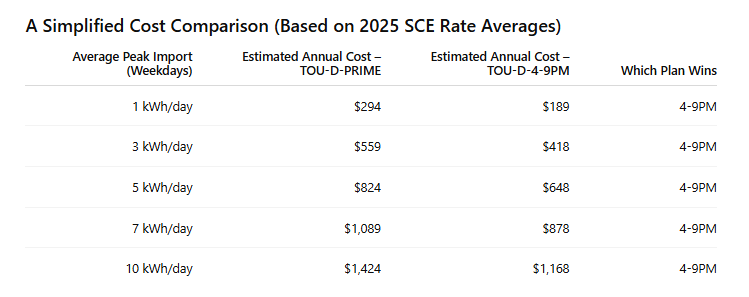
Understanding how solar billing works in California is essential before committing to either plan.
This plan works well for NEM 2.0 customers who have stable daytime solar production, keep most of their energy use outside of peak hours, and don't rely heavily on grid power in the evenings. The low daily fixed charge is its biggest advantage — it simply costs less to be on this plan if your battery or behavioral habits already reduce your 4–9 PM grid draw.
TOU-D-PRIME is required for all NEM 3.0 solar customers. If you interconnected your system after April 2023, you're enrolled here automatically. It's also a fit for households with EVs that charge heavily in the evening or high overall energy usage that benefits from the slightly lower per-kWh on-peak rates.
One SCE homeowner in Southern California — running an 8.1 kW solar system under NEM 2.0, one Powerwall battery, and an EV charged throughout the day — received a rate comparison notice from SCE showing an estimated $113 annual savings by switching from TOU-D-PRIME to TOU-D-4-9PM.
Their situation is common: even with an EV and a battery, the lower fixed charge of TOU-D-4-9PM outweighed the minor per-kWh rate differences.
The key insight? The daily fixed charge on TOU-D-PRIME adds up to roughly $215 per year. If your energy habits and battery strategy already minimize your 4–9 PM grid usage, you're paying that fixed charge without getting proportional value from it.
Whether you're on NEM 2.0 or NEM 3.0 is the single most important factor in this decision. Learn more about NEM 2.0 vs NEM 3.0 explained to understand your current billing program.
If you connected your solar system before April 2023, you're likely on NEM 2.0. This means you still receive near one-to-one credit for the solar power you send back to the grid. Under NEM 2.0, you can choose between TOU-D-4-9PM and TOU-D-PRIME — and for most households, TOU-D-4-9PM wins on overall annual cost.
One important caveat: once you switch plans, SCE does not allow another switch for 12 months. So it's worth getting a professional savings comparison before making the move.
If you installed solar after April 2023, you're under NEM 3.0 (now called the Net Billing Tariff). Export credits dropped significantly — to roughly $0.08 per kWh — making self-consumption and battery storage far more valuable than exporting to the grid.
SCE requires all new NEM 3.0 solar customers to enroll in TOU-D-PRIME. There's no choice here. That's why under NEM 3.0, your focus should shift entirely to when your battery discharges rather than which plan you're on.
Regardless of which rate plan applies to you, battery storage is what actually determines how much you save during peak hours. Without a battery, your solar system stops producing at sunset — right when SCE's most expensive rates kick in.
With a properly programmed battery, you can cover most or all of your 4–9 PM household load using stored solar energy instead of paying $0.50+ per kWh from the grid. Learn why a solar battery is worth it in California and how to calculate whether the numbers work for your home.
Under TOU-D-4-9PM or TOU-D-PRIME, the goal is identical: charge your battery from solar during midday (10 AM–3 PM), and discharge it during the 4–9 PM peak window. This strategy is compatible with QCells Q.HOME CORE, Tesla Powerwall, and Enphase IQ battery systems.
For NEM 3.0 customers especially, a battery isn't optional — it's the mechanism that makes solar financially worthwhile when export credits are low.
Battery strategy aside, shifting discretionary loads to off-peak windows compounds your savings further. Running dishwashers, laundry, and pool pumps before 4 PM or after 9 PM costs you 40–50% less per kWh than running them during peak hours. EV charging overnight (after 9 PM) is another major savings lever under both plans.
Understanding SCE time-of-use hours breakdown in detail can help you build smarter daily energy habits around your rate plan.
Choosing a rate plan is just one piece of the puzzle. The bigger savings driver is having a system that's sized, programmed, and installed to work with your specific rate plan and SCE usage data from day one.
US Power is Southern California's exclusive QCells partner, offering American-made, high-efficiency solar panels at factory-direct pricing — typically 15–20% below market rates. Every system comes backed by a 25-year comprehensive warranty covering panels, workmanship, and performance.
Our CSLB-licensed consultants don't just quote you a system — they review your actual SCE billing history to help you understand how your rate plan, battery programming, and system size work together. With 200+ five-star Google reviews and a 3–4 week installation timeline from approval to power-on, US Power is built for Southern California homeowners who want results fast.
To maximize solar savings with battery storage, having an experienced team program and size your system correctly from the start makes all the difference.
California's AB 205 energy reform introduced a new income-based fixed monthly charge starting in late 2025. Non-CARE residential customers now pay a Base Service Charge (BSC) of around $24 per month — separate from their rate plan's daily charge.
This change slightly reduces the per-kWh cost advantage that TOU-D-4-9PM holds over TOU-D-PRIME, since both plans now carry this base fee. However, the daily charge difference between the two plans still matters — and TOU-D-4-9PM continues to be the lower-cost option for most NEM 2.0 households.
If your current annual savings difference between the two plans is under $10 per month, it may be worth waiting for all AB 205 changes to fully settle before making a permanent switch — since plan changes are locked for 12 months with SCE.
For most NEM 2.0 homeowners in Southern California, TOU-D-4-9PM offers the better annual savings — primarily because the lower daily fixed charge outweighs its slightly higher on-peak rate. If you're on NEM 3.0, TOU-D-PRIME is required, so your energy focus should shift to battery optimization and self-consumption strategy.
Either way, the rate plan is just one lever. The bigger wins come from having a correctly sized solar system, a properly programmed battery, and a team that understands how SCE billing actually works.
US Power offers free consultations — virtual or on-site — to help Southern California homeowners get both the right system and the right rate plan strategy from day one. With factory-direct QCells pricing, a 25-year warranty, and a 3–4 week installation timeline, there's never been a better time to take control of your SCE bill.
Switching rate plans is only one piece of the savings puzzle. The biggest cost reduction still comes from producing and storing your own clean energy.
At US Power, homeowners can take advantage of:
Our team helps you find the most cost-effective combination of panels, batteries, and rate plans — customized for your home and your SCE usage data.
As SCE continues to adjust rates and California phases in new fixed charges, homeowners with solar have more control than ever over their energy bills. For most NEM 2.0 customers, TOU-D-4-9PM offers the best balance of low daily fees and flexible solar credits. For newer NEM 3.0 systems, TOU-D-PRIME remains the required and most compatible plan.
Either way, your battery strategy and solar efficiency matter more than the plan name — and that’s where professional guidance from US Power makes all the difference.
Before installing a solar + battery storage system, schedule your free solar quote with us.
Find out which rate plan and solar setup can save you the most with your current SCE bill.


Own it in year 6. No lien. No credit check. Priced below cash. Call us today!

Electricity bills hitting record highs? You're not imagining it—here's why.

Save on energy and gain shade—here’s why solar carports are trending in SoCal.







Copyright © 2026 US Power - Axia by QCells. All Rights Reserved.
Get an instant solar estimate using satellite!