

A big-box solar quote and a factory-direct quote can cover the same roof and the same Qcells panels, yet land thousands of dollars apart. The gap is not the hardware, it is the layers of markup, dealer fees, and sales commissions baked into the retail channel. This guide breaks down what each quote really contains, where the hidden money sits, and how US Power's factory-direct model keeps your price 15 to 20 percent below market.
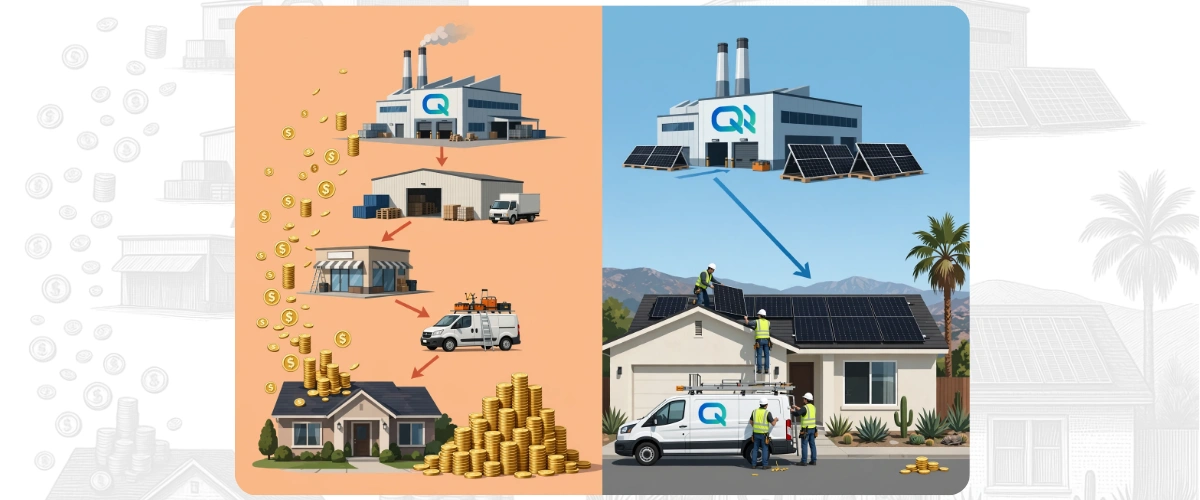
You get two solar quotes for the same roof, and the totals sit thousands of dollars apart. One comes from a big-box retailer or a large national installer, the other from a factory-direct company that works straight from the manufacturer. On the surface they look alike, maybe even the same panels and the same promise of a lower bill. Underneath, they are built in completely different ways, and those differences decide how much you actually pay. A big-box quote carries layers of markup that a factory-direct quote simply does not have. This guide breaks down how the two quotes differ, where the extra money hides, and how US Power's factory-direct model keeps your price 15 to 20 percent below what the retail channel charges.
Homeowners are often shocked when two quotes for an identical system come back so far apart. The panels can be the same wattage, the roof is the same size, yet one price towers over the other. The reason is almost never the equipment.
Solar hardware is close to a commodity, so the panels and inverters in each quote may be nearly identical. What changes the total is how many hands the deal passes through before it reaches you. Every extra hand adds a fee, and those fees stack up long before anyone touches your roof. If you want the full picture, our look at why California solar can cost three times more than it should shows how the retail channel inflates a simple system.
A big-box or national quote usually travels through a lead broker, a sales dealer, and a subcontracted crew, each taking a cut. You never meet most of these people, but you pay every one of them. A factory-direct quote removes those middle layers so your dollars go toward the actual system and the people installing it.
A big-box quote looks clean on paper, often a single bottom-line number. The trouble is what that number quietly bundles together, since the biggest costs are the ones that never get their own line.
National solar sellers and retail programs pay large commissions to the salesperson and a dealer fee to the finance company. These can add many thousands of dollars, and they are usually folded into the system price where you cannot see them. Our breakdown of the hidden costs that can eat into your California solar savings walks through the fees that rarely appear as their own line.
Many big-box and national quotes are sold by one company and installed by another. When the crew on your roof does not work for the company that sold you the system, accountability gets blurry the moment something goes wrong. That gap is also where the classic sales pitch lives, like the zero-bill promise some salespeople make that rarely tells the whole story.
A factory-direct quote starts from the opposite direction. Instead of layering markup on top of a wholesale price, it begins near the manufacturer's cost and adds only what is truly needed to design and install your system.
Because a factory-direct company sources panels straight from the maker, there is no distributor markup and no dealer fee riding along. That is the core of going factory-direct with Qcells, where the savings come from cutting out the resellers rather than cheapening the equipment. You get the same American-made panels for a materially lower price.
A strong factory-direct quote shows you the equipment, the labor, the permitting, and the warranty as clear line items instead of one mystery total. When every cost is visible, there is nowhere to hide a commission or an inflated fee. That transparency is the practical difference you feel when you compare the two documents side by side.
When you lay both quotes next to each other, the differences show up in specific places. Knowing where to look turns a confusing comparison into an easy one.
Compare the panels and battery first, since those should be similar in quality. Then compare the labor and the fees, because that is where a big-box quote balloons. Our guide on how to compare solar quotes in California helps you line up the numbers so the real gap becomes obvious.
Every honest quote should spell out system size, panel brand and wattage, inverter type, warranty terms, and the total price with no vague add-ons. If a quote leaves any of these blank, treat it as a warning sign. The elements every solar quote should include give you a simple checklist to hold each bid against.
US Power was built around the factory-direct model, not bolted onto a retail sales operation. That structure is why our quotes read so differently from the big-box version.
As an exclusive Qcells partner, US Power sources American-made panels through our partnership with Qcells and installs them with our own CSLB-licensed consultants and crews. One team designs, supplies, and installs your system, so there is no finger-pointing if a question ever comes up. Our 25-year comprehensive warranty covers the panels, the workmanship, and the performance, and our 200 plus five-star Google reviews reflect that single point of accountability.
Because we skip the distributor and the dealer fee, your price lands 15 to 20 percent below the typical retail quote for the same equipment. That is not a discount gimmick, it is simply what solar costs when you remove the middlemen. You also get a clear, itemized quote and a 3 to 4 week installation timeline once your project is approved.
Before you sign anything, a few pointed questions will tell you which kind of quote you are really holding. The answers reveal the markup that a bottom-line number hides.
Ask who physically installs the system, who honors the warranty, and whether any dealer or financing fee is baked into the price. Ask for the price in itemized form, not a single number. If the answers are vague, that is a signal, and our list of solar installer red flags to watch for explains why those dodges matter. A company confident in its pricing will answer each question plainly, because it has nothing folded in that it needs to hide.
A verbal reassurance is easy to give and hard to hold anyone to later. Ask for the itemized quote, the warranty terms, and the installer's license number in writing before you commit. A factory-direct company that stands behind its price will hand those over without hesitation, while a channel built on markup often pushes you to sign first and read later. The willingness to put everything on paper is itself one of the clearest signals of which model you are dealing with.
The panels on your roof look the same either way, but the quote behind them decides how much you pay. A big-box quote hides dealer fees, commissions, and subcontractor markup inside one tidy number, while a factory-direct quote shows every cost and cuts out the middlemen. That gap is worth thousands of dollars on a typical home system. With rising utility rates making every saved dollar matter more, compare an itemized factory-direct quote before you sign. US Power gives you that honest number, backed by American-made Qcells panels and one accountable team.


What factory-direct solar pricing really means for Florida homeowners in 2026.
Vet solar contractors before you sign, not after a crew is up on your roof.
Your residential roof type in CA should not stop you from saving on electricity.







Copyright © 2026 US Power - Axia by QCells. All Rights Reserved.
Get an instant solar estimate using satellite!