
AC solar panels explained: how they work, costs, and who they're best for.
If you're a homeowner in California, Texas, Florida, or Illinois thinking about switching to solar, you've likely come across the term "AC solar panels." But with so many options out there, it's hard to know whether they're worth the extra cost — or just another upsell.
Your electricity bill keeps climbing. Your roof isn't perfectly angled. And the last thing you want is to invest in a system that underperforms.
In this guide, you'll learn exactly how AC solar panels work, what makes them different from traditional setups, and how to decide if they're the right fit for your home — so you can make a confident, well-informed decision.
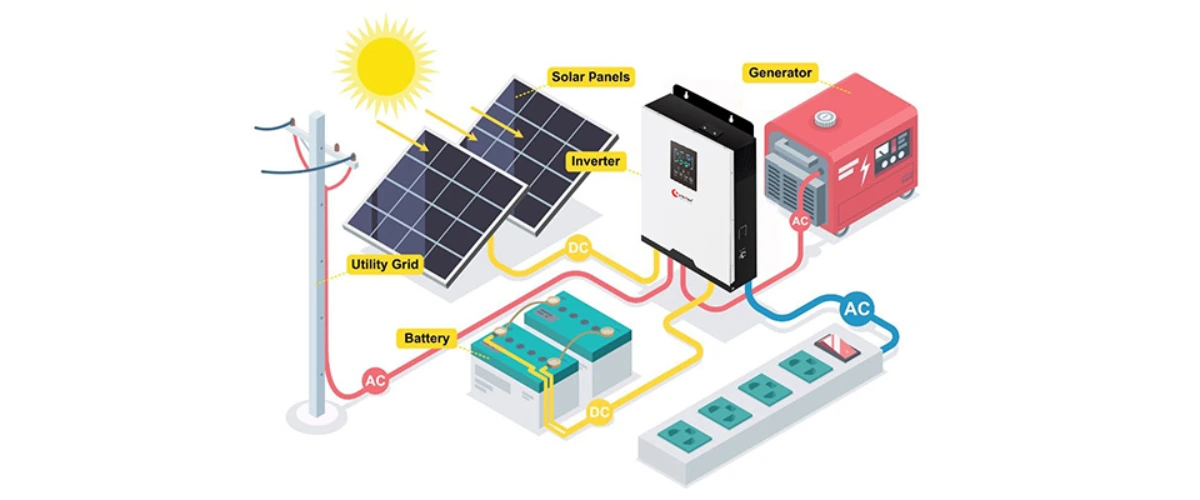
Solar panels convert sunlight into electricity — but that electricity comes out as DC (direct current). The problem? Your home runs on AC (alternating current). That's why most solar systems require a separate inverter to convert DC into usable power.
To understand how AC and DC power work in solar, think of DC as a one-way street and AC as a two-way highway — your appliances need AC to function.
AC solar panels solve this conversion challenge at the source. Each panel has a built-in microinverter that converts DC to AC right on your roof, before the electricity ever enters your home.
In a traditional solar setup, all panels feed into a single central inverter. If one panel is shaded or underperforms, it can drag down the entire system.
With AC panels, each module operates independently. One shaded panel has zero effect on the rest. That's a significant performance advantage — especially for homes with complex roofs or partial shading.
Standard appliances — refrigerators, air conditioners, lighting, washers — all require AC electricity to operate. Solar panels need an inverter to make that conversion happen. AC panels simply do it earlier, at the panel itself, which keeps high-voltage DC wiring off your roof entirely.
AC solar panels offer a set of advantages that are especially relevant if you live in a state with hot summers, complex housing styles, or grid reliability concerns.
Many homes in Southern California, Texas, and Florida have trees, dormers, or rooftops that face multiple directions. Before going solar, it's worth asking whether your roof is ready for solar — because roof complexity directly affects which inverter system will work best.
AC panels shine in these situations. Because each module has its own microinverter, a single shaded panel doesn't reduce what the rest of your array produces. Studies show microinverter systems can recover 15 percentage points of annual yield loss compared to standard string inverter setups in shaded conditions.
AC modules are often described as plug-and-play. There's no central inverter box to mount, fewer wiring runs to manage, and simpler commissioning for the installation crew.
For homeowners, this often means shorter installation windows and less time with workers on ladders. US Power's typical installation timeline runs just 3–4 weeks from approval to activation.
Planning to add more panels down the road? With AC panels, expansion is straightforward. You can add modules without rewiring or replacing a central inverter — something you'd often need to do with a traditional string-inverter system.
This flexibility matters if you expect your energy needs to grow: an electric vehicle, a new HVAC system, or just more people at home.
Because DC-to-AC conversion happens at each panel, AC systems eliminate high-voltage DC cabling across your roofline. This reduces fire risk and complies with rapid-shutdown regulations — an important consideration in wildfire-prone areas of California and Texas.
AC solar panels aren't the right fit for every home or every budget. Here's an honest look at the tradeoffs.
Each panel includes its own microinverter, which adds cost compared to a single central inverter. Choosing microinverters over a string-inverter system typically adds $1,000–$2,500 to your total installation cost, depending on system size.
For context, solar panel cost in California in 2026 averages around $2.75–$3.25 per watt before any incentives. In Texas, it typically runs slightly lower. The microinverter premium narrows your payback window, though it often pays off through better long-term output.
A 20-panel system means 20 microinverters on your roof. If one fails, accessing it requires roof access — unlike a ground-level string inverter that's easier to reach and replace.
That said, most quality microinverters come with 25-year warranties, matching the lifespan of the panels themselves. US Power's systems include a comprehensive 25-year warranty covering panels, workmanship, and performance.
If your roof faces south, gets full unobstructed sun all day, and you have no plans to expand — a traditional string-inverter setup may deliver similar results at a lower upfront price. The microinverter premium is most justified when shading, roof complexity, or future expansion are part of the picture.
One of the biggest concerns for homeowners in California and Texas isn't just the monthly bill — it's what happens when the grid goes down. Rolling blackouts, wildfire shutoffs, and peak-demand outages are real risks in both states.
Pairing AC solar panels with battery storage addresses all of it. During the day, your panels power your home directly. Excess energy charges your battery. When the grid fails or the sun sets, your battery takes over — keeping your AC, refrigerator, and lights running.
Understanding the difference between AC vs DC solar battery options is an important step in designing your system correctly. AC-coupled batteries integrate seamlessly with microinverter-based systems, making them the natural pairing for AC solar panels.
If you're on the fence about storage, it's worth reviewing whether solar batteries are worth the cost for your specific situation — especially given California's SGIP rebate program, which offers meaningful incentives for homeowners who add battery storage.
California's Self-Generation Incentive Program (SGIP) provides rebates for home battery systems, with higher incentives for homeowners in high fire-threat zones or areas with frequent outages.
When you combine utility bill savings with SGIP rebates, the total cost of going solar with battery backup becomes significantly more manageable — even without the federal tax credit that expired at the end of 2025.
Not all AC solar systems are built the same. The panels, the microinverters, and the company behind the installation all determine how much value you get over a 25-year system lifespan.
QCells solar panels are American-made, manufactured at QCells' Georgia facility, and consistently ranked among the top-performing residential modules available today. As the exclusive QCells partner in Southern California and Texas, US Power offers factory-direct pricing — typically 15–20% below what you'd pay through a third-party reseller.
When you're investing in a system that will be on your roof for 25+ years, the company you choose matters as much as the equipment.
AC panels are a strong fit for certain home situations. Knowing where you fall helps you make the right call.
AC solar panels make sense if:
You might not need AC panels if:
Not sure which category you fall into? Choosing the best solar panels for your home starts with a proper assessment of your roof, your usage, and your long-term energy goals — which is exactly what US Power's free consultation covers.
AC solar panels offer a compelling combination of performance, reliability, and flexibility — particularly for homeowners dealing with shading, complex rooftops, or rising electricity costs in California, Texas, Florida, or Illinois.
Yes, the upfront cost is higher than a basic string-inverter system. But the long-term benefits — better energy output, simpler expansion, built-in safety, and seamless battery integration — make them a smart investment for the right home.
With utility rates continuing to climb and state incentives still available, 2026 is a strong year to act. US Power's CSLB-licensed advisors are ready to show you exactly what your home qualifies for — at factory-direct pricing no one else can offer.



California hot weather reduces solar efficiency slightly—but savings remain massive.
Discover how solar batteries store energy and maximize your monthly savings.

Tips for maintaining net metering while expanding home solar panels in 2025.








Copyright © 2026 US Power - Axia by QCells. All Rights Reserved.
Get an instant solar estimate using satellite!