

California law gives homeowners who sign a solar contract at home, not at a seller's business location, three full business days to cancel with no reason and no penalty. This guide covers what the Home Solicitation Sales Act protects, how to send a valid cancellation notice before the deadline, and why that window matters more now that NEM 3.0 changed the battery math. It also covers your options once that window closes, and where to file a complaint if a seller won't honor a valid cancellation.
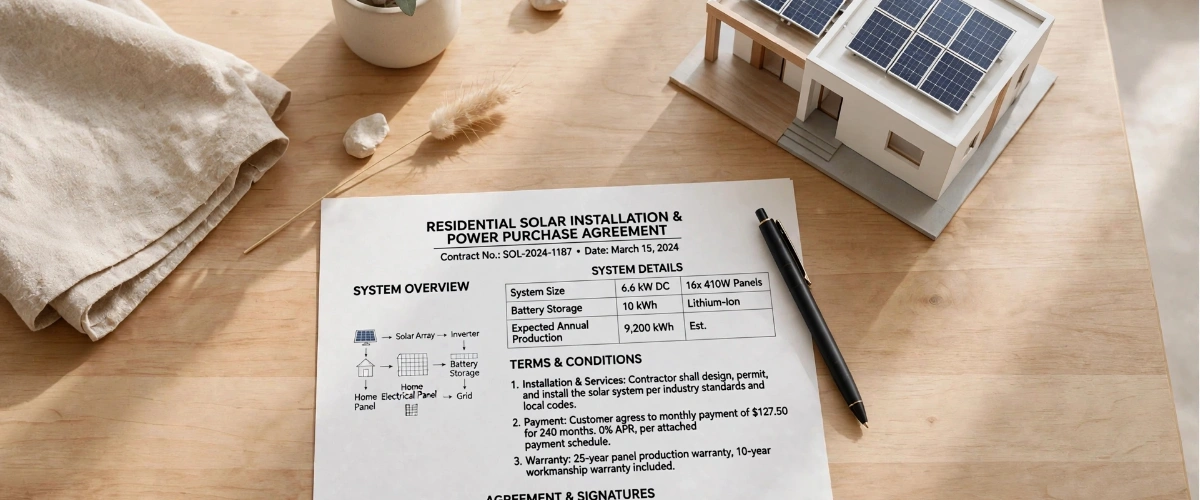
Three business days. California's Home Solicitation Sales Act lets you cancel a solar contract signed at your home or away from the seller's business, with no reason needed and no penalty.
Signing a solar contract at your kitchen table can feel final the moment the pen goes down, but California law gives you a built-in second chance. Under the state's Home Solicitation Sales Act, homeowners who sign a solar agreement away from a seller's permanent place of business get three business days to cancel, no reason required, no penalty owed. Most homeowners never hear about this protection until they need it, whether that's buyer's remorse after a high-pressure pitch or new information that changes the math. With utility rates climbing across California and NEM 3.0 reshaping what a battery actually saves you, taking those three days seriously before you commit is worth understanding in detail. Here's exactly what the rule covers, how to use it, and what your options look like if that window has already closed.
A sales rep sits at your dining table, walks through a proposal, and hands you a contract to sign that same evening. What most homeowners don't realize in that moment is that California treats this exact scenario, a sale made in your home rather than at a business location, as one that comes with automatic cancellation rights.
Lawmakers built this rule around a simple problem: high-pressure, in-home sales tend to produce decisions people regret once the salesperson leaves. Solar contracts are large, long-term commitments, often bundled with financing, so California treats them the same way it treats other big in-home purchases, with a mandatory cooling-off period. Knowing what every California homeowner should check before signing makes this window far more useful than just a legal formality.
You don't need to ask for this right or negotiate it into your contract. California Civil Code Section 1689.6, part of the Home Solicitation Sales Act, requires the seller to include a Notice of Cancellation form with every applicable contract, whether or not the salesperson mentions it during the pitch.
Not every solar sale qualifies, and the details of where and how you signed matter more than most homeowners expect.
The three day right applies when a contract is signed at your home, or anywhere other than the seller's regular place of business, such as a trade show table or a pop-up event. If you walked into a permanent showroom and signed there, different rules may apply, so it's worth checking the specific circumstances of your signature.
State law requires the cancellation notice to appear in the same language used during the sales presentation, printed in boldface type of a minimum size, and positioned near your signature line, not buried in fine print on the last page. A seller who buries or omits this notice is exactly the kind of predatory contract behavior the law was designed to catch.
The clock counts business days, not calendar days, and excludes Sundays and legal holidays. If you sign on a Friday evening, your right to cancel typically runs through the following Wednesday, giving you a full weekend to think it over without losing a day of your window.
The Home Solicitation Sales Act generally covers consumer purchases above a small dollar threshold, and a residential solar system easily clears that bar. It applies whether you're paying cash, financing through a solar loan, or using a lease or power purchase agreement, since the protection is tied to where and how the contract was signed, not how you're paying for the system.
If you decide to use this right, doing it correctly matters as much as doing it on time.
Verbal cancellation to the sales rep isn't enough. Mail, deliver, or send the signed Notice of Cancellation form to the seller's address listed on your contract, and make sure it's postmarked or delivered before midnight of the third business day.
Send the notice by a method that gives you a record, such as certified mail or a dated email to an address listed in your contract, and keep a copy of what you sent along with confirmation of when it went out. This protects you if there's ever a dispute about timing.
If you also signed a loan agreement tied to the solar purchase, cancellation of the underlying contract should void the financing too. Follow up in writing with your lender to confirm the loan has been closed out, not just paused. If your real goal is a better deal rather than walking away entirely, reviewing the essential elements every solar quote should include can help you decide whether to cancel or renegotiate specific terms instead.
The three day window isn't just a legal formality. It gives you time to double check the financial assumptions a fast-moving sales conversation may have glossed over.
Under NEM 3.0, exporting extra solar power back to the grid pays far less than it used to, which is a big part of why battery storage now drives so much of a system's real savings. A rushed signature can lock in a system sized around outdated export assumptions instead of the storage-first math that actually makes sense today.
Utility rates keep climbing across California, Texas, Florida, and Illinois, and a proposal built on last year's rate schedule can understate how fast a system actually pays for itself. Using your cancellation window to compare your solar quote against current rate assumptions is time well spent before you're locked in.
Not every installer treats this window the same way, and how a company talks about it tells you something about how they'll treat you after the sale.
US Power's CSLB-licensed consultants walk homeowners through the cancellation notice as a standard part of every in-home consultation, not something buried in the paperwork and hoped nobody reads. A 25-year comprehensive warranty covering panels, performance, and workmanship only means something if the contract behind it is just as transparent.
Factory-direct pricing 15 to 20 percent below market rate doesn't depend on rushing a decision. US Power's consultants are trained to leave homeowners the full three days without a single follow-up call pushing for a faster signature, which is part of how the company built 200+ five-star Google reviews.
Missing the window doesn't necessarily mean you're stuck, but your options narrow considerably.
Some solar contracts include their own cancellation or trial period clauses that extend beyond the state's mandatory three days. Read the fine print of your specific agreement, since a company's internal policy may give you more room than the law requires, and revisit how to vet a solar contractor before signing anything new if you decide to shop around instead.
Many contracts tie your financial obligation to project milestones, such as permitting or material delivery, rather than the signature date alone. Understanding the typical installation timeline helps you gauge how much room you actually have if installation hasn't started yet, even outside the formal cancellation period.
If a seller refuses to honor a valid cancellation notice sent within the window, California's Contractors State License Board and the state Attorney General's consumer protection division both handle complaints against solar sellers who ignore this law.
Even if you're outside the formal window and the seller is honoring the contract as written, getting a second consultation before installation begins can confirm the system size, equipment, and financing terms still make sense for your home. Reviewing common solar installer red flags at this stage costs nothing and can surface questions worth raising with your current installer before crews show up.
The three day right to cancel exists because California recognizes how much pressure an in-home sales conversation can create. Whether you use that window or not, knowing it exists changes how you approach the signature itself, giving you room to double check the numbers, the equipment, and the fine print before a decision becomes permanent. A company confident in its pricing and its contract has no reason to rush you past those three days. Before you sign anything, read the cancellation notice, understand the clock it starts, and use the time if you need it.


Before you sign a solar lease or buy, know what the contract really commits you to.
Installers just exposed the hidden cost of bargain solar. Things you should avoid.

"Three weeks later, I was generating my own power. My neighbor? Still waiting."








Copyright © 2026 US Power - Axia by QCells. All Rights Reserved.
Get an instant solar estimate using satellite!