
California homeowners face a critical choice when going solar: string inverter or microinverter? The wrong decision could cost you thousands in lost savings under NEM 3.0. Here's what you need to know before signing anything.
Most California homeowners spend weeks comparing solar panels. They obsess over brand names, watt ratings, and efficiency percentages. Then they sign a contract without giving their inverter a second thought.
That's a problem — because your inverter is the brain of your entire solar system. It determines how much energy you actually use, how well you pair with a battery, and what happens when something goes wrong.
With rising electricity costs in Southern California hitting record highs in 2026, getting this decision right has never mattered more. The difference between a string inverter and a microinverter isn't just technical — it's financial.
Before comparing the two types, it helps to understand what an inverter does. Your solar panels generate DC (direct current) electricity. Your home runs on AC (alternating current). The inverter converts one to the other.
Without one, your panels are useless. And solar panels do need an inverter — there's no way around it.
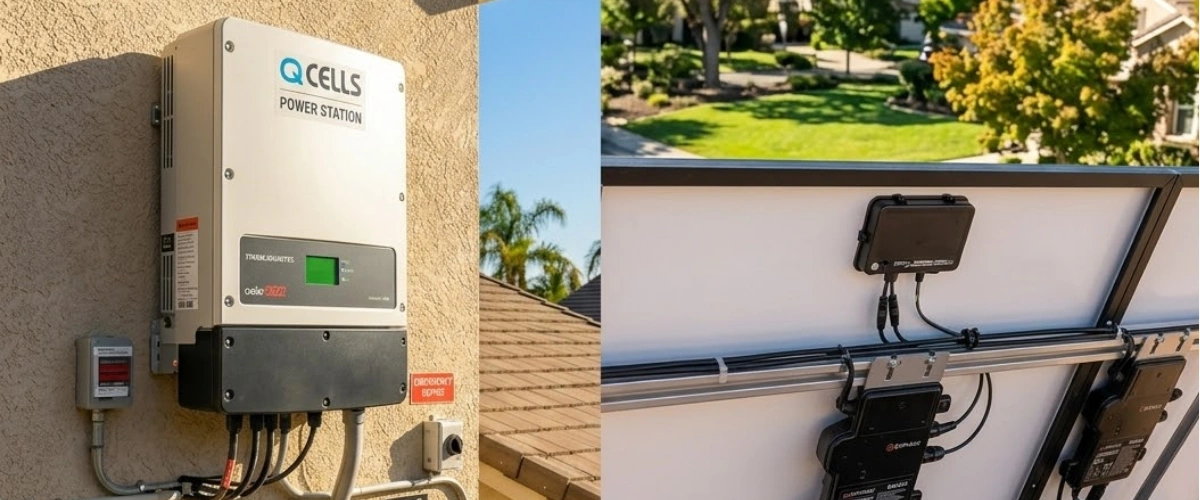
A string inverter connects all your panels in a series — like links in a chain — and converts the energy from the entire array in one centralized unit. It's typically mounted on an exterior wall near your electrical panel.
This is the older, simpler architecture. One device manages everything.
A microinverter is a small device attached directly to the back of each individual solar panel. Instead of converting energy from the whole array at once, each panel converts its own energy independently.
If you have 20 panels, you have 20 microinverters. Each one works on its own — and that distinction changes everything about how the system behaves over time.
Here's the scenario that keeps California homeowners up at night: your string inverter fails on a Tuesday in August. PG&E or SCE rates are at their peak. Your panels are soaking up sun.
And you're producing zero electricity.
With a string inverter, one failure means 100% production loss until a technician arrives and replaces the unit. That could be days — or longer — depending on availability.
With microinverters, one failure costs you about 5% of your production. The other 19 panels keep working. You don't even notice until you check your monitoring app.
Understanding what causes solar inverters to fail — heat stress, voltage spikes, manufacturing defects — helps explain why this matters. Inverters don't last forever. The question is what happens when one stops working.
There's a real tradeoff here that microinverter fans often minimize. When a microinverter fails, a technician has to climb your roof, remove the panel above it, and swap the unit. That's labor-intensive and expensive — especially if your installer is no longer in business.
A failed string inverter? Unbolt the old one from the wall, bolt the new one up, reconnect the wires. It's a ground-level job that takes a fraction of the time.
The labor cost difference is significant. Many California homeowners who installed microinverter systems years ago have found themselves with no monitoring, failed units, and no installer left to call.
Shade is where microinverters have a genuine, undisputed advantage.
In California, many homes deal with partial shading — from neighboring homes in dense LA neighborhoods, trees in the San Fernando Valley, or chimneys that cast shadows during certain hours. With a string inverter, one shaded panel drags down the output of the entire string.
Think of it like old-style Christmas lights: one bad bulb dims the whole strand.
Microinverters solve this completely. Each panel operates independently, so a shaded panel on one corner of your roof doesn't affect the rest. Panel-level monitoring also lets you see exactly which panels are underperforming and why.
If your roof faces south or southwest with no obstructions — a common setup in Southern California's inland communities — the shade advantage of microinverters largely disappears. In that case, the argument for a string inverter gets much stronger: simpler architecture, lower maintenance complexity, and better battery compatibility.
Understanding the solar panel inverter ratio for your specific system size is something a qualified consultant should walk through with you before any decision is made.
This is the part most California homeowners don't hear until it's too late.
Under NEM 3.0, the export rates for solar electricity sent back to the grid dropped dramatically. The old model — produce during the day, get paid well for exports — is largely gone. Now, the smartest move is to store your solar energy in a battery and use it yourself during peak evening hours when SCE and PG&E rates are highest.
That changes the inverter equation completely.
Batteries are worth it for solar in California — but only if your inverter architecture supports them efficiently. String inverters and hybrid inverters are designed to work seamlessly with battery storage. The DC energy from your panels flows directly into your battery without an extra conversion step.
Microinverters convert DC to AC at the panel level. To charge a battery, that AC power has to be converted back to DC. You're paying an efficiency penalty every single day — and that adds up across 25 years of operation.
Solar and battery systems protect California homes during grid failures — something increasingly important given the wildfire-related outages hitting communities across Southern California.
A hybrid string inverter paired with a battery can form its own microgrid during an outage, seamlessly keeping your home powered. Some newer microinverter systems now offer similar capability, but the integration is typically more complex and expensive to configure properly.
Most solar companies put any inverter in your system based on what's easiest to install — not what's best for your home. US Power approaches this differently.
As California's exclusive factory-direct QCells partner, US Power recommends inverter configurations based on your specific roof layout, shading conditions, energy goals, and whether you're adding battery storage now or planning to later.
That means you're not getting a one-size-fits-all answer. You're getting a system designed for your home — backed by solar panel warranties built for Southern California homes, including a 25-year comprehensive warranty covering panels, workmanship, and performance.
Because US Power works directly with QCells — American-made panels, straight from the source — you're getting pricing that's 15–20% below what most installers charge. That savings can go toward the right inverter setup, a battery, or simply back in your pocket.
With 200+ five-star Google reviews and a 3–4 week installation timeline after approval, US Power delivers on what most California homeowners say they want most: speed, transparency, and someone who actually picks up the phone.
The inverter conversation is a good litmus test for any solar company you're evaluating. If they push one option without asking about your shade situation, your battery plans, or your long-term goals — that's a red flag.
Choosing the right solar company in Los Angeles means finding a company that treats your home as unique — because it is. The installer who recommends microinverters for a shade-free south-facing roof just because it's easier to install isn't working in your interest.
Ask prospective companies these questions before signing anything: What happens if my inverter fails in year 12? How does this system handle battery storage if I add it later? Who do I call for service, and will you still be in business?
String inverter or microinverter — neither is universally better. The right answer depends on your roof, your shade, your battery plans, and the rates you're fighting against from SCE or PG&E.
What's clear is this: the inverter decision deserves as much attention as your panel choice. Get it wrong, and you're looking at efficiency losses, incompatibility with battery storage, or expensive roof-level repairs years down the line.
US Power's team will help you get it right — with factory-direct pricing on American-made QCells panels, a 25-year warranty, and a process that goes from consultation to installation in 3–4 weeks.


Your BWP utility bill just went up 9.9%. But here's how to get $3,700 back.
Real 2026 solar costs by state, no markup, no sales pitch, just the numbers.

Why solar companies want you to lease in 2026 and why ownership still wins!


Copyright © 2026 US Power - Axia by QCells. All Rights Reserved.
Get an instant solar estimate using satellite!