

Southern California homeowners pay some of the highest electricity rates in the country. Understanding the difference between kilowatts and kilowatt-hours is the first step to taking control of your bill — and your energy future.
If you've ever stared at your SCE or PG&E bill wondering what all those numbers actually mean, you're not alone. Terms like kW, kWh, and watts appear everywhere — on your statement, in solar quotes, and on every appliance in your home.
Here's the problem: most homeowners don't know the difference, and that confusion costs them money. Why your electricity bill is so high often comes down to not knowing which numbers to watch — and how to change them.
This guide breaks it all down simply. Once you understand kW versus kWh, you'll be able to read your bill clearly, size a solar system accurately, and make smarter energy decisions starting today.
Southern California homeowners face some of the highest electricity rates in the United States. As of 2026, SCE's average residential rate is 34.5¢ per kWh — roughly 71% above the national average, and up more than 80% over the past decade.
Most people pay their bill every month without really knowing what they're paying for. The numbers look technical, but they're actually straightforward once you know two things: what power is, and what energy is.
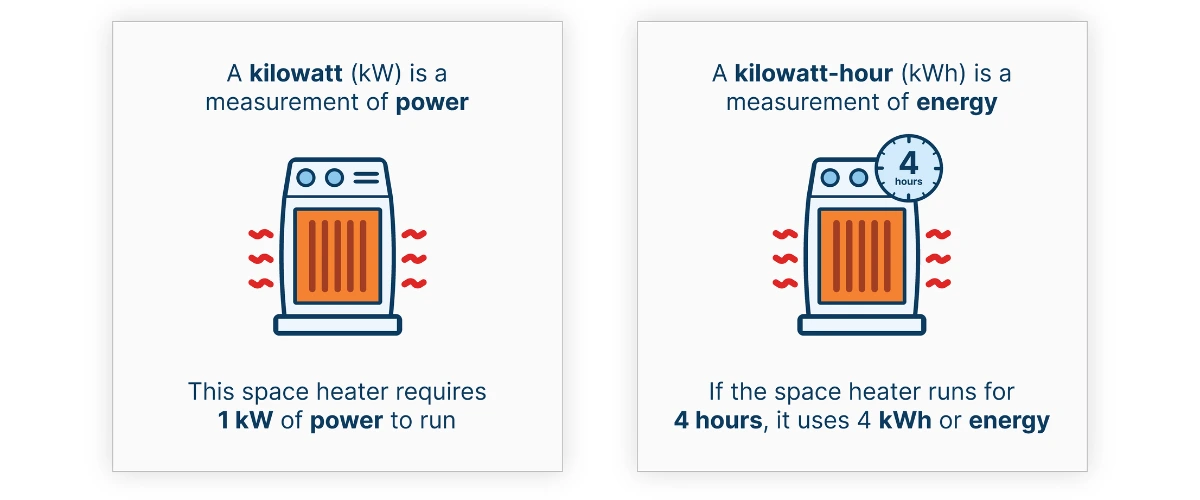
Think of it this way. Power is how fast electricity flows at any given moment. Energy is how much electricity you actually use over time.
Your utility doesn't charge you for power — it charges you for energy. And energy is measured in kilowatt-hours.
California homeowners typically use around 500–900 kWh per month, depending on home size, appliances, and habits. At SCE's current rate, a home using 600 kWh pays roughly $207 per month before fixed charges — and that number climbs hard in summer when air conditioning runs for weeks at a time.
Understanding where those kWh come from is the key to reducing them.
A watt (W) measures power — the rate at which a device draws electricity at any given second. A kilowatt (kW) is simply 1,000 watts grouped together to make the math more manageable.
Here's a quick reference for common household devices:
The conversion is simple:
Watts ÷ 1,000 = KilowattsA 4,000-watt air conditioner equals 4 kW. Nothing more complicated than that.
When a solar system is described as "8 kW," that's its peak power output — the maximum electricity it can produce under ideal sunlight conditions. This number tells you how fast the system generates power, not how much it generates over a full day or year. You'll need kWh for that.
A kilowatt-hour (kWh) measures energy over time. It's the amount of electricity consumed when a 1 kW device runs for one full hour.
The formula:
Watts × Hours ÷ 1,000 = kWhHere's a real SoCal example. Your central A/C draws 4 kW and runs for 6 hours during a hot September afternoon:
4 kW × 6 hours = 24 kWh in a single afternoon
At SCE's rate of 34.5¢/kWh, that one afternoon costs about $8.28. Run that pattern daily for 30 days and you're looking at roughly $248 just from air conditioning — before the rest of your home's usage.
This is why understanding how many kWh per day is normal for a home matters so much in Southern California, where cooling season stretches from May through October.
Your utility tracks every kWh you consume and multiplies it by the applicable rate. When SCE's rate jumped roughly 13% in late 2025, bills rose even for homeowners whose usage didn't change at all. That's the risk of staying grid-dependent — you have zero control over what each kWh costs.
Not all devices affect your bill equally. The top appliances that use the most electricity in a typical SoCal household tend to be the ones running longest or drawing the most power.
Central air conditioning dominates summer bills. A 4 kW unit running 8 hours a day burns through 32 kWh daily — over 960 kWh in a single month just from cooling one room.
Electric water heaters are the silent drainer most homeowners overlook. At around 4.5 kW running 3–4 hours daily, they add 13–18 kWh per day to your total without any obvious sign they're doing it.
Pool pumps, common across the San Fernando Valley and LA suburbs, draw 1–2 kW and often run 6–8 hours daily — adding up to 480 kWh or more to your monthly bill.
Older refrigerators run 24/7. An inefficient model from 2010 can consume nearly three times more kWh per month than a current Energy Star unit.
Knowing which devices drive your consumption gives you a precise roadmap for where solar production has the biggest financial impact.
When you receive a solar quote, you'll see two distinct figures. Understanding both prevents you from getting a system that underperforms or overcharges.
System size in kW is the panel capacity — how much power your system can produce at its peak. An 8 kW system using 400 W QCells panels requires 20 panels and produces up to 8,000 watts of electricity in perfect sunlight.
Annual production in kWh is how much energy that system actually generates over a full year, factoring in real-world sun hours, seasonal variation, and roof orientation. In Southern California, an 8 kW system typically produces around 12,000–13,000 kWh per year — enough to offset most of an average household's annual consumption.
Getting the size right matters more than most homeowners realize. Undersize your system and you'll still pay significant utility bills every month. Oversize it and you're spending more than necessary upfront without a proportional return.
The starting point is always your average monthly kWh consumption, found directly on your past 12 SCE or PG&E bills. From there, how to sizeyour solar system correctly involves factoring in your roof's orientation, shading patterns, and whether you plan to add an EV or battery storage in the future.
If you're considering battery storage alongside solar, you'll encounter both units again — this time applied to what the battery can hold and deliver.
kWh = how much total energy the battery stores (its tank size)kW = how fast it can release that energy at once (its flow rate)
A 13.5 kWh battery can store a solid amount of energy, but if its continuous power output is rated at 5 kW, you can't run more than 5 kW of appliances from it simultaneously. Pairing the wrong battery to your load profile is one of the most common and costly solar mistakes.
Practical example: Your fridge (0.2 kW) + lights (0.2 kW) + central A/C (4 kW) draws 4.4 kW total. A battery with 5 kW output handles that load. A battery with 3.8 kW output cannot keep the A/C running.
For everything you need to understand before choosing a battery, solar and battery storage explained covers sizing, compatibility, and what to expect from different storage systems available in SoCal today.
Under California's current Net Billing structure (NEM 3.0), the solar kWh your panels produce during the day offset your consumption directly. Any surplus you export earns credits, though at wholesale rather than retail rates.
How solar billing works in California explains the full mechanics, but the core insight is this: every kWh you consume directly from your own panels saves you at the full SCE retail rate of 34.5¢. That's why self-consumption — using your solar production as it happens — delivers the strongest financial return under today's billing rules.
Adding a battery amplifies this further. It stores kWh produced at midday and releases them during SCE's expensive 4–9 PM peak window, when summer rates can reach 63¢/kWh. Every kWh you discharge from battery storage instead of buying from SCE during peak hours saves you at nearly double the average rate.
Understanding residential solar system sizes helps you see exactly how production capacity translates to monthly bill reduction — in real dollar terms, based on your home's actual usage profile.
The math behind your electricity bill isn't as complicated as it looks. Watts measure the power a device draws at any moment. Kilowatts group those watts into manageable figures. Kilowatt-hours track your actual consumption over time — and that's exactly what SCE charges you for every single month.
Once you understand these units, solar becomes a straightforward financial decision: replace expensive utility kWh at 34.5¢ with your own solar kWh at a fraction of that cost, protected by a 25-year comprehensive warranty.
US Power's CSLB-licensed consultants have helped 200+ Southern California homeowners make that transition with American-made QCells panels, factory-direct pricing, and installations completed in 3–4 weeks. Your free consultation starts with your actual kWh data and ends with a custom solar plan built around your home — not a generic template.
Book your free consultation today. Your next SCE bill will thank you.


Discover why owning home solar panels saves more money than leasing over time.

Panels need storage and smart tech to meet rising energy needs and grid demands.

Check ADU solar rules and Title 24 standards to stay compliant in California.









Copyright © 2026 US Power - Axia by QCells. All Rights Reserved.
Get an instant solar estimate using satellite!