

The best solar panels for most homes in 2026 are N-type panels rated 21.5% to 24% efficient with 25-year warranties, led by Qcells, REC and Maxeon. Choosing on price alone can cost you output every hot afternoon for 25 years. Here is how the top five compare and which one fits your roof.
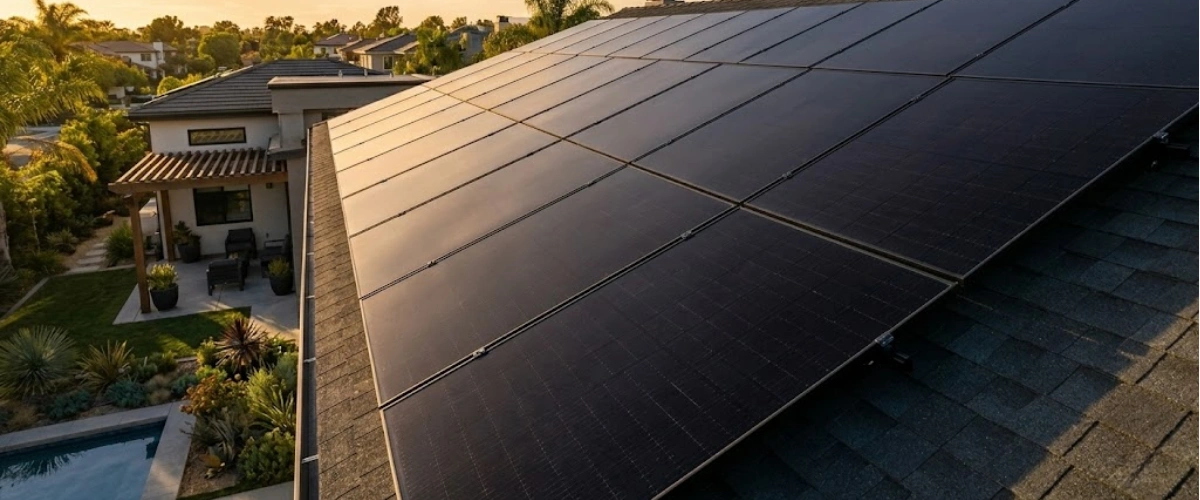
There is no single winner for every home. Maxeon leads on efficiency at up to 24.1%, REC on heat tolerance, and Qcells offers the best balance of 22.5% efficiency, a 25-year warranty, and Georgia manufacturing.
Every solar quote you get names a panel brand, and every salesperson says theirs is the best. One quote lists 22.6% efficiency, another promises a 40-year warranty, and a third is simply the cheapest. Without a way to compare them, it is hard to tell a real advantage from a sales pitch.
The good news is that the best solar panels share a short list of measurable traits, and the manufacturers publish every one of them. This guide compares five leading 2026 residential panels side by side, explains which specs actually change your savings, and shows how to pick the right one for your roof and your state.
For most homeowners, the best solar panels in 2026 are N-type panels rated 21.5% to 24% efficient, backed by at least a 25-year product warranty. The leaders on published specs are Maxeon for peak efficiency, REC for heat and degradation, and Qcells for the best balance of performance, price and U.S. manufacturing.
These figures come from each manufacturer's current datasheet or product page for its flagship residential line.
| Panel | Power | Efficiency | Temp. coefficient | Warranty | Made in |
|---|---|---|---|---|---|
| Qcells Q.TRON BLK M-G2+ | 420–440W | Up to 22.5% | -0.29%/K | 25 yr product + performance | Georgia, USA |
| REC Alpha Pure-RX | 450–470W | Up to 22.6% | -0.24%/°C | 25 yr power (>92% at yr 25) | Singapore |
| Maxeon 7 | Up to 475W | Up to 24.1% | Varies by source | Up to 40 yr (eligible markets) | Varies |
| Silfab Prime SIL-440 QD | 440W | Up to 22.6% | About -0.29%/°C | 25 yr workmanship, 30 yr performance | USA |
| Canadian Solar TOPHiKu6 | Varies | Up to 22.5% | -0.29%/°C | 12 yr product, 30 yr performance | Varies |
Efficiency differences at the top are now small. Warranty length, heat performance and who stands behind the panel matter just as much.
A 1-point efficiency gap sounds minor, but it changes how many watts fit on a small roof. On a 20-panel array, a 440-watt panel produces 400 more watts than a 420-watt panel of the same size. Over a year on a Southern California roof, that works out to roughly 600 extra kWh, about what a modern refrigerator uses in a year. If you want to translate watts into panel counts, see how many solar panels a Los Angeles home needs.
Three specs do most of the work. Efficiency gets the headlines, but heat loss and degradation decide how much power you still have in year 15.
Panels are rated at 25°C (77°F), but a dark roof in July often pushes panels to 65°C. The temperature coefficient tells you how much power you lose for each degree above the rating.
At 40 degrees over the rating, a 430-watt panel at -0.29%/°C loses about 11.6%, or 50 watts, at that moment. A panel at -0.24%/°C loses about 9.6%, and an older panel at -0.34%/°C loses about 13.6%. In the Inland Empire, Central Valley, Texas or Florida, that gap repeats every sunny afternoon.
All panels lose a little output each year. Qcells guarantees at least 90.58% of rated power after 25 years, with no more than 0.33% loss per year after year one. REC guarantees more than 92% in year 25.
Also check what the warranty covers. A product warranty covers defects in the panel. A performance warranty covers output. Neither covers the installation, so ask your installer who pays if a roof leak or wiring fault shows up in year 8.
All-black panels with black frames and backsheets blend into dark roofs and are the norm on Southern California homes. They can run slightly warmer than silver-framed panels. Our look at all-black solar panels in 2026 covers the tradeoffs.
The best panel on paper is not always the best panel for your climate. Here is what to prioritize in the four states US Power serves most.
California combines high rates, hot inland summers and NEM 3.0, which pays roughly 5 to 8 cents per kWh on average for exported solar at SCE, PG&E and SDG&E. That makes heat tolerance and output per square foot more valuable than extra exports. Prioritize a coefficient near -0.29%/°C or better and pair the array with a battery for the 4 to 9 PM peak. Homes on LADWP still get retail-rate net metering, which changes how large the array should be. Here is more on why Qcells panels suit California's climate.
Texas summers push roof temperatures as high as California's, and hail is a real risk in much of the state. Look at the panel's hail and load test ratings on the datasheet, not just efficiency, and confirm your homeowner's insurance covers rooftop solar.
In Florida, wind and hurricane exposure drive the decision. Permitting in many counties requires wind-rated racking and panels with recognized product approvals, so choose a panel your installer has already permitted locally. Heat and humidity also favor N-type panels with low degradation.
Illinois roofs deal with snow loads and cold winters, so check the panel's snow load rating. Cold actually improves panel output, which means efficiency and a strong performance warranty matter more here than temperature coefficient.
On specs alone, Maxeon wins on efficiency and REC wins on heat. For most homeowners, though, Qcells delivers the strongest overall value.
Qcells builds modules in Dalton, Georgia. In June 2026 it began producing cells at its Cartersville, Georgia plant, which Qcells calls the first U.S. factory to make ingots, wafers, cells and modules under one roof. Combined, the two sites target 8.6 GW of annual capacity. Domestic production means fewer import delays and less exposure to tariff swings. More detail is in our guide to American-made Qcells panels.
Most installers buy panels through distributors, and each step adds markup. US Power offers exclusive factory-direct Qcells pricing, roughly 15-20% below typical market pricing. That often puts a premium U.S.-built panel below the price of a mid-tier import from a typical installer.
The best panel still underperforms if the system is sized from guesswork. Every US Power consultation starts with a real 12-month bill analysis, and CSLB-licensed consultants check roof layout and shading before recommending a panel. US Power installs Qcells and other leading brands, including REC, so the recommendation follows your roof, not a quota.
The 30% federal residential solar tax credit expired on December 31, 2025, so the price you pay for equipment now matters more than it did. A panel that costs 20% more but produces 3% more power rarely pays for itself. A panel that holds output in heat and degrades slowly usually does.
The simplest test is cost per expected kWh over 25 years. Ask each installer for the system price and the estimated first-year production, then compare. You can get a first estimate for your address with the US Power solar calculator.
Under NEM 3.0, a battery often adds more value than a more expensive panel. It lets you store midday solar and use it during the evening peak instead of exporting it for a few cents. It also keeps critical circuits running during outages. Our guide to the best home solar battery in 2026 compares Qcells, Tesla and FranklinWH options.
Ask every installer for the exact model number and its datasheet. Compare efficiency, temperature coefficient and year-25 output side by side.
Check the product warranty length, the year-25 output guarantee, and whether labor for replacements is covered. A 12-year product warranty and a 25-year one are not the same deal.
Hot inland roofs reward a low temperature coefficient. Snowy or hurricane-prone roofs reward strong load ratings and local permitting experience.
The installer carries the workmanship risk for decades. Here are the red flags to watch for when choosing a solar company.
The best solar panels in 2026 are efficient N-type panels with long warranties and strong heat performance. For most homeowners, Qcells offers the best mix of performance, U.S. manufacturing and price, while REC and Maxeon make sense for specific roofs.
US Power builds every proposal from your real 12-month bill analysis, prices Qcells panels factory-direct, backs each system with a 25-year comprehensive warranty, and typically installs in 3 to 4 weeks. More than 200 five-star Google reviews come from homeowners who wanted straight answers. To see which panel fits your home, book your free 12-month bill analysis.
Pick the panel for your roof. The savings follow.


Learn how to decode your California electric bill to maximize solar savings.
Choosing the right solar system with US Power prevents costly energy mistakes.

Find the right solar system size for your California home to save energy efficiently.








Copyright © 2026 US Power - Axia by QCells. All Rights Reserved.
Get an instant solar estimate using satellite!