

US Power's Black Friday Solar Special pays $100 cashback per kW, so a 6 kW system earns $600. You need to sign by end of day November 30, 2026, and the cashback arrives after your install gets PTO. Here is how it works, what it adds up to for your system size, and what to check before you sign.

The US Power Black Friday Solar Special pays $100 cashback per kW of installed solar. Sign by end of day November 30, 2026. A 6 kW system earns $600, paid after installation and PTO.
It is Black Friday week, and your inbox is full of doorbuster deals on TVs and gadgets. Solar rarely gets a deal like that. This year, US Power is putting a real number on it: $100 cashback for every kilowatt (kW) of solar you install.
Here is how the Black Friday Solar Special works, what it adds up to for your system size, why the November 30 deadline matters, and what to ask before you sign.
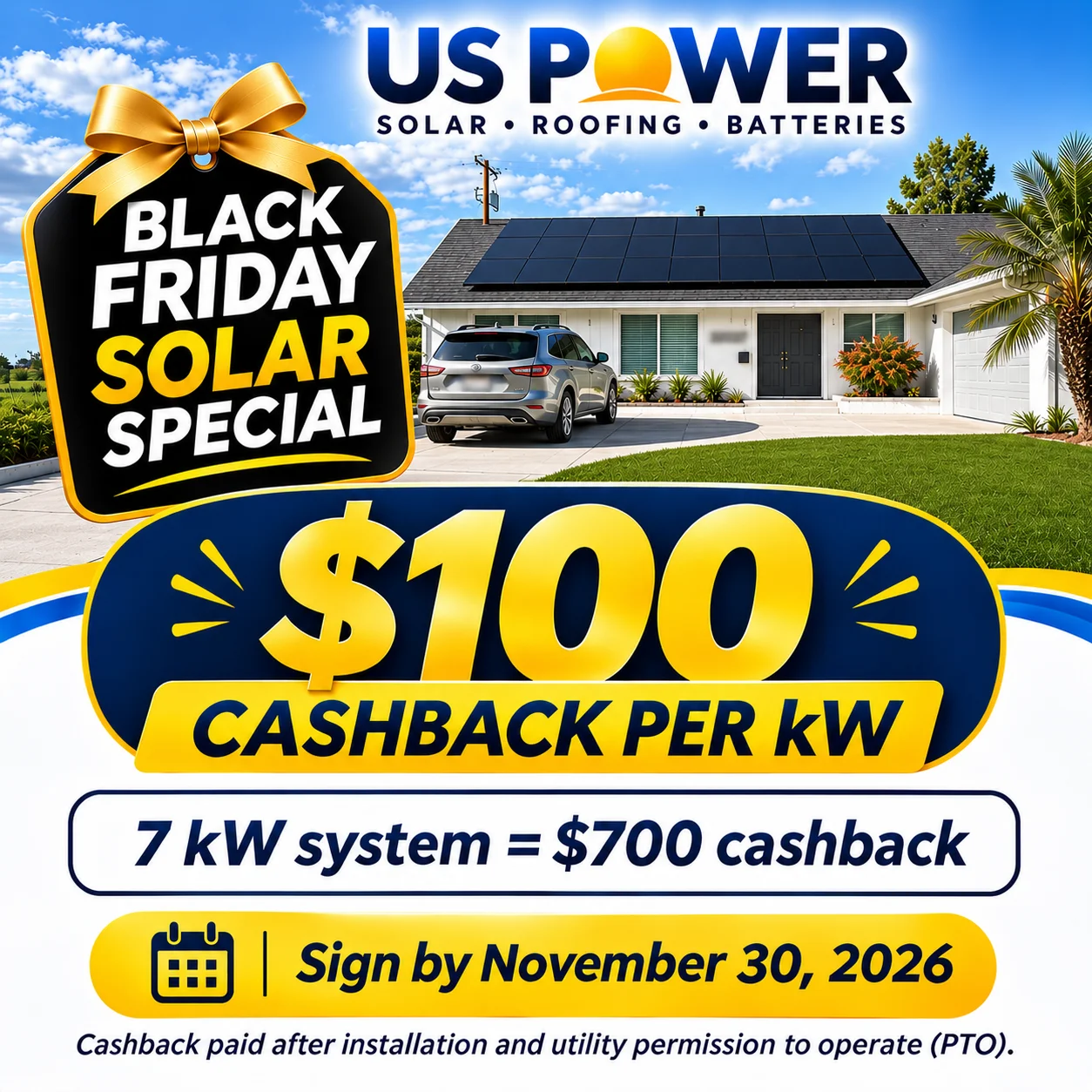
The Black Friday Solar Special pays you $100 cashback per kW of installed solar. A 7 kW system earns $700, and the amount scales with the size of your system. It applies to customers who sign a solar agreement with US Power by the deadline below.
The cashback is sent after your installation is complete and your utility grants permission to operate (PTO). PTO is the utility's approval to switch your system on and send power to the grid. You do not pay anything extra to get it, but you do need the system running before the cashback goes out.
To qualify, you need to sign your solar agreement by the end of day on November 30, 2026. Signing a proposal is not enough, so plan to review your design and contract a few days early. If you are on the fence, a free bill analysis shows you whether solar fits your home before the date passes.
The math is simple: your system size in kW times $100. Here is what that looks like for common home systems:
Not sure what size you need? A home that uses about 750 kWh a month usually needs a 6 to 7 kW system. Run your own bill through the US Power solar calculator to get a starting point.
Put $100 per kW next to real prices. October 2026 California market data puts the average quoted price at about $2.52 per watt, so $100 per kW works out to $0.10 per watt, roughly 4% of the system price. On the average 8.44 kW California system, that is about $844 back on a system that costs around $21,235 before incentives. Our California solar cost guide breaks down those numbers by size and utility.
That is a real saving, but it is a bonus on top of a fair price, not a replacement for one. Compare the total price per watt first, then count the cashback.
Yes, for most homeowners. The 30% federal residential credit ended on December 31, 2025, so systems you buy with cash or a loan in 2026 do not qualify for it. The reason solar still pays is your electric rate. In 2026, SCE's average rate is about 34.4 cents per kWh, and solar typically pays for itself in about 7 to 11 years in California. Our guide to solar incentives still available in 2026 lists what remains.
Take a 6 kW system in SCE territory at about $3.00 per watt, which is $18,000. It produces roughly 9,300 kWh a year and saves around $1,675 in its first year under NEM 3.0, based on our cost guide's assumptions. The $600 Black Friday cashback does not change that yearly saving, but it brings your net cost down to $17,400 and shortens payback by about four months.
November 30 is not only a promotion date. Two other clocks are running in California.
California law excludes a new solar system's added value from your property tax assessment. That exclusion covers systems completed before January 1, 2027. Many assessors read "completed" as fully operating with PTO, so the date you finish matters. Read the details in California's solar property tax exemption after 2026.
A typical US Power install reaches PTO in 3 to 4 weeks after signing. Permits, utility queues and your roof can add time, so no one can promise an exact date. Signing in November gives you the best chance of finishing before the year ends, and it keeps you on track for the cashback.
The special fits some homeowners better than others. You are a strong candidate if any of these describe you:
If your roof needs replacement soon, handle that first. Panels on a worn roof cost more to remove and reinstall later, and a roofer can tell you quickly whether your roof is ready.
Missing November 30 means missing the full $100 per kW, which is $600 on a 6 kW system and $1,000 on a 10 kW system. A December signing also leaves less room to finish before January 1, so the property tax exclusion becomes harder to count on. Utilities and cities slow down near year end, and a delay of even a few weeks can push PTO into the new year.
Under NEM 3.0, California utilities pay very little for exported solar, about 3.7 to 4.6 cents per kWh, while evening rates run above 30 cents between 4 and 9 PM. A battery lets you store midday solar and use it in that window instead of exporting it. In October 2026 data, a typical 13 kWh battery added about $13,480 to the price.
If you are weighing storage, read our solar battery cost guide. Ask your consultant whether battery capacity counts toward the kW used to calculate your cashback, and have that answer in writing.
You can pay for solar with cash, a loan, or a prepaid program such as Propel or Participate Energy. Each has different ownership timing and pricing. If you want to compare them, start with our comparison of Propel vs Participate vs Maxwell Power and our guide to buying versus leasing solar in 2026.
Before you choose, ask your US Power consultant how the cashback applies to the option you pick, and confirm it in your agreement. The offer terms live in your signed contract, so that is the document that counts.
Every US Power consultation starts with a real 12-month bill analysis, so your system is sized to your actual usage, not a guess. It also shows how much cashback your system size would earn.
Check the system size, panel brand, inverter, battery and total price per watt. US Power uses American-made Qcells panels from Dalton, Georgia, at factory-direct Qcells pricing that runs 15% to 20% below market.
Sign your agreement on or before the deadline. Keep a copy that shows the Black Friday Solar Special terms.
US Power's CSLB-licensed team handles permitting and installation, then works with your utility to get PTO. Most installs reach PTO in 3 to 4 weeks.
Once the installation is complete and the utility grants PTO, your $100 per kW cashback is sent to you.
Confirm the kW figure used, which is your system's rated size, and the exact dollar amount in writing.
Check that the company holds an active CSLB license. US Power consultants are CSLB-licensed, the company has more than 200 five-star Google reviews, and every install carries a 25-year comprehensive warranty.
Because cashback follows PTO, ask how delays from the utility or the city are handled. Knowing this up front avoids surprises later.
The Black Friday Solar Special gives you $100 cashback per kW, which is $600 on a 6 kW system, for signing by the end of day on November 30, 2026. It is a bonus on top of a fair, factory-direct price, with a real bill analysis behind it and a 25-year comprehensive warranty on every install.
To see what your cashback would be, book your free 12-month bill analysis or call US Power at 818-650-8010. The deadline will not move, and your electric bill will not wait either.
Offer terms: The Black Friday Solar Special requires a signed US Power solar agreement by end of day November 30, 2026. Cashback is paid after installation is complete and the utility grants permission to operate. Eligibility and final terms are confirmed in your agreement.


Arizona homeowners can now enjoy our expert solar panel installation services.

Install and activate solar by December 31, 2025, to claim the 30% federal tax credit.

AI growth is fueling grid stress—see how solar can help balance California’s energy.









Copyright © 2026 US Power - Axia by Qcells. All Rights Reserved.
Get an instant solar estimate using satellite!