
Southern California homeowners are discovering that solar panels don't always eliminate electric bills—especially under NEM 3.0. Here's why your system might go negative and what you can do about it.
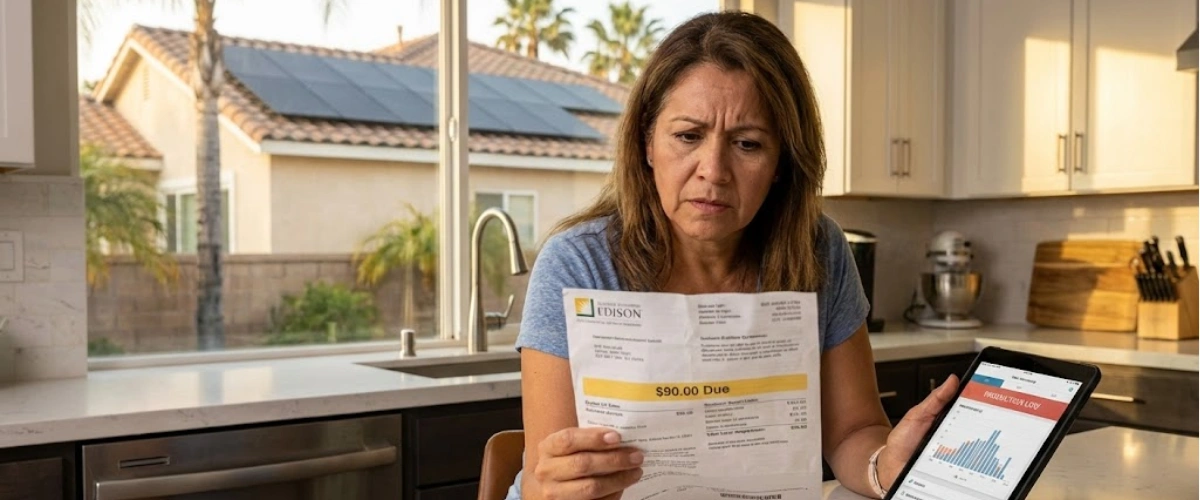
Yes, you can still get a bill. Solar only produces when the sun shines, so evening or cloudy-day use draws from the grid. Under NEM 3.0 credits for excess power are lower, so winter bills can rise.
You installed solar panels to eliminate your electric bill. For months, everything worked perfectly—you generated more than you used, banked credits with SCE or PG&E, and barely paid anything beyond the monthly connection fee.
Then winter hit. Cloudy days, shorter daylight hours, and heaters running constantly. Suddenly, you're getting bills for $70, $90, even $150. Your solar system went negative, and you're left wondering if something's broken.
Here's the truth: Your solar panels are working fine. The problem is how California's NEM 3.0 policy calculates energy credits—and why most Southern California homes now need battery storage to avoid these surprise bills.
Solar panels generate electricity based on sunlight exposure. In summer, with 14-hour days and intense sunshine, your system produces significantly more than your home uses. Under the old net metering rules (NEM 2.0), that excess energy earned you full-value credits—basically a 1:1 exchange with your utility.
California's NEM 3.0 policy, which took effect in April 2023, slashed export credit rates by about 75%. Now, when you send excess solar energy back to the grid during the day, SCE or PG&E pays you wholesale rates—often just $0.05 to $0.08 per kilowatt-hour (kWh).
But when you pull energy from the grid in the evening or on cloudy days? You pay retail rates, which can hit $0.50 to $0.65 per kWh during peak hours (4 PM to 9 PM).
The result: Your summer surplus doesn't cover your winter deficit anymore.
Los Angeles gets about 14 hours of daylight in June but only 10 hours in December. Add in frequent cloud cover during winter months, and your solar production can drop 30-40% compared to summer peaks.
Meanwhile, your energy usage often increases in winter:
One Pasadena homeowner we spoke with generated 450 kWh in July but only 280 kWh in January—while her usage stayed around 350 kWh both months. That 70 kWh deficit meant a $45 bill instead of the usual $16 minimum charge.
Many homeowners assume net metering means "zero electric bill." That was closer to reality under NEM 2.0, but NEM 3.0 operates very differently.
Under NEM 3.0, your export credits and import charges are calculated using different rate structures:
When you export excess solar (daytime):
When you import grid power (evening/cloudy days):
This means you need to export 4 to 6 times more than you import just to break even on costs.
A Van Nuys homeowner told us: "I generated 400 kWh and only used 350 kWh last month. I should have gotten a credit, right?"
Not exactly. Here's what likely happened:
Net result: Despite producing 50 kWh more than consumed, the homeowner owed $66.50.
Even when your solar production matches your usage perfectly, you'll still pay delivery charges—the infrastructure fees SCE and PG&E charge for maintaining the grid. These non-bypassable charges typically add $15-25 per month, regardless of your solar production.
The solution to going negative isn't bigger solar panels—it's battery storage. Learn why battery storage is essential under NEM 3.0 for optimal savings.
Here's the fundamental problem: Your solar panels generate peak power from 10 AM to 3 PM, but your home uses the most electricity from 5 PM to 10 PM. Without batteries, you're forced to export cheap daytime solar and import expensive evening grid power.
Batteries break this pattern. Instead of sending excess solar to the grid for $0.08 per kWh, you store it in your battery. Then, when evening peak rates hit $0.55 per kWh, you use your stored solar instead of grid power.
Real example from Sherman Oaks:
A 2,400 sq ft home with a 7 kW solar system and 13 kWh battery:
Under NEM 3.0, consuming your own solar energy is worth 5-6 times more than exporting it. A properly sized battery ensures you use virtually all your solar production rather than giving it away at wholesale prices.
Think of it this way: Would you rather sell something for $5 or use it to avoid buying the same thing for $30? That's the math batteries enable.
Many people think batteries are just for power outages. That's a nice feature, but under NEM 3.0, the real value is daily bill reduction. Your battery cycles every single day, charging from solar and discharging during expensive peak hours.
Over a year, this daily optimization saves Southern California homeowners $600-1,200 compared to solar-only systems.
The number one reason solar systems go negative? Undersizing. Many homeowners installed systems based on their average usage without accounting for seasonal variation or future needs.
If your highest-use month is 500 kWh but your average is 350 kWh, size your system for 500 kWh. Under NEM 3.0, there's no financial penalty for slightly oversizing—excess generation during high-production months earns minimal credits anyway, so you're not losing much.
The real penalty is undersizing. Every kWh you need to import costs you $0.30-0.65, while excess kWh you could export only earn $0.05-0.12.
Planning to buy an EV in the next few years? Add 300-400 kWh/month to your sizing calculation now. Retrofitting more panels later means dealing with permits, roof work, and potential NEM status complications. Understand how much solar panels cost in California to plan your investment properly.
That home office you're building? The pool you're installing next summer? The upgraded HVAC system? These all increase electrical demand. It's far easier and cheaper to size correctly the first time than to expand your system later.
Not all solar companies understand NEM 3.0's implications. Some still design systems like it's 2022, leaving homeowners with undersized arrays and surprise bills.
US Power's consultants start every project by analyzing your last 12 months of SCE or PG&E bills—not just your average usage. We identify your peak months, your time-of-use patterns, and your seasonal variations.
Then we design a residential solar panel system sized to handle your actual demand, not some generic calculation. If your bills show heavy evening usage, we'll recommend larger battery capacity. If you have high summer cooling loads, we'll size panels to handle peak production needs.
As an exclusive Qcells factory-direct partner, US Power offers pricing that's 15-20% below typical market rates. That means you can afford the right-sized system with adequate battery storage—not a compromised system that saves money upfront but costs you more every month in grid charges.
Our QCells factory-direct pricing also comes with comprehensive 25-year warranties covering panels, workmanship, and performance. No hidden fees, no surprise costs.
Most solar companies quote 8-12 weeks for installation. US Power's streamlined process with experienced local installers typically completes projects in 3-4 weeks after permits are approved.
Why does this matter? Every month you wait is another month of high SCE/PG&E bills. Our 180+ five-star Google reviews consistently mention our speed and efficiency.
With all this talk of reduced export credits and negative bills, some homeowners wonder if solar is even worth it anymore. The answer is absolutely yes—but only if you design your system correctly for 2026 conditions.
SCE and PG&E raised rates by 8-13% in 2024 and another 5-9% in 2025. Peak-hour rates now exceed $0.60 per kWh in many areas. By 2030, analysts project rates could hit $0.75-0.85 per kWh during peak times.
Solar panels lock in your energy costs. Once installed, your solar electricity costs essentially zero cents per kWh for 25+ years. As utility rates keep climbing, your savings compound year after year.
A properly sized solar + battery system in Southern California typically pays for itself in 6-8 years through utility bill savings. After that, you're essentially getting free electricity for another 17-19 years of the panels' warrantied life.
Compare that to doing nothing: A household paying $180/month now ($2,160/year) could easily pay $250+/month by 2030 ($3,000+/year) with continued rate increases.
While the federal 30% tax credit ended December 31, 2025, California still offers various state and local incentives:
US Power's consultants help you identify and claim every incentive you qualify for.
If you're tired of surprise solar bills or considering solar for the first time, here's how US Power makes the process simple.
Share your last 12 months of electric bills with our team. We'll analyze your usage patterns, identify your peak demand periods, and calculate your optimal system size. This free solar consultation comes with no obligation.
Our CSLB-licensed consultants design a system specifically for your home, roof layout, and energy needs. We'll show you exactly how much you'll save with different battery configurations and help you choose the right balance of upfront cost and long-term savings.
Get a detailed quote with no hidden fees. We offer flexible financing options including $0 down for qualified homeowners, making solar + battery systems accessible without requiring large upfront payment.
Once you approve the design, we handle permits, utility interconnection, and installation—typically completed in 3-4 weeks after approval. Our experienced installers minimize disruption to your daily routine.
After installation, you'll have access to monitoring tools showing your production, consumption, and savings in real time. Our 25-year warranty means we're invested in your system's long-term performance.
Solar panels going negative on your bill isn't a system failure—it's a design problem. How NEM 3.0 changed everything requires proper system sizing and battery storage to maximize savings.
The good news? With the right design from US Power, you can eliminate surprise bills, lock in predictable energy costs, and protect yourself from utility rate increases for the next 25 years.
Don't wait for your next high electric bill. Schedule a free consultation with US Power today and see exactly how much you could save with a properly designed solar + battery system.


Find out which inverters and batteries will work best with Qcells solar panels.

The perfect solar tilt angle can make your California system more efficient.

Check ADU solar rules and Title 24 standards to stay compliant in California.







Copyright © 2026 US Power - Axia by QCells. All Rights Reserved.
Get an instant solar estimate using satellite!