

Even with the base charge, solar savings hold up in 2026.
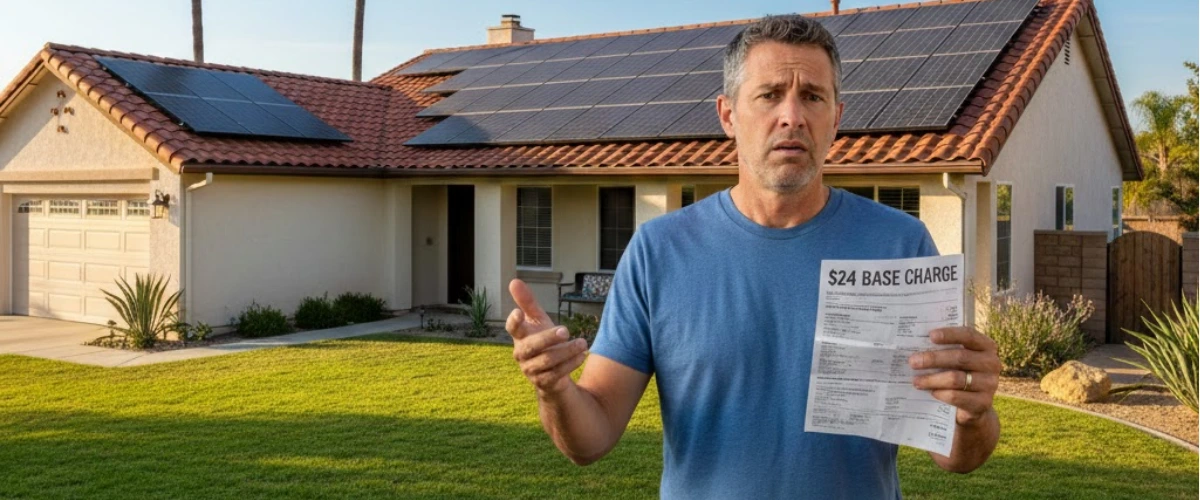
If you went solar expecting a zero dollar bill and are still seeing a monthly charge, the base service charge is usually why. This guide breaks down what that fixed charge covers, how it affects your total savings, and what still makes solar worth it in 2026.
California's major utilities, including PG&E and SCE, apply a fixed monthly service charge to all residential customers, solar or not. It covers grid maintenance and infrastructure costs and does not decrease no matter how little electricity you pull from the grid.
Homeowners without solar barely notice the base charge because it is a small part of a much larger bill. Solar customers, who might otherwise have a bill close to zero, see the base charge as effectively their entire remaining bill, which can feel confusing if you were not expecting it.
The base service charge is a fixed monthly amount, small relative to what most Southern California households were paying before solar. Even accounting for it every month, the majority of homeowners still see the large majority of their previous bill eliminated.
Factoring the base charge into your payback calculation typically adds a modest amount of time to your break-even point, generally measured in months rather than years, when weighed against total lifetime savings from a properly sized system.
A battery does not eliminate the base service charge, since that fee applies regardless of your grid usage. What a battery does is reduce how much you pull from the grid during peak rate hours, which under NEM 3.0's reduced export credits has become one of the more effective ways to control your total bill.
Understanding why electricity rates keep climbing in Southern California helps put the base charge in perspective. A fixed monthly fee looks small next to a usage rate that has been rising steadily, which is exactly why solar and battery savings continue to grow relative to the alternative of staying fully on the grid.
A properly designed system accounts for the base charge and your actual usage pattern from the beginning, rather than promising a zero dollar bill that was never realistic. Correctly sizing a system to your real usage avoids both overpaying for excess capacity and underestimating your true monthly cost.
US Power's factory-direct partnership with Qcells keeps equipment pricing 15 to 20 percent below typical market rates, which means a lower total system cost going in, backed by CSLB-licensed consultants and a 25-year comprehensive warranty on every install.
Some sales quotes present savings figures that quietly ignore the base service charge, making the projected bill look lower than reality. Ask specifically whether your quoted savings already account for the fixed monthly fee.
Since the base charge is unavoidable regardless of system size, the more useful design question is how much of your usage-based charges the system eliminates, not whether it hits zero. A consultant who explains this clearly is generally giving you a more honest picture than one who does not mention it at all.
The base service charge is a real, fixed cost that solar cannot eliminate, but it is a small piece of the overall savings picture for most Southern California homeowners. Between factory-direct equipment pricing and continually rising utility rates, solar paired with a properly sized system, and battery storage where it makes sense, still delivers substantial savings even with that fixed fee factored in.



Solar Industry in 2025 is evolving fast with major updates homeowners should know.
Follow this guide to find a trusted and reliable solar installers in your local area.
Your solar panels handle the storm fine. Without a battery, your power will not.








Copyright © 2026 US Power - Axia by QCells. All Rights Reserved.
Get an instant solar estimate using satellite!