

PG&E's solar export credit dropped nearly 75% under NEM 3.0. Here's what it pays in 2026 and how to still maximize your savings.
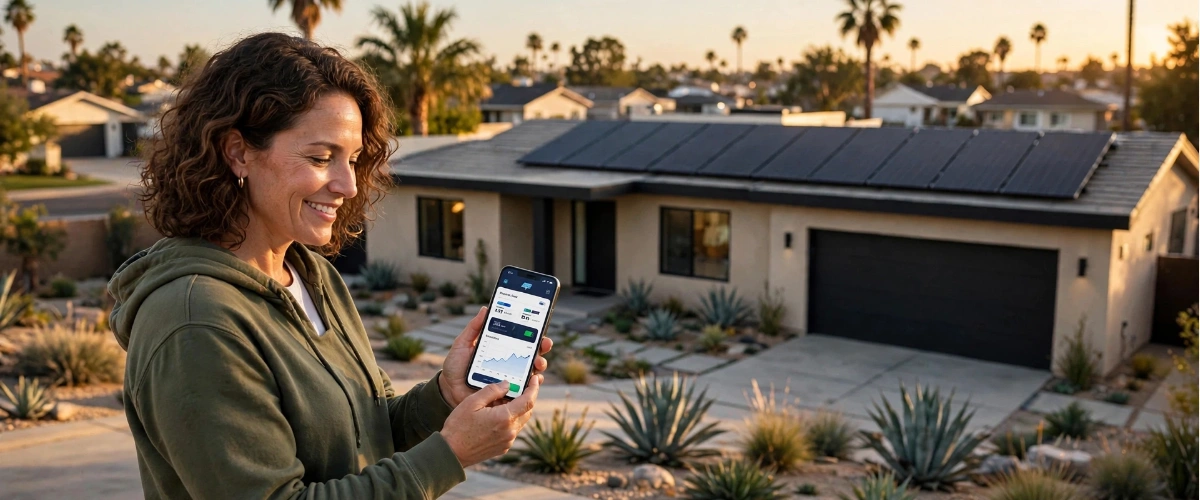
Most PG&E NEM 3.0 customers see export credits averaging roughly $0.05 to $0.09 per kWh for midday production, with higher values at evening peak. Your rate depends on your interconnection date and plan.
You installed solar to stop overpaying PG&E. Then you heard your export credit isn't what your neighbor got two years ago, and now you're wondering if the math still works.
Here's the short answer: PG&E pays far less for exported solar power in 2026 than it did before. But that doesn't mean solar stopped paying off. It means the strategy changed. This guide breaks down the real numbers, why they dropped, and how California homeowners are still cutting their power bills in half.
If you're comparing notes with a neighbor who installed solar in 2021, the numbers won't match. PG&E overhauled how it compensates homeowners for the power their panels send back to the grid, and the change was significant.
California's Net Billing Tariff, known as NEM 3.0, replaced the old one to one credit system. Under NEM 2.0, exporting a kilowatt-hour of solar power earned you close to the same rate you'd pay to buy it back. Under NEM 3.0, that credit is based on the "avoided cost" to the utility, not the retail price you pay.
The result: export credits fell by roughly 75%. Instead of earning close to $0.30 per kWh, most PG&E solar customers now see closer to $0.05 to $0.09 per kWh for midday exports, with brief evening spikes during peak demand hours.
As of 2026, PG&E's average residential rate sits around $0.39 per kWh, and peak pricing under plans like E-TOU-C can climb well above $0.45 per kWh during summer evenings. Meanwhile, your export credit for that same kilowatt-hour is often a fraction of what you're paying to buy power back. That gap is the whole story of solar economics in 2026.
Homeowners who locked in their system before April 2026 may still qualify for NEM 2.0 style billing for a limited window, but new interconnections fall under the current export structure. If you're unsure which tariff applies to your home, one of our CSLB-licensed consultants can pull your account details and explain it in plain terms.
It helps to understand why the credit dropped so sharply, because it changes how you should design your system going forward.
PG&E no longer credits your exports at the retail rate. Instead, it uses California's Avoided Cost Calculator, which estimates what it would have cost the utility to generate or buy that power elsewhere. That number moves hour by hour and season by season. Midday exports, when solar production is highest and grid demand is lowest, are worth the least. Evening exports during peak demand can be worth significantly more, sometimes spiking during extreme summer conditions.
Homeowners who locked in their interconnection date earlier may also qualify for an ACC Plus adder, a small bonus credit added on top of the base export rate for the first several years of the program. It's modest, but it adds up over time.
The rate plan PG&E puts you on also shapes what solar is actually worth to your household. Whether you're on E-TOU-C, E-TOU-D, or E-ELEC, your peak hours, off-peak pricing, and baseline allowance all differ. We've broken down PG&E's rate plan comparison in detail if you want to see which one fits your household's usage pattern. Picking the right plan can shift your annual bill by hundreds of dollars either direction.
None of this means solar stopped making sense in California. It means the winning strategy shifted from exporting as much power as possible to using more of it yourself.
Under NEM 2.0, sending extra solar to the grid was the smart move. Under NEM 3.0, it's often the opposite. A home battery lets you store the cheap midday power your panels produce and use it during PG&E's expensive evening peak hours instead of buying it back at $0.45 or more per kWh.
This is why most new California solar systems now pair with solar battery storage options. It's not an upsell, it's become the core of how solar actually pays for itself under current rules. Many homeowners also pair batteries with an EV charger or backup power setup, and adding a meter collar for battery backup can make that installation faster and cheaper by skipping an expensive panel upgrade.
Oversizing a solar system to bank export credits made sense years ago. It doesn't anymore. A system matched closely to your actual household usage, sized with room for future needs like an EV or heat pump, tends to deliver a better return than a bigger array chasing export income that barely exists. This is one of the biggest mistakes we see in current solar installation costs in California: homeowners paying for capacity they'll never use efficiently.
A lot of proposals floating around Southern California are still built around outdated export assumptions. That's how homeowners end up disappointed with their first bill.
As an exclusive factory direct partner for factory-direct Qcells solar panels, we design systems around how much power your home actually uses, not how much you can technically fit on your roof. Every system comes with a 25-year comprehensive warranty covering panels, workmanship, and performance, so you're not gambling on equipment that underdelivers a decade in.
Every month you wait is another month at PG&E's current rates. US Power moves from approval to installation in 3 to 4 weeks, and we offer flexible solar financing options so getting started doesn't require a lump sum upfront. Our CSLB-licensed consultants walk through transparent pricing with no hidden fees before you sign anything.
Lower export credits change the shape of your savings curve, but they don't erase it. Understanding where the real value comes from helps you set realistic expectations before you sign a contract.
Export income was never the main driver of solar savings, even under NEM 2.0. The bigger win has always been avoiding retail rate increases altogether. PG&E's rates have climbed steadily for years, and every kilowatt-hour you generate and use yourself is one you never have to buy at whatever PG&E charges next summer. That's the math that still holds up strongly in 2026, even with smaller export credits.
If you already have solar without a battery, retrofitting one used to mean an expensive panel upgrade. A meter collar changes that by connecting new equipment directly at the meter instead of your home's main panel, often saving thousands and weeks of permitting. It's one of the simplest ways to adapt an older NEM 2.0 system to make the most of today's rate structure.
PG&E's export credit dropped, and it's not going back to what it used to be. But the homeowners seeing real savings in 2026 aren't chasing export income. They're using a properly sized system, often paired with a battery, to avoid PG&E's rising rates altogether. That shift in strategy, not a bigger roof full of panels, is what makes solar worth it today.


When solar installers cover your dryer vent, your problems are just beginning.

Understand how to manage and minimize your ongoing solar costs in California.

Save on bills by tackling phantom loads with Qcells solar solutions through US Power.








Copyright © 2026 US Power - Axia by QCells. All Rights Reserved.
Get an instant solar estimate using satellite!