

Powerwall price varies wildly depending on who you ask. Here is a straightforward breakdown of what installing a Tesla Powerwall with Qcells solar actually costs Southern California homeowners in 2026.
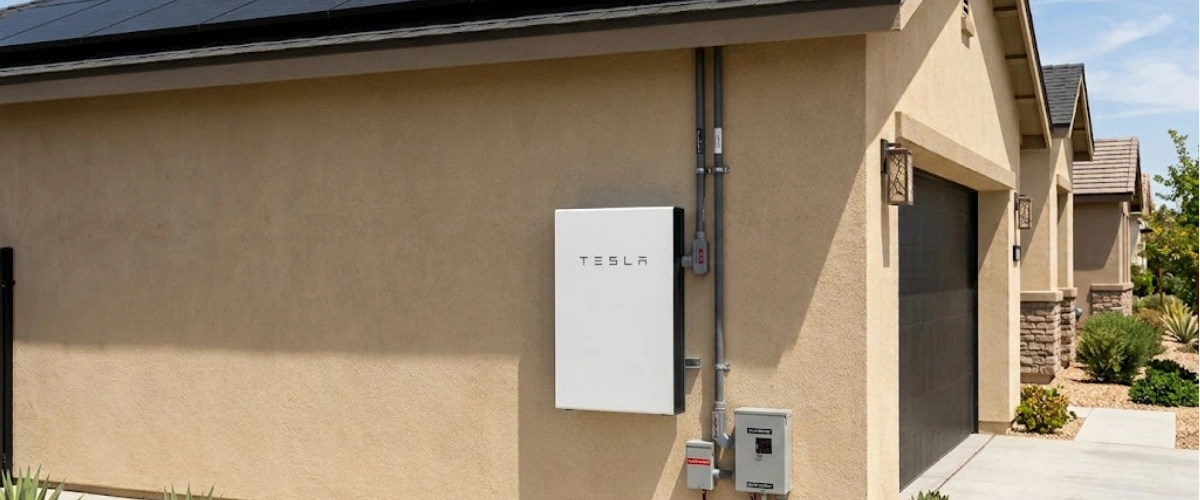
Yes. A Tesla Powerwall can integrate with Qcells solar as long as the hybrid inverter supports Tesla's control logic. Installers document compatibility and warranty coverage in writing before installation.
Powerwall price alone never tells the full story of what you actually pay to get one installed and working with solar, and most of the pricing content online treats the battery like a standalone product instead of part of a system.
This guide breaks down the real cost of installing a Tesla Powerwall alongside Qcells solar panels in 2026, what pushes that number up or down, and how to avoid the markups that inflate so many Southern California quotes. By the end, you should be able to look at any quote you receive and tell whether it is fair, inflated, or missing something important.
Tesla's published powerwall price covers the battery hardware itself. It does not include the labor, permitting, electrical panel work, or backup hardware that turns that battery into a working whole-home system. Two homeowners can pay very different totals for the exact same battery, depending entirely on how the rest of the installation is designed.
This is why comparing quotes purely on the sticker price of the battery leads to confusion. A quote that looks cheaper on paper can end up costing more once you account for a poorly designed backup setup, and a quote that looks expensive upfront can actually be the fairer price once every component is accounted for correctly.
Yes, and it is a common pairing across Southern California. For the full technical rundown on inverter compatibility, voltage limits, and warranty considerations, see our full technical breakdown of Qcells and non-Qcells batteries. This guide focuses specifically on what that pairing costs.
This single decision swings your total cost by thousands of dollars. Many installers default to a Tesla Gateway 3 and a new subpanel when a simpler Tesla Backup Switch vs. Gateway 3 setup would deliver the same whole-home backup for far less. For a standard 200-amp home, that unnecessary hardware is often the biggest hidden cost in a Powerwall quote.
Ask any installer to explain both options and justify whichever one they are recommending. If they cannot walk you through the tradeoff clearly, or if they claim your panel is "full" without offering breaker consolidation first, that is a sign the quote may be padded with equipment you do not need.
A single Powerwall covers moderate evening usage, but homes with higher consumption may need two. Properly sizing your solar and battery system to your real load, rather than a generic estimate, keeps you from paying for capacity you will never use or underbuying and running out of power mid evening.
The right approach starts with your actual evening usage between 4 PM and 9 PM, since that is when SCE's peak rates hit hardest and when your battery does the most financial work. A consultant who skips this step and jumps straight to a battery count is sizing based on guesswork, not your household.
When paired with a factory-direct Qcells solar system, most Southern California homeowners see a Powerwall installation land in a moderate range once labor, backup hardware, and permitting are included, well above the standalone battery price Tesla lists but often well below what oversized or overcomplicated designs quote. The exact cost of a Powerwall for your home still depends on your panel, your backup goals, and whether a subpanel upgrade is genuinely needed.
Two Powerwalls roughly doubles the battery cost but rarely doubles the labor and permitting portion, which is why households needing more storage often find the second unit is proportionally cheaper than the first. This is worth discussing directly with your consultant if your usage suggests you may need more than one.
California's Self-Generation Incentive Program can meaningfully offset the cost of installing a Tesla Powerwall. Learn more about SGIP rebates for home batteries and whether your household qualifies for standard, equity, or equity resiliency incentive tiers before you finalize a quote.
A correctly sized, correctly configured Powerwall pays for itself by shifting usage away from expensive peak hours. A misconfigured one can leave you still paying Edison after going solar, which is one of the most common and expensive mistakes we see homeowners inherit from other installers.
The most common version of this mistake is a battery that exports excess solar to the grid instead of storing it for the evening peak window. Under current NEM rules, that exported power earns pennies on the dollar, while the same energy stored and used during peak hours can be worth several times as much. Getting this setting right at installation, not months later, is what actually determines whether your Powerwall pays for itself on schedule.
While the Powerwall itself comes from Tesla, the solar panels charging it do not have to carry a reseller markup. US Power's factory-direct Qcells partnership keeps the solar portion of your system 15 to 20 percent below typical market rates, backed by CSLB-licensed consultants and a 25-year comprehensive warranty on the panels.
Runtime depends heavily on your usage and backup goals. Here is how long a solar battery can actually power your home during an outage, based on real household scenarios rather than marketing estimates.
Your Powerwall's return on investment depends heavily on which SCE plan you are on. Choosing the best SCE rate plan for solar and battery owners can shift hundreds of dollars a year in savings without changing a single piece of hardware. If you are still weighing your options, US Power's solar battery storage solutions page compares Powerwall against other battery options side by side.
The cost of a Powerwall paired with Qcells solar comes down to backup hardware choices, correct sizing, and available rebates, not a single number pulled from Tesla's website. Homeowners who get the design right the first time avoid the thousands in unnecessary costs that come from an oversized Gateway 3 setup or a misconfigured battery.
If you already have a Powerwall quote in hand, it costs nothing to have a second set of eyes review it before you sign. Every rate increase makes that first quote more expensive to delay.


Cold weather boosts solar efficiency. CA homeowners: maximize year-round savings.

Discover why US Power homeowners prefer QCells for long-lasting solar energy.

Your PWP bill keeps rising. Here's how Pasadena homeowners are fighting back.








Copyright © 2026 US Power - Axia by QCells. All Rights Reserved.
Get an instant solar estimate using satellite!