

Electric bills are rising fast in 2026. The national average is now $165/month, but homeowners in California, Texas, Florida, and Illinois often pay far more. This guide breaks down what you're actually paying, why it keeps climbing, and how solar changes the math permanently.
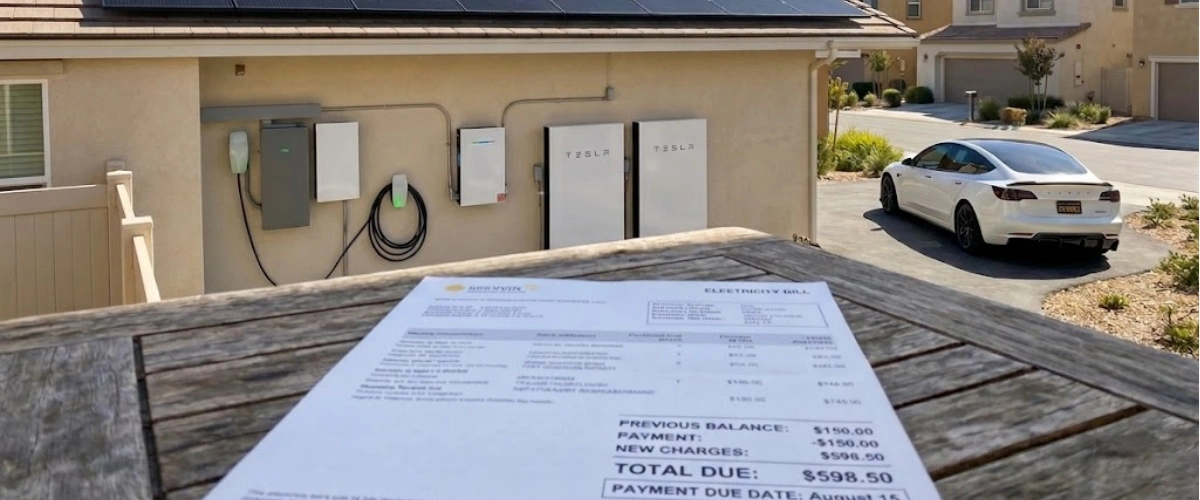
If your electricity bill feels harder to manage every year, the data backs you up. U.S. residential electricity rates rose 7.4% year over year as of early 2026, pushing the national average to around $165 per month. For homeowners in California, Texas, Florida, and Illinois, that number is often much higher. Understanding what you're actually paying — and what is driving it up — is the first step toward deciding whether solar makes financial sense for your home.
The U.S. average electric bill sits at approximately $165 per month in 2026, based on a residential rate of around 18.7 cents per kWh and average household consumption of 875 kWh monthly. That figure is a useful benchmark, but it masks a wide range of what homeowners actually pay.
California is one of the most expensive states in the country for electricity. Homeowners served by SCE, PG&E, or SDG&E are averaging an estimated $235 to $260 per month in 2026, nearly double the national per-kWh rate. Summer months push bills even higher, with some Southern California households seeing charges above $400 when air conditioning runs continuously.
Texas sits closer to the national average at around 15.4 cents per kWh, but ERCOT grid volatility means summer spikes are real. Florida homeowners deal with high year-round consumption because of heat and humidity — HVAC accounts for over 50% of total electricity use in hot-climate states. Illinois residents in deregulated markets can shop providers, but seasonal swings still drive bills above average during peak months.
Your monthly charge is not just a cost per kilowatt-hour. Transmission fees, delivery surcharges, baseline allocations, and state taxes all stack on top of your usage. In California, these fixed line items can add $30 to $60 per month before you've used a single watt of power. Many homeowners are surprised to find that even with low usage, the bill barely budges because of these unavoidable charges.
The 7.4% year-over-year increase recorded in early 2026 is not a one-time event. It is part of a consistent upward trend driven by aging grid infrastructure, surging demand from data centers and EVs, and utility capital investments that get passed to customers through rate increases.
SCE customers saw an average 10% rate increase in 2025 alone, adding roughly $17 to $20 per month to typical household bills. Understanding SCE's Solar Billing Plan changes matters because it shapes not just what you pay now, but how much more you will owe if you stay on utility power. For PG&E customers, choosing the PG&E rate plan that saves you the most with solar makes a significant difference in net monthly costs once a solar system is in place.
A California homeowner paying $240 per month today, with a conservative 5% average annual rate increase, will be paying over $380 per month within seven years. Over a decade, that is more than $35,000 sent to a utility company with no return and no end. That compounding math is what drives most homeowners to finally act.
Solar panels generate electricity from sunlight and offset the kilowatt-hours you would otherwise pull from the grid. Every kWh your system produces is one you don't pay for. In states with high per-kWh rates, that offset creates real monthly savings quickly.
Homeowners who go solar with a properly sized system consistently see their utility charges drop sharply. A Southern California homeowner with good roof exposure often sees their SCE or PG&E charge fall to the minimum connection fee — typically $10 to $30 per month. Summer months frequently produce more power than the home uses, building bill credits that offset winter months when output naturally dips. California winter solar production numbers from real 2026 data confirms that a well-sized system delivers year-round, not just in summer.
Under California's current billing structure, the credit rate for excess power exported to the grid is significantly lower than under the previous program. Pairing solar with a battery lets you store daytime power and use it at night when utility rates are highest, which is now the most financially effective configuration for California homeowners and increasingly for those in Texas and Florida too.
The most common hesitation is the system price. A typical residential installation in California runs between $18,000 and $28,000 depending on size and whether battery storage is included. The comparison that matters is not the sticker price versus your monthly bill. It is the monthly loan payment versus the bill it replaces.
When financed over 10 to 15 years, most solar systems carry a monthly payment that lands near or below the electric bill it eliminates. A homeowner previously paying $180 to $200 per month often finds their solar loan comes to around $150 to $160 per month, plus a small connection fee. The immediate savings may be modest. But the loan payment is fixed. The utility bill was never going to stay the same.
Get a detailed solar panel cost estimate for your home to see how your usage, roof setup, and local rates affect the real comparison before signing anything.
Ownership delivers greater long-term savings than leasing. When you own your system, all the power it generates belongs to you. Once the loan is paid off, that power is essentially free. With a lease, you pay an escalating contracted rate that typically increases 1 to 2% annually. For a detailed breakdown for Los Angeles, solar PPA vs. ownership in Los Angeles covers the numbers side by side. For the broader Southern California picture, solar PPA vs. financing in Southern California walks through how the math shakes out now that the federal credit is off the table.
Not every solar installation delivers the same result. The savings a homeowner sees depend on factors that have nothing to do with the panel brand.
A system that is too small leaves you drawing from the grid more than necessary. One that is oversized won't return full value either. The right solar system size for your home calculation starts with your annual kWh consumption and works backward. South-facing roof space in California generates significantly more power than east or west-facing installations — getting sizing right is where savings are won or lost.
Under NEM 3.0, power exported to the grid during peak solar hours earns a much lower credit than it once did. That makes storage a core financial decision rather than an optional add-on. Reviewing your battery storage options for your solar system before finalizing your design is the best way to lock in maximum monthly savings from day one.
Choosing the wrong installer can undermine even the right financial decision. An undersized system, substandard panels, or a contractor who disappears after installation can turn a smart investment into a frustrating one.
US Power is the exclusive factory-direct QCells partner in California, Texas, Florida, and Illinois. With no distributor markup, the pricing advantage passes directly to you — typically 15 to 20% below what other installers charge for comparable equipment. American-made QCells panels and factory-direct pricing explains what makes this supply chain different and why it matters for long-term performance and price stability.
For a full picture of what a US Power project includes, residential solar installation in California covers the process from design through utility interconnection. CSLB-licensed consultants handle permitting and approvals. The 25-year comprehensive warranty covers panels, workmanship, and performance from day one.
Start with a quick get your solar savings estimate to see your real numbers before rates climb again.
Every dollar sent to a utility company builds no equity, earns no return, and comes back larger the following month. Solar converts that spending into a fixed, time-limited investment that pays you back for the life of your home. In California, where rates are already close to double the national average, the case for acting now is as clear as it has ever been. US Power's factory-direct pricing, 25-year warranty, and 3 to 6 week installation timeline remove most of the friction that keeps homeowners waiting.



Rising rates and changing policies are pushing SoCal homeowners to go fully solar.

Choose trusted solar experts for quality panels, reliable setup, and lasting savings.

Step-by-step guide to securing solar permits for your California home property.








Copyright © 2026 US Power - Axia by QCells. All Rights Reserved.
Get an instant solar estimate using satellite!