

Net metering sounds like one statewide rule, but NEM 3.0 pays out differently for SCE versus SDG&E customers. Both utilities value exported solar power with the same Avoided Cost Calculator, yet different time of use plans, non bypassable charges, and baseline rates change what lands on your bill. This guide breaks down SCE's TOU-D-PRIME plan, SDG&E's higher baseline rates, and how battery storage shifts the payback math in both territories, so you can size a system around your real utility.
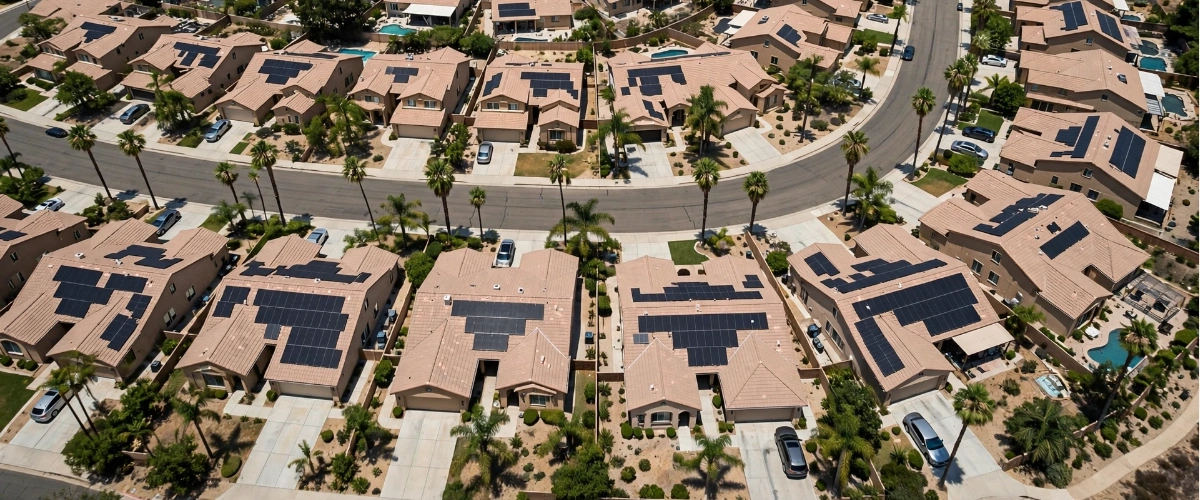
Both SCE and SDG&E value exports with the same Avoided Cost Calculator under NEM 3.0, but different time of use plans, non-bypassable charges, and baseline rates change what lands on your bill.
"Net metering" sounds like a single, fixed policy, but if you live in Southern California, the utility stamped on your bill quietly rewrites the math. Southern California Edison and San Diego Gas and Electric both operate under the state's NEM 3.0 rules, officially called the Net Billing Tariff, yet the credit you earn for every kilowatt hour your panels export, the fees layered on top of it, and the rate plan it all sits inside are not identical between the two utilities. Homeowners comparing quotes across SCE and SDG&E territory often assume net metering means the same thing everywhere, then get surprised when a neighbor two cities over reports a completely different payback timeline. Here's how NEM 3.0 actually works, what changes utility to utility, and what it means for sizing a system correctly.
The California Public Utilities Commission sets the statewide framework for NEM 3.0, but SCE and SDG&E each layer their own rate design, fees, and default plans on top of it. A kilowatt hour exported from a rooftop in Riverside under SCE and a kilowatt hour exported from a rooftop in Chula Vista under SDG&E are valued using the same underlying export credit table, yet the total bill impact rarely matches, because the two utilities apply different time of use windows, non bypassable charges, and generation rate structures around that shared export value.
Sales conversations often describe net metering in general terms, you get paid for what you send back, without naming which utility's rate plan the numbers actually assume. A proposal built on SCE's default residential rate can understate or overstate what an SDG&E customer would really see, which is exactly why comparing your solar quote against your current utility's plan matters more than comparing it against a generic statewide average.
Under NEM 3.0, both SCE and SDG&E compensate exported solar power using the same statewide Avoided Cost Calculator, a CPUC maintained schedule that estimates the value of solar energy to the grid at a given hour and month, rather than simply crediting the retail rate you would otherwise pay. Midday export, when the grid is already flooded with solar power statewide, is typically worth far less than power exported during the early evening peak, so the hour you send electricity back matters as much as how much you send.
Every kilowatt hour you pull from the grid, even in a home with solar and a battery, carries a small non bypassable charge that covers costs like wildfire mitigation and low income programs. These charges apply the same way whether you're an SCE or an SDG&E customer, and solar production cannot offset them, so they show up on every bill regardless of how large your system is.
Because export credit follows the Avoided Cost Calculator's hourly schedule rather than a flat retail rate, the same solar panel producing the same amount of power looks different from one month to the next, and different again depending on whether that power leaves your house at noon or at six in the evening. This is the mechanic that makes battery storage central to NEM 3.0 economics in both utility territories, since shifting your own export or usage to a higher value hour recovers savings a straight grid tie system leaves on the table.
A free consultation walks through your specific utility's numbers instead of a statewide average.
SCE's standard rate plan for new solar customers is TOU-D-PRIME, a time of use structure that replaced the older TOU-D-4-9PM plan for most new applicants, though some existing customers remain on legacy plans. Understanding SCE's time of use rates and which hours cost the most is essential before assuming your export credits will offset your import costs one for one.
SCE's peak pricing window generally runs through the early evening hours, which is also when the Avoided Cost Calculator tends to assign its highest export value, so timing a battery to discharge stored solar power during that window, rather than exporting it at midday, is usually the single biggest lever SCE customers have over their real NEM 3.0 savings.
Getting Permission to Operate from SCE follows the state's Rule 21 interconnection process, but SCE's own processing queue and inspection scheduling shape how long that final step actually takes, which is worth understanding before assuming a system will be exporting on day one. Delays in SCE's PTO process are common enough that homeowners in SCE territory should plan around them.
SDG&E has carried some of the highest residential electricity rates in California for years, and that baseline shapes NEM 3.0 economics differently than it does for SCE customers, since a higher starting import rate means every kilowatt hour you avoid buying from the grid is worth more, even while your exported kilowatt hours are compensated on the same statewide Avoided Cost Calculator schedule.
While both utilities apply non bypassable charges, the specific rate components and total fixed charge structure on an SDG&E bill are not identical to SCE's, and SDG&E's own rules for expanding an existing net metering system show how the utility handles adding capacity differently than SCE does for customers still on legacy NEM 2.0 agreements.
The core mechanic, hourly export value tied to the Avoided Cost Calculator plus non bypassable charges layered on every kilowatt hour imported, is identical in structure between SCE and SDG&E. What differs is the dollar amount underneath that structure, which is exactly why a system sized correctly for one utility's territory can be sized wrong for the other if the same assumptions get copied over.
Get a free, no obligation review of your specific utility's rate plan before you commit to a system size.
US Power's CSLB licensed consultants build every proposal around the rate plan a homeowner is actually on, whether that's SCE's TOU-D-PRIME or SDG&E's own time of use structure, rather than a generic statewide savings estimate. That distinction matters most in the first year of ownership, when a system sized around the wrong utility's export assumptions can leave real savings unclaimed.
Whether you're in SCE or SDG&E territory, US Power's exclusive Qcells partnership keeps factory direct pricing 15 to 20 percent below market rate, backed by a 25 year comprehensive warranty covering panels, performance, and workmanship, so the utility you're under changes the math, not the hardware or the guarantee behind it.
For SCE customers, a battery lets you store midday solar production, when export credits are lowest, and discharge it during the early evening peak, when both import rates and export values run highest, turning a system's NEM 3.0 numbers into something closer to what NEM 2.0 customers used to see without a battery at all.
SDG&E's historically higher baseline rates mean the value of self consuming your own stored solar power, rather than exporting it, is often even larger in dollar terms than it is for an SCE customer, which is part of why pairing a battery with an existing system has become close to standard practice for new SDG&E installations.
If you're weighing whether to expand a legacy NEM 2.0 system or start fresh under NEM 3.0 in either utility's territory, reviewing how NEM 2.0 and NEM 3.0 battery payback timelines actually compare is a useful gut check before assuming the older plan is automatically better.
A factory direct quote accounts for your specific utility's NEM 3.0 rate plan from the start.
Net metering under NEM 3.0 is a single statewide rulebook, but SCE and SDG&E apply it through different rate plans, fee structures, and baseline pricing, which means the export credit on paper and the savings on your actual bill are two different questions. Knowing which utility governs your account, and sizing your system and battery around that utility's specific numbers rather than a generic estimate, is what turns NEM 3.0 from a source of confusion into a plan you can actually trust.
See real numbers for SCE or SDG&E before you decide anything.



QCells panels + Tesla Powerwall deliver reliable solar energy through US Power.

Solar lease companies promise savings from day one, learn before signing a contract.

Your residential roof can look stunning and save you thousands, here's how.







Copyright © 2026 US Power - Axia by QCells. All Rights Reserved.
Get an instant solar estimate using satellite!