

Zero grid draw. EV charged. AC running. This is real solar in California.
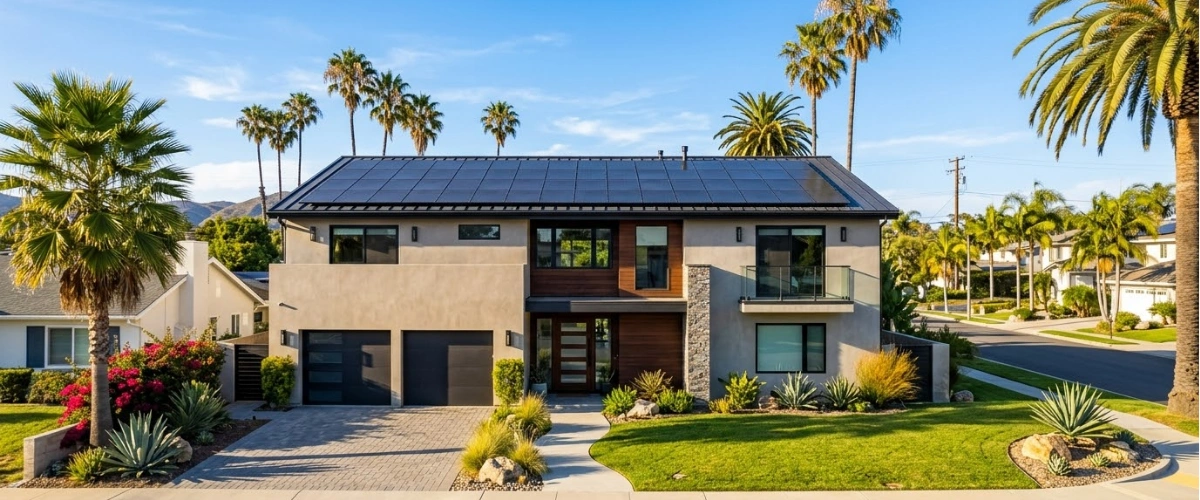
What if your electricity bill dropped to nearly zero — starting on Day 2?
That's not a sales pitch. It's exactly what one homeowner experienced after installing solar panels with battery storage. Two air conditioners running. An EV charging overnight. Battery at 99% by end of day. Zero watts pulled from the grid.
Whether you're paying SCE rates in Los Angeles, PG&E bills in the Bay Area, or SDG&E charges in San Diego, real production data from systems like this one is showing what's actually possible when you go solar the right way.
Here's a breakdown of what the numbers showed, why it matters for your home, and how to get the same results anywhere in California.
No matter which utility serves your home, California ratepayers are paying some of the highest electricity rates in the country — and the long-term trend isn't going away.
Why California electricity bills keep rising comes down to a combination of wildfire infrastructure costs, grid hardening, and energy procurement expenses — all passed directly to ratepayers by all three major utilities.
SCE customers saw a sharp ~13% rate increase in October 2025, pushing average residential rates to around 34.5–35.3 cents per kWh as of early 2026. PG&E has made modest reductions — cutting bundled customer rates about 5% in January 2026 — but California's average electricity rates have still more than doubled since 2015. SDG&E customers continue to face some of the highest residential electricity rates in the entire country, routinely exceeding 40 cents per kWh on standard plans.
The average combined residential electricity bill across California now hovers around $275–$340 per month for a typical household — before summer peak pricing.
California's residential electricity rates have climbed approximately 104% between 2015 and 2025, according to the CPUC's Public Advocates Office. Even in years when individual utilities post small decreases, the decade-long trajectory is unmistakably upward.
Every month you wait to go solar is another month paying for power at rates that will almost certainly be higher five years from now.
On Day 2 after installation, a properly designed solar-plus-battery system produced 37.6 kWh in a single day — on a sunny, zero-cloud afternoon. Here's what was running simultaneously:
The setup was straightforward but well-designed:
By 6 PM, the battery was sitting at 99% state of charge — essentially full. The home's load was drawing 632W. Grid draw: 0.00 watts.
Of the 37.6 kWh produced that day:
Two air conditioning units were running. An EV was charging at 2 kW overnight. The battery discharged to around 20% by morning — and started refilling again with the next day's sun.
For real solar production data for California homes, results like these reflect what's achievable across the state — from San Diego to Sacramento — with the right system design and equipment.
Results like these aren't just about energy independence. Under California's current billing rules, how solar batteries maximize your savings under NEM 3.0 is now the central question for any homeowner going solar statewide.
Under the old Net Energy Metering rules, SCE, PG&E, and SDG&E customers all received retail rates — around $0.30–0.35/kWh — for excess solar exported to the grid. Under NEM 3.0, which took effect in April 2023 for all new solar customers on these three utilities, that dropped to roughly $0.05–0.08/kWh.
That's a 75% reduction in what you earn for sending solar back to the grid.
Instead of exporting cheaply and buying back expensively, a battery lets you do the opposite: store what you produce during the day and use it at night when TOU peak rates hit their highest point (typically 4–9 PM across all three utilities).
At peak TOU pricing, you could be paying $0.45–0.55/kWh or more from the grid. Your stored solar costs you nothing extra to use.
The math is no longer complicated. Whether you're in Fresno, San Jose, or San Diego, are batteries worth it for solar in California has one clear answer in 2026 — yes.
The 37.6 kWh produced in the example above came from a 7.44 kW system on a perfect sunny day. California homes vary in location and usage — but most of the state enjoys 4.5–6.5 peak sun hours daily, making it one of the strongest solar markets in the world.
Understanding how much solar your home actually needs starts with your monthly kWh consumption. A home using 800–1,000 kWh per month typically needs a 7–9 kW system to get close to full offset.
Under NEM 3.0, sizing at 110–120% of your annual usage is optimal — enough to cover your needs with a small buffer, without over-exporting at rock-bottom rates. A CSLB-licensed consultant can calculate this precisely for your address and utility.
If you're charging an EV at home, add another 250–400 kWh per month to your usage estimate. Charging your EV with solar in California is one of the most financially powerful moves available — because charging from your own stored solar costs you nothing per mile, compared to utility rates that keep climbing across all three major California utilities.
The homeowner in this example was charging an EV at 2 kW overnight, powered entirely by the day's solar harvest stored in the battery. Free fuel, every night.
With the federal solar tax credit having ended December 31, 2025, California's Self-Generation Incentive Program (SGIP) is now the primary financial incentive for homeowners adding battery storage — and it's available statewide for PG&E, SCE, SoCalGas, and SDG&E customers.
For qualifying low-income households or those in high fire-threat areas, SGIP can cover 80–100% of battery installation costs. For general market customers, rebates typically cover 15–25% of the installed cost — meaning a 10 kWh battery installation could yield $1,500–$2,500 back.
Funding is limited and first-come, first-served. Your installer handles the application on your behalf, but timing matters.
California's solar property tax exclusion means adding solar won't increase your home's assessed value for tax purposes. That benefit continues statewide, regardless of federal policy changes.
Not all solar installations deliver results like these. The difference between a system that zeros out your bill and one that underperforms often comes down to who installs it and what equipment they use.
US Power is California's exclusive partner for American-made QCells solar panels, offering factory-direct pricing that runs 15–20% below what most competitors charge for the same hardware.
QCells panels are manufactured in Dalton, Georgia, and rank among the top-performing panels in independent testing. When you go factory-direct, the distributor markup disappears — and that savings passes directly to you.
US Power backs every installation with a 25-year comprehensive warranty covering panels, workmanship, and performance. Whether you're in Los Angeles, the Bay Area, Sacramento, or San Diego — if something isn't right a decade from now, you're covered.
With 200+ five-star Google reviews and a CSLB-licensed installation team, US Power's track record reflects what consistent quality looks like. And with a 3–4 week installation timeline after approval, you won't be waiting months to see results like the ones above.
Explore US Power's home solar battery systems and complete solar system packages to see what's available for your home today.
The data from Day 2 is clear: a well-designed solar-plus-battery system in California can cover your entire home load — AC, EV, everything — while keeping your battery full and your grid draw at zero.
California electricity rates have more than doubled since 2015. SCE customers absorbed a 13% increase in late 2025 alone. SDG&E customers pay some of the highest rates in the country. And even PG&E, which has made modest cuts, still charges rates roughly 23 cents per kWh above the national average.
The homeowners who act now lock in their energy costs and stop being subject to whatever rate change comes next — from Los Angeles to San Francisco to San Diego.


Your complete guide to solar panels and battery storage for your home energy.

California hot weather reduces solar efficiency slightly—but savings remain massive.
Your home HVAC alone could be eating half your electricity bill every month.









Copyright © 2026 US Power - Axia by QCells. All Rights Reserved.
Get an instant solar estimate using satellite!