

What would you do if your electric bill dropped to $0.59 for the entire month? That's exactly what happened to a Texas homeowner this spring after going solar. The secret isn't magic — it's overgeneration credits, a right-sized system, and a smarter way to think about energy. In this guide, we break down how it works, what Texas incentives are still on the table in 2026, and how US Power helps homeowners across the Lone Star State get to near-zero bills faster than you'd expect.
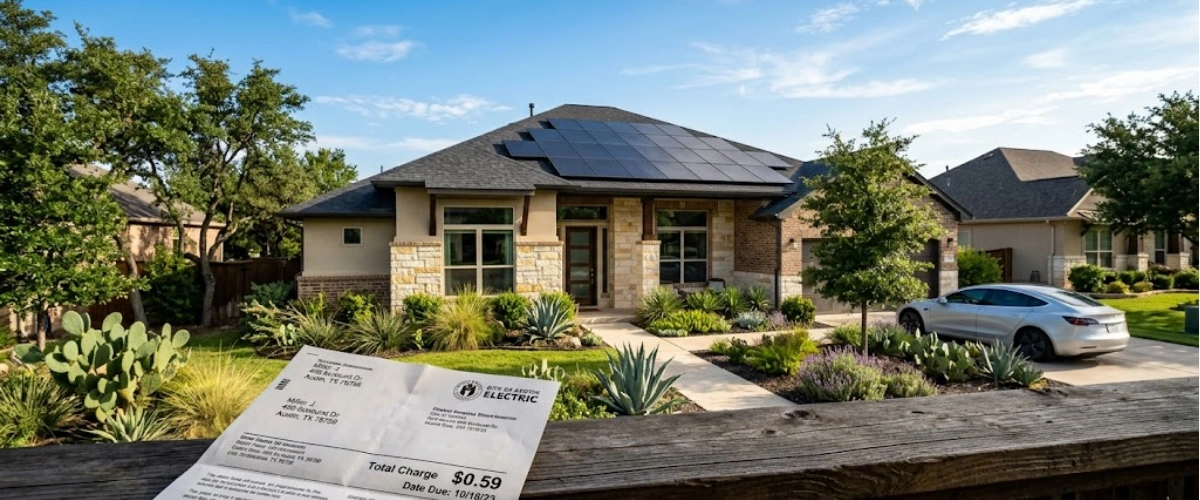
When your panels make more power than you use, the surplus goes to the grid and your retail provider credits you at its buyback rate. Texas has no mandatory net metering, so buyback rates vary by provider.
Imagine opening your electric bill and seeing $0.59.
Not a typo. Not a billing error. Just fifty-nine cents — for an entire month of electricity. That's exactly what one Texas homeowner experienced this spring after installing solar panels. And while there's a certain novelty to paying less for power than you would for a 1980s-era fast food cheeseburger, the real story is what it reveals about solar in 2026.
Because this wasn't luck. It was the result of a well-sized system, overgeneration credits, and a utility grid that — whether it means to or not — sometimes pays you back. Read how homeowners are achieving a near-zero electric bill with solar — and what it actually takes to get there.
If you're a Texas homeowner tired of watching your electricity bill climb every season, this article is for you.
Texas homeowners are paying more for electricity than ever before. The national average residential rate hit 18.05 cents per kWh in April 2026 — up 5.4% from just a year ago. In Texas, rates vary by provider but are rising steadily, driven by demand from AI data centers, cryptocurrency mining operations, and rapid industrial expansion across the state.
If you're in the Dallas–Fort Worth area on Oncor's grid, you've likely already felt this. Oncor has filed for a rate increase that would add approximately $7 per month for a household using 1,000 kWh. And that's probably not the last increase you'll see.
Three forces are pushing Texas electricity costs higher with no sign of slowing:
See how much solar panels can save on a monthly and annual basis depending on your current bill — but the higher rates go, the more solar saves you.
That Texas homeowner's $0.59 bill didn't happen because solar is magic. It happened because their system produced more electricity than they used that month. The excess power flowed back to the grid, and their utility credited them for it — nearly wiping out their entire bill.
This is called an overgeneration credit (or a solar buyback credit). When your panels produce more than your home consumes, your retail electric provider (REP) pays you for that surplus power. The rate they pay varies by provider and plan, so choosing the right REP matters enormously in a deregulated state like Texas.
California has Net Energy Metering (NEM 3.0), which gives solar owners credits at a fixed rate tied to retail pricing. Texas has no statewide net metering mandate. That means your buyback rate depends entirely on which REP you choose — some are generous, some aren't.
This is actually an advantage if you know how to work it. Texas homeowners can shop REPs specifically for solar-friendly buyback plans, locking in favorable rates. The key is pairing your solar system with the right plan — and ideally, a battery. Learn exactly how solar and battery storage work together to maximize what you keep.
With a battery, energy your panels produce midday doesn't get sold back at a low rate — it gets stored and used in the evening when grid rates are at their peak. That's how you maximize savings in Texas, not just generate them.
The 30% federal residential solar tax credit (Section 25D) expired on December 31, 2025. That changes the upfront math — but it doesn't erase the long-term case for solar in Texas.
Here's what the numbers actually look like for a Texas homeowner in 2026:
And Texas electricity prices have historically risen 3–5% per year. Every time rates go up, your solar savings go up with them — because your panels still produce the same amount of free electricity regardless of what the grid charges.
Still on the fence? Here's a detailed breakdown of why solar is still worth it in 2026 — even without the federal tax credit.
Even without the federal credit, Texas homeowners have meaningful protections and programs available:
Property Tax Exemption: Under Texas Tax Code Section 11.27, the added home value from your solar system is 100% exempt from property tax assessment. On a $23,500 system that adds $20,000 in home value, this saves approximately $400–$600 per year depending on your county — up to $13,000 over 25 years.
ONCOR Rebate (DFW Area): If you're in Oncor's service territory, you can qualify for up to $9,000 in rebates for a qualifying solar-plus-storage system. The catch: battery storage is required. Solar-only systems don't qualify. The program runs annually from January through November, or until funds run out — whichever comes first.
Austin Energy Rebate: Austin homeowners can access a $2,500 rebate plus the Value of Solar Tariff, which pays 9.91 cents per kWh for all energy your panels generate.
AEP Texas Rebate: AEP customers in west and south Texas can access up to $3,000 in rebates for qualifying systems.
Understanding whether to buy vs. lease your solar panels is one of the first decisions you'll face — and it has a big impact on which incentives you can access.
Most solar companies buy panels through distributors, adding markups at every step. US Power is an exclusive QCells partner, which means panels come directly from the manufacturer — typically 15–20% below what you'd pay through other installers.
QCells panels are American-made, built in Georgia, and carry a reputation for premium performance in high-heat climates like Texas. When August temperatures push past 100°F and your system is running hard, the quality of your panels matters. Cheaper imported panels often lose efficiency faster under extreme heat stress. QCells panels are engineered to hold their output.
One of the most common complaints Texas homeowners have about solar is the wait. Some companies quote 3–6 months from contract to permission to operate (PTO). US Power's average installation timeline is 3–4 weeks after approval — one of the fastest in the industry.
That matters right now, because the ONCOR rebate closes November 30, 2026. If you wait too long to start, you may miss the funding window.
See how solar installation actually works from contract to PTO so you know exactly what to expect.
A solar system doesn't just cut your monthly bill — it increases what your home is worth. Studies consistently show that owned solar systems add roughly 4% to a home's resale value. In a Texas market where property values are already significant, that's a meaningful return on top of your energy savings.
And because of the Texas property tax exemption, that added value doesn't increase your tax bill. You keep the equity gain entirely. Find out more about how solar panels increase your home's value and what that means at resale.
Winter Storm Uri. Summer heat waves. ERCOT stress events. Texas homeowners know better than most that the grid is not always reliable. A solar-plus-battery system keeps your lights, HVAC, and refrigerator running when the grid can't.
This is where the ONCOR rebate structure starts to make a lot of sense. The utility is incentivizing battery storage because it helps stabilize the grid — and you benefit from both the rebate and the backup power.
Before you meet with a solar consultant, it helps to gather a few things: your last 12 months of electricity bills, a rough idea of your monthly usage in kWh, and any questions about financing. Review what to look for in a solar quote so you're comparing apples to apples when you get multiple offers.
US Power's consultations are free — virtual or on-site — and there's no pressure to sign anything. A licensed consultant will walk you through your specific usage, the right system size for your home, and which Texas incentives apply to your situation.
If you're in Oncor's DFW territory, the rebate clock is ticking. The program runs through November 30, 2026, or until funding runs out — whichever comes first. In past years, popular programs have been fully committed well before the deadline. Starting now gives you the best chance of locking in that rebate before it disappears.
Even if you're outside Oncor's territory, electricity rates aren't going down. Every month you wait is another month of bill payments that could have been going toward an investment you own.
That $0.59 electric bill wasn't an accident. It was the result of a homeowner who made a decision, installed a right-sized solar system, and let their panels do the work. The overgeneration credit practically erased their bill.
Texas rates are rising. The ONCOR rebate window is closing. And every month you wait is another month of electricity costs you don't have to pay.
US Power makes the process straightforward — American-made QCells panels, factory-direct pricing, a 25-year comprehensive warranty, and a 3–4 week installation timeline. Over 200 five-star Google reviews back that up.
Your $0.59 moment is waiting. The question is when you'll start.



Quick and effective strategies to lower your electricity bills at home now.

Your ADU tenant could quietly double your SCE bill — unless you plan ahead.

Go beyond energy savings—solar wipes out transmission and hidden utility costs.









Copyright © 2026 US Power - Axia by QCells. All Rights Reserved.
Get an instant solar estimate using satellite!