
Getting solar quotes that range from $20,000 to $40,000 for your Southern California home? You're not alone. Here's why solar prices vary so much—and the one number that actually matters when comparing installers.
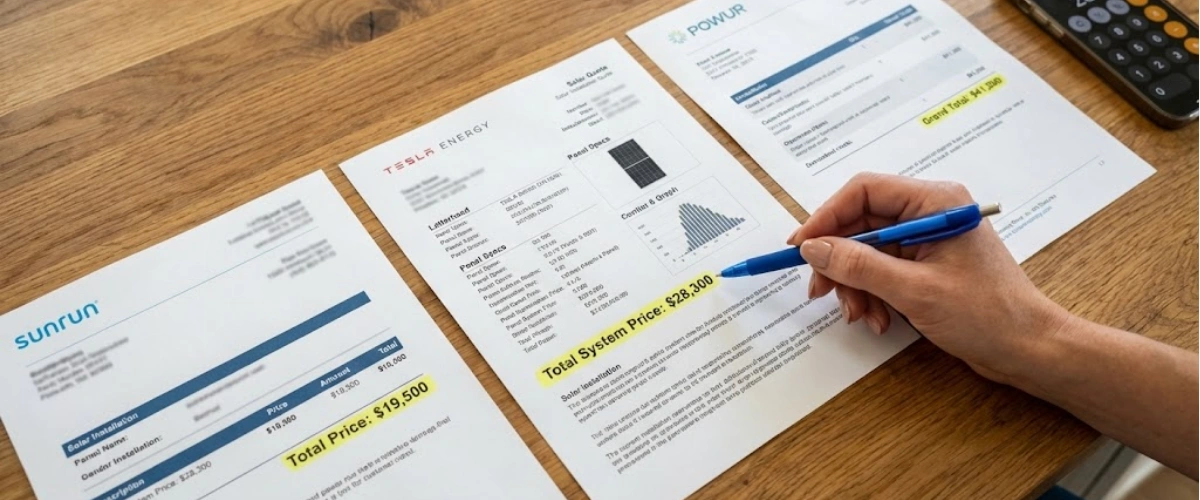
Quotes vary because of electricity usage, roof condition, panel orientation, shading, and how well the installer sized the system. Compare cost per watt and equipment quality rather than only the total price.
You requested five solar quotes for your Los Angeles home. The numbers came back: $19,500, $24,800, $28,300, $35,000, and $41,200.
Same house. Same roof. Same electricity bill.
How is this possible? And more importantly—which quote is actually the fair one?
If you're a Southern California homeowner shopping for solar in 2026, this price confusion isn't just frustrating. It's costing you thousands in potential overpayment or leading you to choose an installer based on price alone (which often backfires).
Here's what's really happening behind those wildly different numbers—and exactly how to compare solar quotes so you choose the right system at the right price.
The solar industry has a dirty little secret: there's no standardized quoting system.
When you request quotes from five different installers, you're often getting proposals for five completely different systems. It's like asking five contractors to renovate your kitchen—one quotes for new cabinets, another includes appliances, and the third plans to knock down a wall.
Here's what actually varies between quotes:
One installer quotes a 7.2 kW system. Another proposes 10.8 kW. Both claim they're "sizing it correctly" for your home.
The reality? Many installers intentionally oversize systems by 20-40% "just in case" your usage increases. This protects them from callbacks but costs you thousands in unnecessary panels.
A Los Angeles homeowner with a $200/month SCE bill typically needs 8-9 kW. But we've seen quotes ranging from 6 kW (undersized) to 12 kW (oversized) for the exact same usage profile.
Not all solar panels are created equal—and the price reflects it.
Budget tier panels (often from lesser-known manufacturers) might cost $2.20/watt installed. Premium American-made panels like QCells typically run $2.50-$2.80/watt. Tesla's system might quote at $2.30/watt but uses imported panels with shorter warranties.
The cheapest option today might cost you more over 25 years when you factor in degradation rates, warranty coverage, and replacement costs.
String inverters (single unit for your whole system) cost significantly less than microinverters (one per panel). A 9 kW system with a string inverter might quote at $23,000, while the same system with Enphase microinverters could hit $27,000.
Neither option is automatically "better"—it depends on your roof's shading, layout, and future expansion plans.
Stop comparing total prices. Start comparing cost per watt.
This single metric cuts through all the noise and lets you compare quotes fairly—even when system sizes differ.
Take the total system cost (after any dealer fees, but before incentives) and divide by the DC system size in watts.
Example:
That's your true price comparison number.
For quality residential solar in Los Angeles, Orange County, and surrounding areas:
Red flag: Anything over $3.50/watt or under $2.00/watt deserves serious scrutiny.
At US Power, our factory-direct QCells partnership means we typically quote $2.50-$2.70/watt for American-made panels with comprehensive 25-year warranties—15-20% below typical market rates for equivalent quality.
For a detailed breakdown of current California pricing, see our guide on What Should Solar Cost per Watt in California.
The single biggest reason quotes vary by $10,000-$15,000? One includes batteries, the other doesn't.
Under California's NEM 3.0 policy (which took effect in 2023), batteries went from "nice to have" to "financially essential" for most Southern California homeowners.
Without a battery under NEM 3.0:
With a battery:
A 13.5 kWh battery (like the QCells Q.HOME CORE) adds roughly $10,000-$13,000 to your quote. But for most Southern California homes with high evening usage, that battery pays for itself in savings.
When comparing quotes, make sure you're looking at apples-to-apples: either all quotes with batteries, or all without.
Learn more about Are Solar Batteries Worth It in California for your specific usage pattern.
A complete solar quote should break down every cost, not just give you a single number.
If a quote doesn't include these details, you're being asked to make a $25,000+ decision with incomplete information.
For a complete checklist, see 5 Essential Elements Every Solar Quote Should Include.
Watch for these "surprise" additions that appear after you sign:
Reputable installers assess these needs upfront and include them in your quote. Budget installers often "discover" them later and charge extra.
Not all price variations are legitimate. Some are red flags.
$18,000 for a 10 kW system? Here's what they're probably cutting corners on:
One Orange County homeowner saved $8,000 by choosing the lowest quote. Two years later, he paid $6,500 to fix roof leaks and replace a failed inverter the original installer wouldn't warranty.
$45,000 for a 9 kW system? Someone's padding the numbers:
For guidance on vetting installers, check out 5 red flags when choosing a solar company.
You've got three quotes on your kitchen table. Here's your step-by-step comparison process.
Calculate $/watt for each quote. This eliminates system size differences.
If Quote A is $24,000 for 8 kW ($3.00/watt) and Quote B is $27,000 for 10 kW ($2.70/watt), Quote B is actually cheaper despite the higher total—and gives you more power generation.
Match panel quality, inverter type, and warranties across quotes:
Create a checklist:
Price means nothing if the installer disappears in 2 years:
For more detailed guidance, see our article on How to Compare Solar Quotes.
Two identical $30,000 quotes can have vastly different real costs:
Always ask: "What is the cash price?" That's your baseline for comparison.
See Solar financing options in southern california to understand your payment choices.
At US Power, we've built our reputation on one principle: no games, no gimmicks, no surprises.
We're the #1 QCells installer in California because we buy directly from the manufacturer. No distributors. No middlemen. No markup.
That means American-made QCells panels at 15-20% below typical market rates—with the same 25-year comprehensive warranty (panels, workmanship, and performance guarantee).
Our quotes break down:
You'll know exactly where your money goes—before you sign anything.
While other installers quote 8-12 weeks (or longer), our streamlined process gets you from approval to activated system in 3-4 weeks. That's faster savings, faster ROI, and less time waiting.
Our team consists of California-licensed solar professionals who design your system based on your actual needs—not commission targets. We right-size systems, we don't oversize them.
Learn more about How to Choose a Solar Company in Los Angeles.
Stop guessing which quote is fair. Get the facts.
Here's what happens when you reach out to US Power:
No hidden fees. No sales tactics. No surprises.
With 180+ five-star Google reviews and an A+ Better Business Bureau rating, our transparency speaks for itself.


550W panels: Too big to handle or the smartest choice for your ground mount?
The 2025 guide to solar ballast systems for California flat roofs. Talk to an expert!
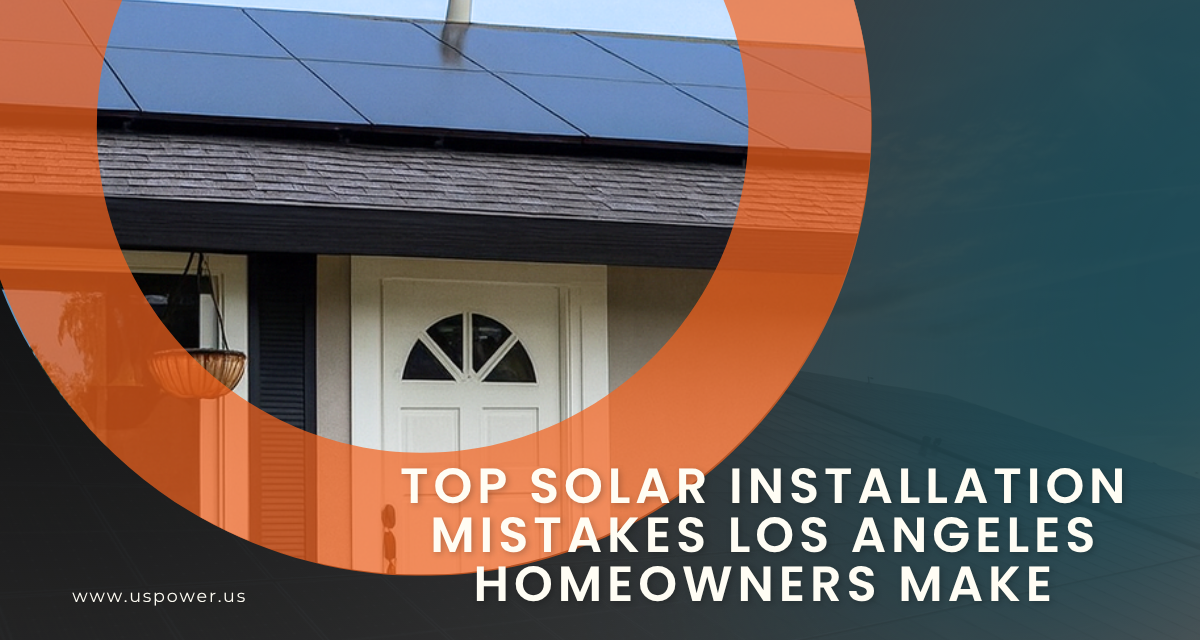
Before signing a solar contract, make sure you know the risks. Read to learn more.







Copyright © 2026 US Power - Axia by QCells. All Rights Reserved.
Get an instant solar estimate using satellite!