

Most homeowners pay $2.50 to $3.80 per watt for solar in 2026, and Qcells systems run $2.65 to $3.10 per watt installed. The gap between quotes comes from who installs and who takes a margin. Here is how to compare companies that install solar panels, price your roof, and avoid overpaying.
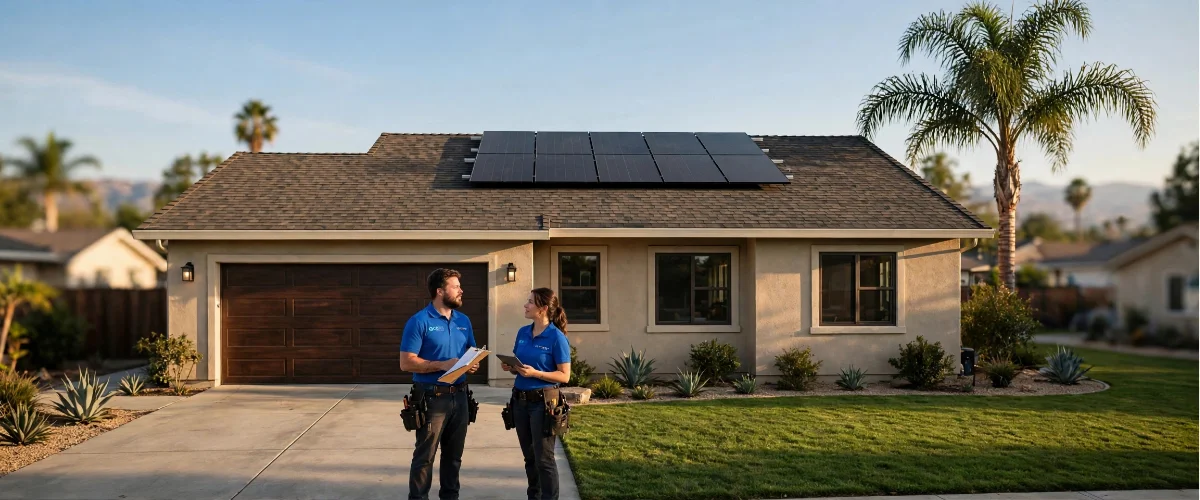
Most homeowners pay $2.50 to $3.80 per watt installed in 2026 before incentives, or about $20,000 to $27,000 for a typical system. Factory-direct Qcells pricing from US Power runs 15-20% below market.
You type "solar system installation near me" and get forty results, half of them ads and none with a price. Your neighbor swears by one company and your cousin swears off another. Choosing among companies that install solar panels should not feel like a coin flip.
Here is the problem. Two quotes for the same roof can differ by $10,000 or more, and the panel brand is rarely the reason. The gap comes from who installs the system, who subcontracts the work, and who takes a margin along the way.
This guide explains which companies that install solar panels you will meet, what solar panels for a home cost in 2026, what Qcells solar panels cost, and what your roof needs before anyone climbs a ladder.
Most companies that install solar panels fall into three groups. Each one prices and services a job differently, and the logo on the truck says little about who does the work.
Large national brands have big marketing budgets and in-house financing. SolarPriceList's 2026 vetting guide notes that they often charge a premium and may use third-party subcontractors for the physical install. That is not automatically bad, but you should know who will be on your roof.
Local companies that install solar panels often charge 5% to 15% less than national brands for equivalent equipment, according to the same guide. The tradeoff is a smaller financial cushion, so check how long they have operated and who backs their warranty.
Among companies that install solar panels, a third model removes a layer between the factory and your roof. US Power is an exclusive Qcells partner, so our consultants source panels factory-direct, and one company designs, installs, and stands behind the system. That shorter chain is how our pricing lands 15-20% below market.
Searching for solar system installation near me finds plenty of companies that install solar panels, but proximity is not proof of quality. The U.S. Department of Energy says to make sure your installer is "licensed, bonded, and insured" to install residential solar in your area. Vetting takes about 20 minutes and can save you thousands.
In California, look up the contractor's CSLB license before you talk numbers. Ask for a certificate of insurance and look for NABCEP certification, which the DOE calls the gold standard among renewable energy installers. Our guide on how to choose a solar installer in California walks through each check.
Reliable companies that install solar panels will not hesitate on any of these checks. Walk away if the company has no physical office address, resists sharing license and insurance documents, offers only one system option, or will not pull the permit itself. SolarPriceList also flags pressure to sign before an incentive reservation is submitted.
Ask which parts of the job subcontractors will handle and how the company supervises them. Also ask who pays if your roof is damaged or leaks after installation. A good installer answers in writing, and a pushy one says the price is only valid today. Written quotes should stay valid for 14 to 30 days.
Published 2026 estimates put installed residential solar between $2.50 and $3.80 per watt before incentives. Sunhub's June 2026 guide lists $2.50 to $3.30 per watt with an average quote near $2.75, while IsSolarWorthIt (June 2026) puts a typical 7-8 kW system at $20,000 to $27,000. For an 8 kW system at $2.75 per watt, that is about $22,000.
You can test your own numbers with the US Power solar calculator before you request any quote.
Panels are 30-40% of the total, according to IsSolarWorthIt. Labor runs 15-20%, and installer overhead and margin another 15-20%. In other words, labor and margin together can cost as much as the panels. That is why companies that install solar panels with identical equipment can still quote very different totals.
Estimates vary by source, so treat these as starting points. TheGreenWatt's April 2026 state table shows these installed rates before incentives. Local utility programs and financing change the final number:
In California, NEM 3.0 net billing pays far less for exported power, and utility peak rates run from 4 to 9 PM, so most quotes now include storage. Our April 2026 California cost guide puts a 7-10 kW system at $18,000 to $30,000 before incentives, with a home battery adding about $10,000 to $15,000. Ask every company to price your system with and without a battery.
Many companies that install solar panels list Qcells, so people who search for q cells solar panels price usually want one number. There are really two: the equipment and the installed system. SolarPanelInstallCost's April 2026 update puts installed Qcells systems at $2.65 to $3.10 per watt, so an 8 kW system lands between $21,200 and $24,800.
Qcells panels such as the Q.PEAK DUO ML-G11 list 20.7% to 21.4% efficiency and a 25-year linear power warranty that ends at 85% output. Our comparison of Q.PEAK vs Q.TRON panels shows which model fits which roof.
Say a market-rate quote for your system is $22,000. US Power's factory-direct Qcells pricing runs 15-20% below market, so the same class of system lands between $17,600 and $18,700. That is $3,300 to $4,400 less, without changing the panel brand. You can review factory-direct Qcells pricing on our sister site.
The same Qcells panel can appear in a $17,600 quote and a $24,000 quote. The panel did not change. The company, its overhead, and the number of hands between the factory and your roof did.
Your roof decides whether a quote is real, so ask companies that install solar panels to inspect it in person, not from a satellite photo. Panels last 25 to 30 years, so the roof underneath should last about as long. If your roof is near the end of its life, replace it first.
Panels work best on roofs with a pitch of 15 to 40 degrees, and a south-facing slope near 30 degrees is ideal, according to Eigen Energy's roofing guide. Shade from trees or neighboring buildings can cut output even when it covers only a few panels. Asphalt shingle, metal, and tile roofs are the most common surfaces for solar.
Removing and reinstalling panels for a future roof replacement costs roughly $1,500 to $4,000, according to IsSolarWorthIt, so it is cheaper to fix the roof first. California homeowners can start with our roof compatibility guide for solar panels to see which roof types work.
You do not need to be an engineer to compare companies that install solar panels. You need three habits.
The DOE suggests dividing the system cost by its capacity in watts. A $22,000 quote for an 8 kW system is $2.75 per watt. Use that number to compare, and check our list of 5 essential elements every solar quote should include to make sure the quotes cover the same equipment.
SolarPriceList recommends at least one quote from a national installer and two from local companies. Compare equipment brand, model number, warranty terms, and who pulls the permit.
Ask the installer to include roof repairs and vent relocation in the proposal. Then confirm the workmanship warranty in writing. If you are comparing quotes that differ by thousands, read why solar quotes vary so much for the same house.
Companies that install solar panels range from national brands to local crews to factory-direct partners, and installed prices run from $2.50 to $3.80 per watt in 2026. Your roof, your state, and the number of hands between the factory and your home decide where you land in that range.
US Power is a CSLB-licensed, exclusive Qcells partner with 200+ five-star Google reviews. Every consultation starts with a real 12-month bill analysis, every install carries a 25-year comprehensive warranty, and most systems reach permission to operate in 3-4 weeks, as our Axia by Qcells installation timeline explains. If you want an exact number for your roof, book your free 12-month bill analysis.
Fewer hands, a clearer price, one warranty to call.


Your residential roof can look stunning and save you thousands, here's how.
Discover how Qcells’ perovskite solar tech could redefine energy in California.
I can't afford $15k for batteries, but I need solar NOW - First step, Call us today!








Copyright © 2026 US Power - Axia by QCells. All Rights Reserved.
Get an instant solar estimate using satellite!