

Yes, if your system can be completed before January 1, 2027. SCE now averages 34.4 cents per kWh and SDG&E runs near 46 cents, and systems finished after that date may raise your property taxes. Here is the math on rates, NEM 3.0 and batteries so you can decide with real numbers.

Yes, if your system is finished before January 1, 2027. SCE averages 34.4 cents per kWh and SDG&E about 46 cents, and systems completed after that date may raise your property taxes.
On September 9, 2026, San Diego Gas & Electric hit an all-time demand record of 5,209 megawatts, and nearly 15,000 of its customers lost power. Two weeks earlier, an underground vault fire in Long Beach left more than 22,000 Southern California Edison customers in the dark during a heat advisory. If you were one of them, you know the feeling: the bill keeps climbing, and the lights still go out.
So the real question is whether this is the moment to go solar in Southern California, given what your utility charges, what the grid is doing, and a state tax deadline that lands in about three months.
Here is what you will learn: what SCE and SDG&E charge in 2026, why January 1, 2027 matters, how NEM 3.0 changes the math, and what to do this fall to take control of your energy costs.
For most homeowners, yes, and the window is tighter than it looks. Three things line up in fall 2026: record-high rates, a fixed monthly grid charge you cannot conserve your way out of, and a property tax exclusion that stops covering new solar systems completed on or after January 1, 2027.
SCE's average residential rate was 34.4 cents per kWh as of its June 1, 2026 rate advisory, and a typical customer using 500 kWh a month pays about $187. That rate jumped roughly 13% in October 2025 alone, from 31.2 to 35.3 cents, largely to recover wildfire-related costs. Summer on-peak prices on SCE's TOU-D-4-9PM plan reach about 58 cents per kWh between 4 and 9 PM.
San Diego is steeper. SDG&E's bundled residential rate averaged roughly 46 cents per kWh in spring 2026, by industry estimates, among the highest in the continental U.S. Customers of LADWP, Burbank, Glendale and Pasadena are on municipal utilities with their own rates and solar rules, so their math works differently.
On top of per-kWh charges, SCE added a $24.15 monthly Base Services Charge in November 2025 for most households. Solar does not erase that fee, but it shrinks nearly everything else on the bill.
Under Revenue and Taxation Code Section 73, California has excluded new solar systems from property tax reassessment for decades. According to the Board of Equalization, systems completed before January 1, 2027 keep that exclusion until the home changes ownership. Systems completed after that date may be assessed as taxable new construction.
An extension bill, AB 2389, would have carried the exclusion to 2031 for systems up to 10 kW, but it stalled in the Assembly Appropriations Committee in May 2026. As of late September 2026, the sunset stands. Our full breakdown of the 2027 solar property tax deadline covers the details.
Two forces work against you at once: prices you cannot negotiate, and a local grid under stress you cannot fix.
Wildfire liability, grid hardening and insurance costs flow straight into your rate. SCE's June 2026 advisory lists $380.7 million in new revenue for 2026 wildfire self-insurance, and even the months when rates dip slightly still carry those costs. Our look at 2026 California energy rate hikes walks through where the increases come from.
September 9 was also the busiest day of 2026 for California's main grid operator, with a peak load of 50,042 megawatts. The statewide system held, but local equipment did not: transformers, underground vaults and circuits failed across Long Beach and San Diego County in August and September. These are the outages that hit your street without warning.
If you already have panels, remember that standard grid-tied systems shut off when the grid does. That is why solar panels alone go dark during power outages, and why storage belongs in the conversation about solar in Southern California.
Since April 2023, new SCE, PG&E and SDG&E solar customers have been placed on the Net Billing Tariff, better known as NEM 3.0. Exported power is credited at an avoided-cost value that changes by the hour, which independent analyses put at roughly 5 to 8 cents per kWh on average. The power you buy back still costs retail. The strategy that wins is simple: use your own solar first, and store the rest for the evening peak.
Now scale it. If a battery shifts 1,000 kWh a year from midday export to summer evening use, the difference is roughly 1,000 x (58 cents minus 7 cents), or about $510 a year. Your real number depends on your usage pattern and plan, which is why choosing between TOU-D-PRIME and TOU-D-4-9PM matters as much as system size.
Then add the tax side. At a typical 1.1% effective rate, a $25,000 system assessed as new construction would add about $275 a year to your property tax bill. With the standard 2% annual increase, that is roughly $8,800 over 25 years, money a system completed in 2026 never owes.
Rounded national estimates hide exactly these details. Every US Power consultation starts with a real 12-month bill analysis, so your proposal reflects your utility, your rate plan and your summer peaks, not an average home in another state. Our CSLB-licensed consultants size the system to what you actually use, because under NEM 3.0 an oversized array mostly produces cheap exports.
The 30% federal residential solar tax credit expired on December 31, 2025, so it is no longer part of the equation. That makes the other levers matter more: equipment price, correct sizing, self-consumption, and avoiding a property tax increase. You can get a first read on your own numbers with the US Power solar calculator before a consultant reviews your bills.
Price is the lever you control most directly. US Power offers factory-direct Qcells pricing roughly 15-20% below typical market pricing, on American-made panels built in Dalton, Georgia, and backed by a 25-year comprehensive warranty. A lower upfront cost shortens payback no matter which utility serves your home.
Under NEM 3.0, a battery usually earns its place in two ways. It moves daytime solar into the expensive 4 to 9 PM window, and it keeps critical circuits running when your neighborhood loses power. On September 9, 2026, more than 140,000 home batteries enrolled in coordinated virtual power plant programs sent over 580 megawatts back to the California grid during the evening peak, a sign of how much stored power is now worth.
Be realistic about rebates. Most ratepayer-funded SGIP battery budgets closed to new applications at the end of 2025, and the income-qualified equity budget is running a waitlist. Plan your battery around bill savings and backup value, not a rebate that may not arrive. For product comparisons, see our guide to the best home solar battery in 2026.
A few steps this fall will tell you quickly whether solar in Southern California makes sense for your home, and whether you can finish before the deadline.
Download a full year of usage from your SCE, SDG&E or LADWP account. Summer months reveal your peak-hour exposure, which drives battery sizing more than any other number.
Check whether you are with an investor-owned utility on NEM 3.0 or a municipal utility with its own rules. It changes the value of your exports and whether SGIP applies at all.
Decide what needs power during an outage: refrigerator, internet, medical equipment, one bedroom AC. That short list sets the minimum battery size and keeps you from overbuying.
Design, permitting, installation and inspection all take time. Ask any installer for a written timeline and what "completed" means for the property tax exclusion. Here is how the Axia by Qcells installation timeline works from signed agreement to power on.
With SCE averaging 34.4 cents per kWh, SDG&E near 46 cents, and the property tax exclusion ending for systems completed on or after January 1, 2027, fall 2026 is the clearest window in years to go solar in Southern California.
US Power builds every proposal from your real 12-month bill analysis, prices it with factory-direct Qcells panels, backs it with a 25-year comprehensive warranty, and typically completes installation in 3 to 4 weeks. More than 200 five-star Google reviews come from homeowners who wanted control, not a sales pitch. To see whether your home can make the deadline, book your free 12-month bill analysis today.
The sun is free. The deadline is not.


Energy costs in Southern California aren’t slowing down—making it the clear choice.
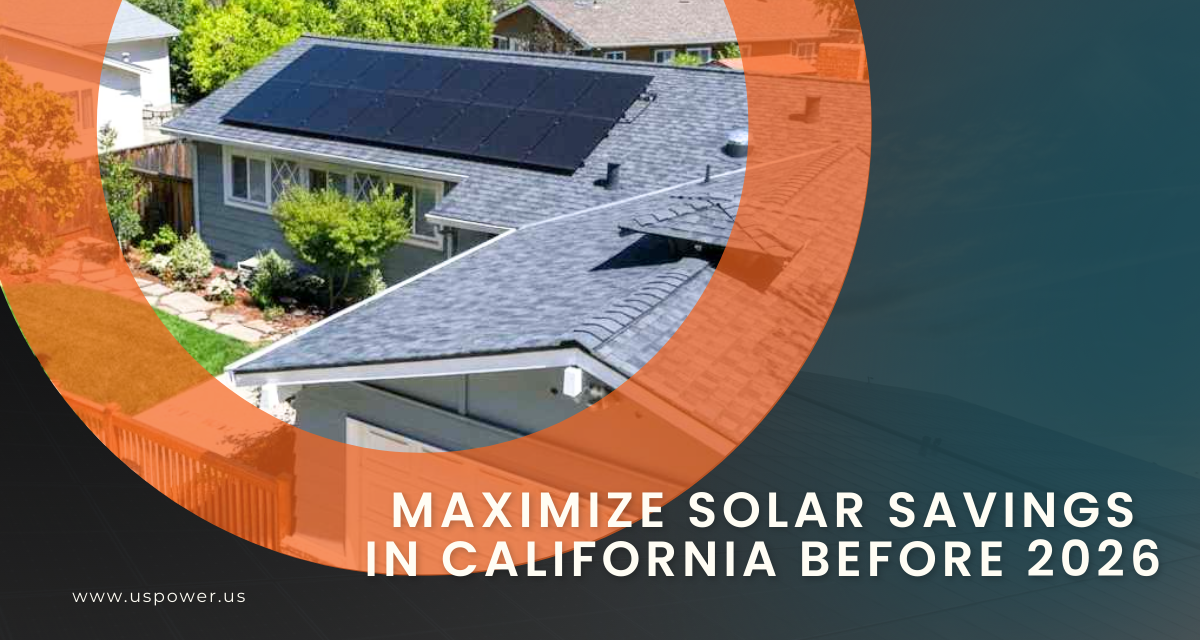
Stay ahead of the energy costs with 2025 solar trends in Southern California.

Explore the reasons why more California homeowners are choosing solar energy now.









Copyright © 2026 US Power - Axia by Qcells. All Rights Reserved.
Get an instant solar estimate using satellite!