

Already have solar panels but no battery? You're not alone. With NEM 3.0 cutting export credits by 75% and SCE rates climbing past $0.40/kWh during peak hours, thousands of Southern California homeowners are retrofitting battery storage to their existing systems. Here's what you need to know before making the investment.
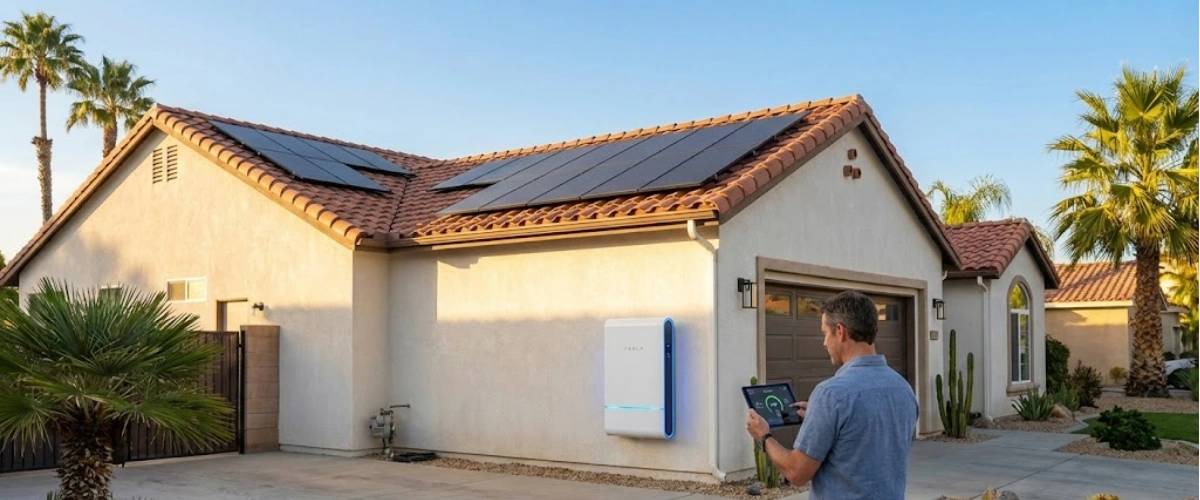
A battery is worth considering. Under NEM 3.0, export credits dropped about 75%, so many Southern California homeowners retrofit storage to use more of their own solar. Physical installation typically takes 1-2 days.
You installed solar panels two or three years ago when net metering still made sense. Your system produces plenty of power during the day, you watch your electric meter spin backward, and you feel good about going green. But lately, something's changed.
Your SCE bill isn't as low as it used to be. Maybe you added an electric vehicle. Or maybe you've heard about NEM 3.0 slashing export credits and you're wondering if you made a mistake not installing battery storage from the start. With why electricity bills are so high in Southern California, you're not imagining it—and you're definitely not alone.
The question thousands of Southern California homeowners are asking right now is simple: Should I add a battery to my existing solar system? The short answer is yes, especially if you installed under NEM 2.0 or earlier. Here's why.
If you're on NEM 2.0 or NEM 1.0, you're grandfathered into better rates—for now. But here's what's happening across Los Angeles, Orange County, Ventura, and the Inland Empire that's making battery retrofits the smart move.
Time-of-use rates during peak hours (4-9 PM) now exceed $0.40 per kWh for many SCE customers. That's the exact time your solar panels stop producing and you start pulling expensive grid power. Without a battery, you're buying electricity at premium prices every single evening.
A homeowner in Pasadena told us: "I have a 7 kW system that covers my usage during the day, but my bills were still $180-$220 monthly because of dinner time and EV charging. Adding a 13.5 kWh battery dropped my bills to under $40."
If you installed solar after April 2023 under NEM 3.0, everything you need to know about solar and battery storage became essential, not optional. Export credits dropped from $0.30/kWh to around $0.05-$0.08/kWh, meaning the grid pays you pennies for the solar energy you send back during the day.
Without battery storage, NEM 3.0 systems lose 70-80% of their financial value. The math is brutal: you're giving away daytime solar production for almost nothing, then buying it back at night for 5-6x more.
Southern California saw increased Public Safety Power Shutoff events during the 2024 and 2025 wildfire seasons. Thousand Oaks, Calabasas, parts of the San Fernando Valley, and Riverside County all experienced multi-day outages.
Here's the frustrating part: if you only have solar panels without a battery, your system shuts down during grid outages. You're sitting there with panels on your roof producing power, but you can't use any of it. Battery storage with backup capability fixes this immediately.
Just like the Virginia homeowner in our opening scenario, you're probably comparing multiple battery brands. Here's what we're seeing work best for Southern California retrofits in 2026.
The Powerwall 3 offers 13.5 kWh of storage with competitive pricing around $15,000-$17,000 installed. If you already own a Tesla vehicle, the integration through the Tesla app is seamless. You can monitor your solar production, battery charge, and home energy use all in one place.
Pros: Strong brand reputation, good warranty coverage, proven track record
Cons: No built-in generator integration, limited to 11.5 kW continuous power (may require two units for larger homes)
As US Power's exclusive battery partner, QCells offers 12-15 kWh configurations with American manufacturing standards and seamless integration with existing solar systems—including those from other installers.
Pros: Factory-direct pricing (15-20% below retail), 25-year comprehensive warranty, CSLB-licensed installation, modular design for future expansion
Cons: Newer to the California market compared to Tesla
This is gaining serious traction in Southern California for one key reason: the generator integration module. For about $1,000 extra, you can connect a portable generator to keep your batteries charged during extended outages—something Tesla and most competitors don't support.
Pros: 15 kWh capacity, generator module, smart load management, vehicle-to-load (V2L) capability
Cons: Requires finding a certified installer (US Power can help with this)
Choosing the right backup for Southern California homes depends on your specific needs—backup duration, budget, existing equipment, and whether you want generator integration as a safety net.
Are batteries worth it for solar in California? Let's run the numbers for a typical Los Angeles homeowner.
Scenario: 8 kW existing solar system, 30 kWh daily usage, SCE TOU-D-4-9PM rate plan
At $16,000 installed cost minus available incentives, you're looking at a 7-9 year payback period. But factor in rising utility rates (SCE has increased rates 32% since 2014), and that payback accelerates significantly.
This is where many homeowners get stuck. You're under-producing—maybe you added an EV, or your household usage increased—and you're wondering: should you expand your solar panels or add a battery?
The answer depends on three factors:
If you have room for 5-10 additional panels, expanding your array makes sense alongside battery storage. More production during the day means more energy to store and use at night.
If you're grandfathered under NEM 2.0 or NEM 1.0: Adding panels maintains your favorable rate structure. This is a limited-time opportunity—once you're off NEM 2.0, you can't get back on.
If you're on NEM 3.0: Battery storage is mandatory for any expansion to make financial sense. More panels without a battery just means giving away more power to the grid for pennies.
A typical battery retrofit: $15,000-$18,000
A typical 3 kW solar expansion + battery: $22,000-$28,000
If budget allows, the combination approach maximizes your energy independence and savings. If not, prioritize the battery first—it fixes your biggest problem (buying expensive grid power at night) immediately.
Here's where the Virginia homeowner's experience offers a cautionary tale: installer choice matters more than equipment choice.
The original poster's installer voided their warranty because an electrician moved a breaker. That's aggressive and unreasonable. How to choose a solar company in Los Angeles means finding partners who stand behind their work even when issues arise.
US Power difference: Our 25-year comprehensive warranty covers panels, workmanship, and performance. We work with homeowners to solve problems, not abandon them over technicalities.
Some installers push specific batteries because they're easier to install with existing systems, not because they're the best choice for your needs. Make sure your installer is certified with multiple battery brands and can recommend objectively.
A common mistake is installing a single 10 kWh battery when your evening usage requires 15-18 kWh. You end up still buying grid power during expensive peak hours, defeating the purpose.
Rule of thumb: Your battery should cover 80-100% of your evening usage (roughly 5 PM - 9 PM). For most Southern California homes with EVs, that means 13-20 kWh of storage.
If you're ready to add battery storage to your existing solar system, here's the streamlined process with US Power:
Step 1: Request a free virtual or on-site consultation. We'll analyze your current system, review 12 months of utility bills, and assess your goals (backup power, bill reduction, energy independence).
Step 2: Receive a transparent quote with multiple battery options. We'll show you QCells, Tesla, and FranklinWH configurations with honest pros/cons for each.
Step 3: Permit and approval process (we handle everything). Timeline is typically 2-3 weeks depending on your local jurisdiction.
Step 4: Professional installation in 1-2 days by CSLB-licensed electricians. We work with your existing solar equipment regardless of original installer.
Step 5: Activation and monitoring setup. You'll have full control through your battery's app to customize charging schedules and backup priorities.
You made the smart decision to go solar. Now it's time to maximize that investment with battery storage that keeps your power—and your savings—right where they belong: in your home.
Whether you're on NEM 2.0 watching your favorable rates slowly erode, on NEM 3.0 giving away daytime production for pennies, or simply tired of expensive evening electricity bills, battery storage transforms your solar system from good to game-changing.
US Power retrofits battery storage to any existing solar system in Los Angeles, Orange County, Ventura, San Bernardino, and Riverside counties. Factory-direct QCells pricing, CSLB-licensed installation, 25-year comprehensive warranty, and 180+ five-star Google reviews.
Ready to stop leaving money on the table? Get your free battery assessment today.


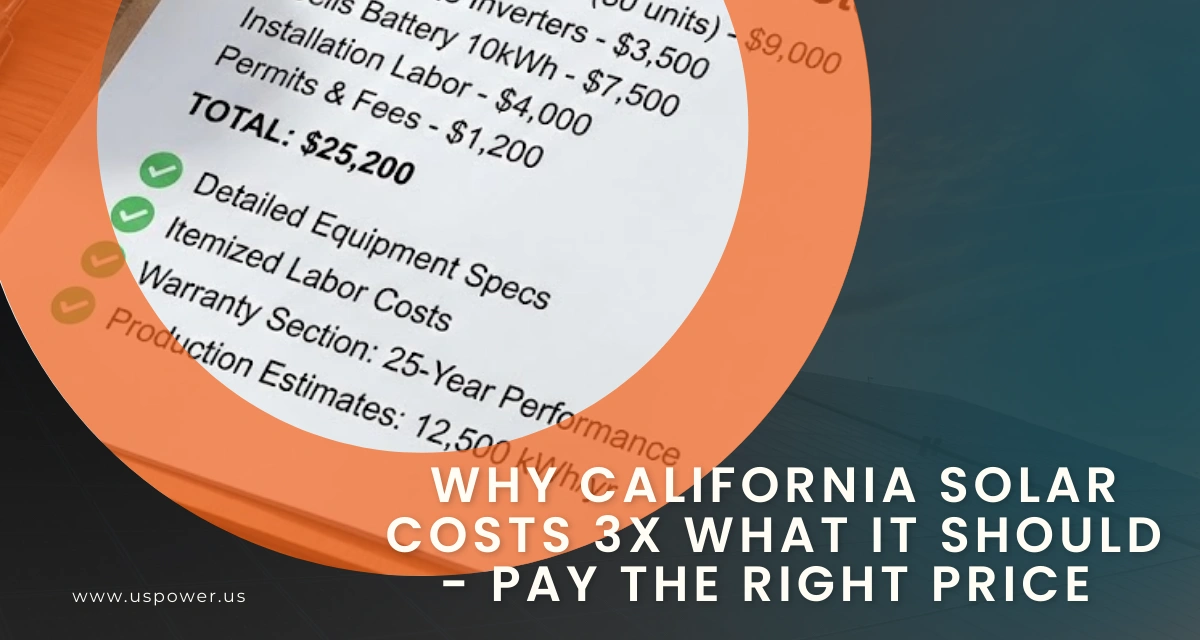
You're not imagining it—California solar really does cost 3X more than it should.

Avoid SCE’s 10% rate hike with solar savings with US Power and Qcells Technology.
Get Smart, start controlling your energy costs before utility rates rise further!








Copyright © 2026 US Power - Axia by QCells. All Rights Reserved.
Get an instant solar estimate using satellite!