

Buying solar in Southern California starts with your utility: LADWP still credits exports at retail, while SCE and SDG&E pay about 5 to 8 cents under NEM 3.0. Coastal homes produce about 1,570 kWh per kW a year and inland homes up to 1,850. This guide walks through all seven buying steps.

Buying solar in SoCal starts with your utility. LADWP still credits exports at retail, while SCE and SDG&E pay about 5 to 8 cents under NEM 3.0, so your ZIP code shapes the right system.
Two neighbors buy the same size system. One lives in Santa Monica under a morning marine layer, the other in Temecula where summer afternoons pass 95°F. One is on SCE, the other just across a city line on a municipal utility. Their savings can be thousands of dollars apart.
Buying solar panels in Southern California is not one decision. It depends on your utility's rules, your climate, your roof and how you pay. This guide walks through seven steps in order, with the regional details that change the answer.
Find out which utility rules apply, check your roof and climate, size the system from 12 months of bills, choose equipment for your conditions, decide on a battery, compare vetted quotes, then pick how to pay. The table below shows why step one matters so much.
| Where you live | Utility | Average rate | Export credit | What it means |
|---|---|---|---|---|
| City of Los Angeles | LADWP | About 26–41¢/kWh by tier (summer 2026) | Retail rate | Size close to 100% of use |
| Most of LA County, Orange County, Inland Empire | SCE | 34.4¢/kWh (June 2026) | NEM 3.0, about 5–8¢/kWh | Size for self-use; a battery helps |
| San Diego County | SDG&E | 45.5¢/kWh (June 2026) | NEM 3.0, about 5–8¢/kWh | Fastest payback; a battery helps |
| City of Riverside | Riverside Public Utilities | Check your bill | Avoided-cost buyback | Size for self-use |
| City of Anaheim | Anaheim Public Utilities | Check your bill | Wholesale-based rate | Size for self-use |
Rates for SCE and SDG&E come from the CPUC Public Advocates Office Q2 2026 rates report. Municipal utility rules come from each utility's solar program pages.
Your utility decides what your exported solar is worth, and that shapes everything else.
The City of Los Angeles is served by LADWP, which still credits exported solar at the retail rate. Most of Los Angeles County, Orange County and the Inland Empire is served by SCE, and San Diego County by SDG&E. Both are under NEM 3.0, which credits most exports at about 5 to 8 cents per kWh.
Several cities run their own utilities. Riverside Public Utilities now pays an avoided-cost buyback rate for exports on new systems, and Anaheim Public Utilities uses wholesale-based export rates. Burbank, Glendale and Pasadena also have their own programs. On any of these, a system sized for self-use usually beats one sized to export.
Near the coast, May and June marine layers trim production. Solar Benchmark modeling puts the Los Angeles coast at about 1,570 kWh per kW a year and the San Diego and LA basin at about 1,540 to 1,640. Salt air matters too, so homes close to the ocean should ask for panels tested to the IEC 61701 salt mist standard.
Inland areas such as Riverside, the Inland Empire and the Coachella Valley produce more, up to about 1,850 kWh per kW a year, but panels also run hotter. Heat costs output, so the panel's temperature coefficient matters more here than on the coast.
If your roof has fewer than 10 years left, replace it first. Removing and reinstalling panels later adds cost. Spanish tile, common across older SoCal neighborhoods, needs tile-specific mounts, and flat roofs use tilted racks.
Much of Orange County and many newer Inland Empire tracts sit in HOAs. California's Solar Rights Act limits how far an HOA can restrict rooftop solar, but you still need to submit plans for approval. Ask your installer to prepare the HOA application alongside the city permit so neither holds up the other.
Sizing depends on your usage and your location. Take a home using 9,000 kWh a year:
On the coast at about 1,570 kWh per kW, it needs roughly a 5.7 kW system, or about 14 panels at 430 watts. Inland at about 1,850 kWh per kW, the same usage needs roughly 4.9 kW, or about 12 panels. At EnergySage's 2026 California average of $2.52 per watt, that is about $14,400 on the coast versus $12,300 inland, before incentives.
Under NEM 3.0, SCE and SDG&E homes often size a little below 100% of annual use and add a battery, while LADWP homes can size closer to 100%. Get a first estimate with the US Power solar calculator, and see our guide to how many solar panels a Los Angeles home needs for the full math.
Every US Power consultation starts with a real 12-month bill analysis, so your system reflects summer peaks, pool season and your utility's rules, not a neighborhood average. CSLB-licensed consultants check roof condition, shade and setbacks before recommending a design.
Look at three numbers on any panel datasheet: efficiency, temperature coefficient and the year-25 output warranty. Current N-type panels run about 22% to 24% efficient. On hot inland roofs, a better temperature coefficient keeps more output on summer afternoons. On small roofs with fire setbacks, higher-wattage panels fit more power in less space.
Most homes do well with Qcells Q.TRON panels built in Georgia, while REC and Maxeon suit specific heat or space limits. Our guide to the best solar panels in 2026 compares current models side by side. Microinverters or optimizers help on roofs with several angles or partial shade. If you may add a battery later, ask whether the proposed inverter supports one without being replaced, since swapping inverters adds cost down the road.
On SCE and SDG&E, time-of-use rates peak from 4 to 9 PM, just as solar output fades. A battery stores midday solar for those hours instead of exporting it for a few cents, which is where most of its savings come from under NEM 3.0. Size it to your evening use. Most home batteries store about 10 to 15 kWh each, so a home that uses 12 kWh between 4 and 9 PM on a typical day can often cover that window with one unit. On LADWP, exports still earn retail credit, so a battery is mainly for backup during outages and heat waves.
Batteries also help in areas prone to wind-driven outages and Public Safety Power Shutoffs. Compare options in our guide to the best home solar battery in 2026.
Get at least three quotes and compare them on price per watt and estimated annual kWh, not monthly payment. Every installer should hold an active CSLB license, provide the state Solar Energy System Disclosure Document on page one of the contract, and ask no more than $1,000 or 10% as a deposit, whichever is less. You can cancel within three business days, or five if you are 65 or older.
For a full vetting checklist, see our guide on how to choose the right solar company in Los Angeles. The same rules apply across Southern California.
To compare fairly, give every installer the same 12 months of bills and ask each one to quote the same goal, such as covering 90% of annual use. Otherwise one quote may look cheaper only because it covers less of your bill.
Cash gives the highest long-term savings, and a loan spreads the cost while you still own the system. Leases and PPAs cost less upfront, and under current rules the provider can still claim a federal commercial credit if the system is placed in service by the end of 2027, often passing that value through as a lower payment. The 30% federal residential credit for systems you buy expired on December 31, 2025.
US Power offers exclusive factory-direct Qcells pricing, roughly 15-20% below typical market pricing, which matters more now that the homeowner credit is gone. Timing also matters: California's solar property tax exclusion only covers systems completed before January 1, 2027. Our 2027 property tax deadline guide explains what that means for your home.
If you plan to add an EV, a heat pump, a pool or an ADU in the next few years, include that load now. Adding panels later often costs more per watt than sizing correctly the first time.
Under NEM 3.0, extra production is exported for about 5 to 8 cents per kWh. Say a system makes 2,000 kWh a year more than the home uses. At 6 cents, those exports earn about $120 a year. The same 2,000 kWh used at home instead of bought at SCE's 34.4 cents would have been worth about $690. That gap is why SCE and SDG&E designs focus on self-use and batteries.
A low monthly payment can hide a long loan term, a dealer fee or an annual lease escalator. Compare the total cost over 25 years and the price per watt of the system itself before you look at payments.
After you sign, expect a site visit, final design, city permit and utility application. California's SB 379 requires cities to offer automated permits for most home systems, which can shorten that step. The installation itself usually takes 1 to 3 days. Final inspection and the utility's Permission to Operate often take the longest, and timing varies by utility and city.
Our homeowner's guide to going solar in California lays out each stage with typical ranges.
Once the system is on, check your monitoring app weekly for the first month and compare real production with the estimate in your contract. Keep your first utility statements too, since they show whether billing switched to the solar rate correctly.
The best way to buy solar panels in Southern California is to start with your utility's rules, size from real bills for your climate, and compare vetted quotes on price per watt. A coastal home and an inland home can need systems about 15% to 20% apart for the same usage.
US Power builds every design from your real 12-month bill analysis, prices Qcells panels factory-direct, backs each system with a 25-year comprehensive warranty, and typically installs in 3 to 4 weeks once the design is approved. More than 200 five-star Google reviews come from homeowners across Southern California. To see what fits your home, book your free 12-month bill analysis.
Same sun, different rules. Start with yours.



Should You Buy a House with Solar Panels? What First-Time Buyers Need to Know
Learn how to choose an installer who actually stands behind their work in SoCal.
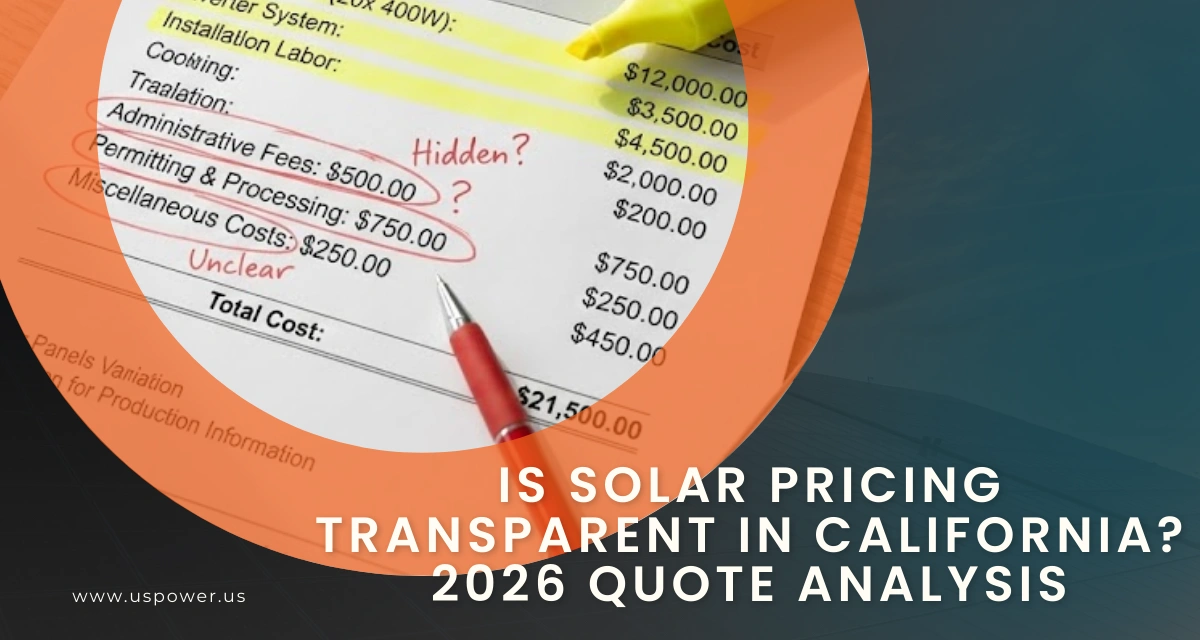
Three quotes. Same house. $15,000 difference. No explanation why. You should worry.









Copyright © 2026 US Power - Axia by Qcells. All Rights Reserved.
Get an instant solar estimate using satellite!