

Discover the fixed monthly charges for SCE, SDG&E, LADWP, and PG&E solar customers, and strategies to reduce bills and maximize solar efficiency in 2025.
Even if your solar system produces 100% of your home's electricity in Southern California, you will still get a bill every month. If you are with SCE, LADWP, or SDG&E, that bill will be between $10 and $25 even when you are a net exporter.
This is not an error. It is how California's Net Billing Tariff (NEM 3.0) is designed to work in 2026.
In this guide, we will break down a real customer bill, explain exactly what those mandatory fees cover, and show you how to design your system so you never pay more than the minimum.
2026 Update: The 30% federal tax credit for homeowner-purchased systems (Section 25D) expired after December 31, 2025. In 2026, most Southern California homeowners go solar through a zero-down lease or Power Purchase Agreement (PPA). For a deeper look at the policy change, read our updated guide on NEM 3.0 in California: What Homeowners Need to Know in 2026.
The 30% federal tax credit for homeowner-purchased systems (Section 25D) expired after December 31, 2025. The residential credit is no longer available for cash or loan purchases installed in 2026.
In 2026, most Southern California homeowners go solar through a zero-down lease or Power Purchase Agreement (PPA) where the installer can still claim the commercial credit (48E) and pass the savings to you as a lower fixed payment.
This is a common sight for solar owners in 2026. This customer exported 495.72 kWh more than they imported during the billing cycle. They were a net producer. Yet the bottom line shows Net Charges of $19.32.
Why? Because California utilities no longer credit you at 1-to-1. You are charged for fixed customer charges and non-bypassable charges on every kWh you pull from the grid at night, even if you sent more power to the grid during the day.
Under the old NEM 2.0 rules, that would have been a $0 bill with credits banked for later. Under NEM 3.0, SCE credits you at the wholesale value of your export, which is 4 to 8 cents, but charges you retail when you pull from the grid at night, which is 45 to 68 cents.
So even if you are a net producer in kilowatt-hours, you are still a net consumer in dollars. That $19.32 is not for the energy itself. It is for the grid infrastructure and mandatory state fees.
Related: This is the exact reason why solar-only is no longer enough for most homes. We explain that shift here: Is Solar Only Enough? The Case for Adding Battery
Under NEM 3.0, your bill is calculated as: Grid Imports - Hourly Export Credits + Fixed Fees = Total Bill. Even if your imports are zero, these three charges remain.
Charge 1: The Fixed Customer Charge. For SCE TOU-D-Prime in 2026, this is $13.53 per month. This covers your meter, billing, and for the grid to be on standby as your backup battery. You pay this every month, even if you import zero kilowatt-hours that month. LADWP is $10.25 to $18.50, SDG&E is $16.50. You cannot make this zero, even with a battery.
Charge 2: Non-Bypassable Charges (NBCs). These are about two to three cents for every kilowatt hour you pull from the grid at night and they can never be offset by solar credits. They include the Wildfire Fund Charge, Public Purpose Programs for low-income discounts, and Nuclear Decommissioning. For a typical home that pulls 400 kWh from the grid at night, that is $8 to $12 per month on top of your customer charge. This is why your bill shows a balance due after being a net exporter. A battery is the only way to avoid NBCs by not importing at night at all.
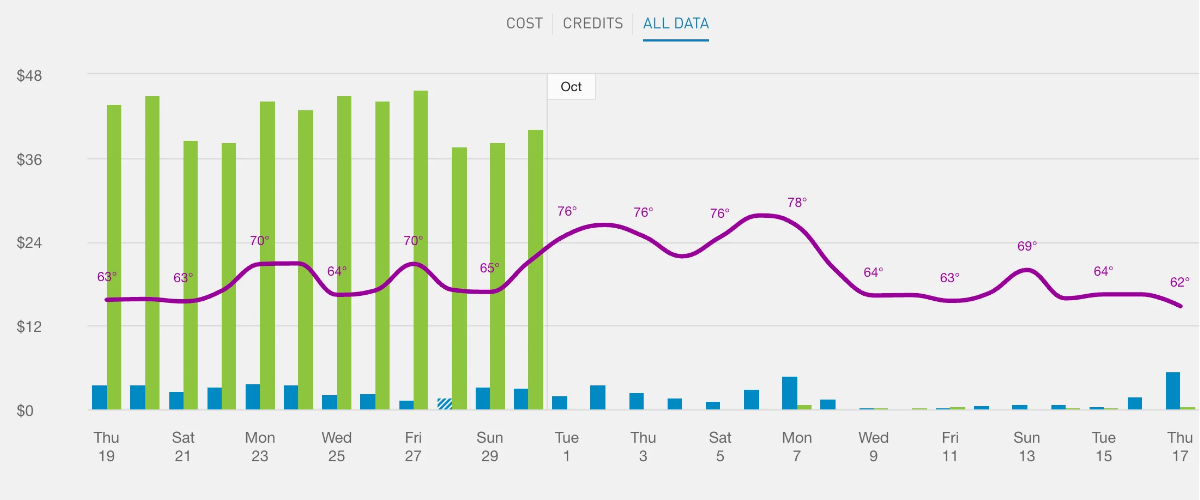
Charge 3: The Time-of-Use Differential. This is the biggest cost driver in 2026. Your solar export is valued at about four to eight cents per kilowatt hour at midday, but the power you import at six to nine PM costs forty-five to sixty-eight cents. That 90% gap is why the old strategy of just exporting more power no longer works. On September 19th, the real home in Figure 2 had about $43 of grid cost but only earned three dollars in export credits.
Here are the verified minimums you will pay even at 100% offset.
To see how your rate plan changes this floor, read our comparison: Best SCE Rate Plan for Solar: TOU-D-PRIME vs TOU-D-4-9PM
Since you cannot avoid the base fee, the strategy is to avoid paying more than it. The average SCE customer who ignores NEM 3.0 pays $80 to $150 over the minimum every month.
First, shift usage to solar hours between ten AM and three PM. Run your EV charger, pool pump, dishwasher, and laundry when your panels are producing. Every kilowatt hour you self-consume is worth five to eight times more than exporting it. This is the single biggest behavioral change under NEM 3.0.
Second, install a battery. A battery stores your low value midday export and lets you use it to avoid high cost peak imports. This is what keeps a typical bill from being forty six dollars instead of three dollars. Under NEM 3.0, a battery is no longer a luxury, it is the core of the savings calculation.
Third, choose the right TOU plan. SCE has TOU-D-Prime and TOU-D-4-9PM and the best plan depends on your usage. The wrong plan can cost you hundreds per year, even with solar and a battery.
Fourth, use a zero-down lease or PPA in 2026. Because the residential purchase credit expired, the most cost-effective path is now a Third-Party Owned system where you get zero down and a fixed low rate. To understand the math, read: Should You Buy or Lease Your Solar Panels in 2025?



The 2025 solar install rush is already over. So is waiting finally the smart move?

Prepare effectively for your solar consultation with these essential steps.

Learn how solar pool heaters work and keep your pool warm year-round. Read more.







Copyright © 2026 US Power - Axia by QCells. All Rights Reserved.
Get an instant solar estimate using satellite!