

Illinois homeowners are sitting on one of the best solar battery incentive stacks in the country — up to $300/kWh from ComEd and Ameren, property tax exemptions, and strong SREC payments through Illinois Shines. But is adding a battery actually worth it in 2026? Here's what the math really looks like and why sizing it correctly makes all the difference.
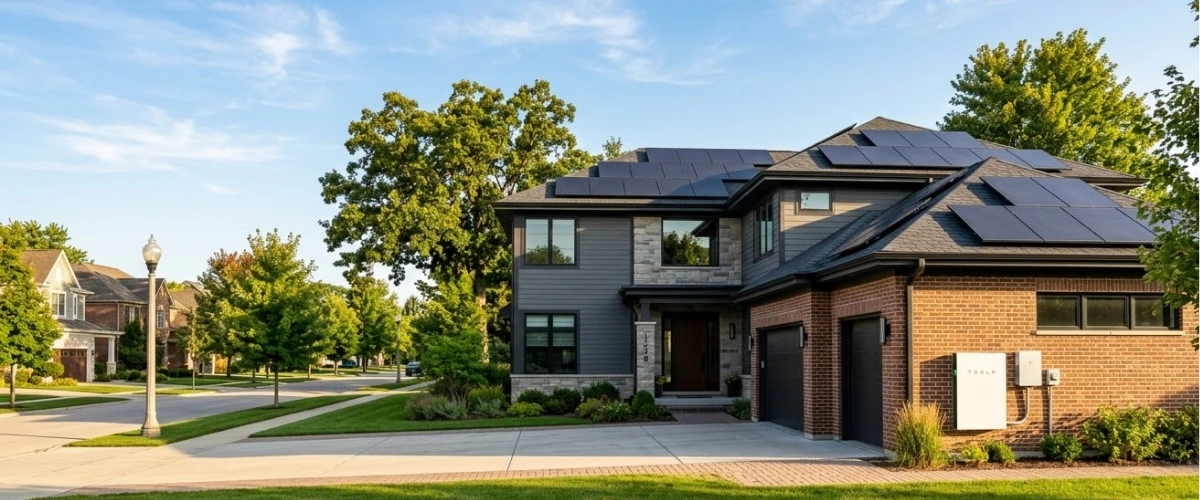
Your solar panels are doing their job — generating clean electricity every day. But when the sun goes down, or when ComEd rates spike during peak hours, where does that power come from? For most Illinois homeowners, the answer is still the grid.
That's where a solar battery changes everything.
In 2026, Illinois has become one of the most financially rewarding states in the country for adding battery storage. Between ComEd and Ameren rebates, the Illinois Shines program, and rising electricity rates, the numbers finally favor homeowners who pair their panels with storage. But only if you size it right — and choose the right partner to install it.
Here's what you need to know before you decide.
Illinois homeowners have watched their electricity bills climb steadily for years. ComEd and Ameren rates have risen roughly 20% since 2021, and that trend isn't slowing down.
Illinois sits at 16–17 cents per kWh on average — above the national average — and that number is moving upward. ComEd is projecting a 40% increase in electricity demand by 2040, driven largely by data centers expanding across the Chicago suburbs.
More demand means more infrastructure spending. And that spending gets passed directly to you on your monthly bill. How much money solar panels save becomes a much more compelling question when your baseline keeps rising.
Here's something many Illinois homeowners don't realize: as of January 1, 2025, new solar customers are no longer enrolled in full retail net metering. Instead, they're placed on Smart Solar Billing, which credits excess energy at the wholesale supply rate — roughly 6–8 cents per kWh — instead of the full retail rate.
That's a significant cut in the value of energy you send back to the grid. The fix? Use more of what you generate on-site. That's exactly what a battery allows you to do.
A solar battery stores the excess electricity your panels produce during the day. Instead of sending that energy to the grid at a low credit rate, you keep it — and use it at night, during peak hours, or when the grid goes down.
Under Smart Solar Billing, every kilowatt-hour you consume from your own battery is worth the full retail rate — because it's a kilowatt-hour you didn't have to buy from your utility. That's the core financial argument for battery storage in Illinois right now.
For a deeper look at how this works, everything about solar and battery storage walks you through the complete picture.
Both ComEd and Ameren offer time-of-use rate plans where electricity costs more during peak hours — typically late afternoon and evening. A properly sized battery lets you charge during the day from your panels and discharge during peak hours, avoiding the most expensive grid electricity entirely.
That timing advantage can make a meaningful difference in your annual savings, especially in summer when demand charges are highest.
For most Illinois homeowners in 2026, the answer is yes — but the math depends on your utility, your current rate plan, and how your system is sized.
Illinois offers one of the strongest battery incentive packages in the Midwest. Here's what's available in 2026:
All told, these incentives can reduce a solar-plus-storage system's cost by 45–60% before financing. Are solar batteries worth the cost breaks down the full analysis.
Without the federal ITC (which ended December 31, 2025), payback periods have shifted. A well-incentivized Illinois solar-plus-storage system now runs 8–12 years depending on your system size, utility territory, and energy usage. With electricity rates rising 3–5% annually, that payback window shortens every year you wait.
This is where Illinois homeowners most often leave money on the table. Bigger isn't always better — and sizing your battery incorrectly can mean underperforming savings or wasted capacity.
The goal is to store enough energy to cover your household's evening and overnight needs — not to maximize storage capacity for its own sake. For most Illinois homes using 30–40 kWh per day, a single battery in the 13–15 kWh range handles nighttime usage comfortably while qualifying for the full ComEd or Ameren rebate.
How solar batteries maximize your savings goes deeper into the sizing math and why getting this right matters more than most homeowners realize.
Under Smart Solar Billing, exporting excess power earns you only a fraction of what you paid for it. A battery captures that value instead of losing it. As the data shows, solar panels alone aren't enough for Illinois homeowners who want to fully protect themselves from rising utility rates.
If you're considering a larger battery setup — say, 30 kWh or more — the configuration of your system matters significantly. Multiple battery units need to be balanced correctly so each unit discharges evenly during high-demand periods. A poorly configured large system can leave capacity sitting unused while one battery drains faster than the others.
This is exactly why working with an experienced, licensed installer is critical. Getting the architecture right from the start protects your investment and your savings.
Most solar companies offer off-the-shelf packages. US Power takes a different approach — starting with a conversation about your specific home, your utility, and your goals.
As an exclusive QCells partner, US Power delivers American-made panels at factory-direct pricing — typically 15–20% below what you'd pay through a middleman installer. QCells panels carry a 25-year comprehensive warranty covering performance, workmanship, and the panels themselves.
That warranty matters especially for battery-paired systems, where panel output directly affects how much your battery charges each day.
Every US Power consultation is handled by a CSLB-licensed consultant who understands the ComEd and Ameren rebate process, Illinois Shines program requirements, and Smart Solar Billing optimization. You won't get a generic quote — you'll get a system designed around your actual bill and usage patterns.
Which backup power option is right for you is a question US Power answers differently for every homeowner. With 200+ five-star Google reviews, that approach shows.
Once your system is approved, US Power targets a 3–4 week installation timeline — significantly faster than the industry average. For Illinois homeowners trying to lock in current incentive levels before they change, that speed is a real advantage.
Electricity reliability in Illinois has become a growing concern. Severe storms, heat waves, and an aging grid infrastructure have led to more frequent outages — particularly in suburban Chicago and downstate communities.
A paired solar-plus-storage system gives your home backup power automatically when the grid goes down. Unlike a gas generator, a battery requires no fuel, no startup time, and no maintenance costs. It simply kicks in.
For families with medical equipment, home offices, or young children, that reliability has real value that goes beyond the financial math.
In January 2026, Governor Pritzker signed the Illinois Clean and Reliable Grid Affordability Act (CRGA) — the most significant energy legislation in Illinois since 2021. Among its provisions: utilities must file virtual power plant (VPP) tariff structures by June 2026, creating a framework where battery owners can earn additional income by allowing their systems to support the grid during peak demand events.
Illinois is actively building a future where home batteries are part of the grid solution. Getting in now means capturing the best incentive levels before the market matures.
Illinois is one of the best states in the country to add solar battery storage in 2026. The ComEd and Ameren rebates are strong, the Illinois Shines program continues to pay out, and rising electricity rates mean every kilowatt-hour you generate and store is worth more with each passing year.
But incentive programs don't stay at their current levels forever. Is battery storage still worth it today — the answer right now is a clear yes, especially in Illinois. The question is how long that window stays open.
US Power makes it easy to find out exactly what your home qualifies for. No pressure, no jargon — just a real consultation with a licensed expert who knows Illinois inside and out.


Your residential solar panels may be working. Your wallet might not be. Here's why.
Your solar panels could be worth twice as much if you stop selling power back to SCE.
Act now as Arizona electric rates rise fast—why solar is the smarter choice.








¿Estás listo para ser dueño de tu poder? ¡Llámenos hoy mismo!
818-650-8010Contractor License #: 1144368

Derechos de autor © 2025 US POWER | Energía solar y techosUS Power - Axia by QCells. All Rights Reserved.
¡Obtenga una estimación solar instantánea usando el satélite!