
A Duke Energy customer just found out their utility could retroactively change their solar agreement to a worse rate, without permission. That raises a harder question for anyone comparing solar lease companies: what happens to your promised savings when net metering rules change after you've already signed? This guide breaks down how solar lease companies actually work, how net metering 3.0 changes the math, and what to check in any lease contract before you commit.
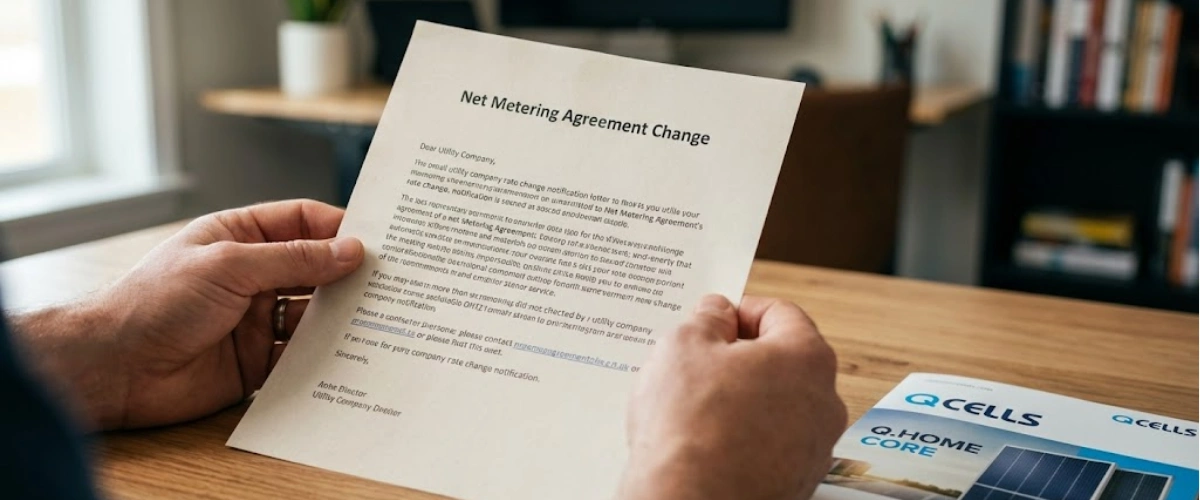
A homeowner in Indiana recently posted a disturbing question on Reddit. Their utility, Duke Energy, sent a letter saying their solar system had been "mistakenly placed on an incorrect net metering tariff" and would be switched to a different compensation plan, one that pays significantly less for excess solar production. "I am worried," they wrote. "How worried should I be?"
That story is about a utility, not a solar lease company, but it points at a question anyone comparing solar lease companies should be asking. If a utility can retroactively change the value of your solar production, what happens to the savings a lease company promised you on day one? The answer depends heavily on net metering 3.0, how your specific lease contract is written, and which solar lease companies actually put their promises in writing.
A solar lease is different from buying a system outright. Under a lease, a third-party company owns the panels on your roof, and you pay a fixed monthly fee to use the electricity they produce, similar to leasing a car instead of buying one. Solar lease companies typically handle maintenance and repairs, and most leases include an escalator clause that raises your payment a set percentage each year. The appeal is no upfront cost, but the tradeoff is real: you don't own the equipment, you generally can't claim any tax benefits tied to ownership, and the value of your production credits depends entirely on how the lease company's contract handles utility rate changes like net metering 3.0.
California moved to the Net Billing Tariff, commonly called NEM 3.0, in April 2023. Export credits for solar sent back to the grid dropped by roughly 75 to 80 percent compared to the old system, from somewhere around 30 to 40 cents per kWh down to 5 to 8 cents. For a homeowner who owns their system, that shift is exactly why battery storage has become essential rather than optional. For a homeowner leasing from one of the solar lease companies, the same shift raises a different question entirely: does your fixed monthly lease payment still reflect a system producing less exportable value than it did when you signed, and does the lease company pass any of that difference back to you? Most standard lease contracts don't adjust downward when export values fall, which means the math that looked good at signing can look considerably worse a few years in.
When NEM 3.0 rolled out, California grandfathered existing solar customers who already had an interconnection agreement, locking them into their prior net metering structure for 20 years from the date of interconnection. That protection is real, but it protects the account associated with the interconnection agreement, not automatically every term of a lease sitting on top of it. If you significantly expand a leased system, if the lease company transfers your contract to a different servicer, or if paperwork around your interconnection wasn't filed correctly in the first place, your grandfathered status can come into question in ways an owned system typically avoids.
Not every lease agreement from every solar lease company is written the same way. Watch for vague language like "subject to utility approval" or "rates may vary based on utility policies," which offers you no real protection. Watch for a contract that never explicitly references net metering grandfathering provisions, or one that lets the lease company set all compensation terms without a locked structure. And watch for an escalator clause that raises your payment automatically every year regardless of whether your system's actual production value has changed.
Before signing with any solar lease companies you're comparing, ask directly whether your production credits are locked for the life of the agreement, what happens if the utility claims an "administrative error" similar to the Duke Energy situation, how the company documents your interconnection paperwork, and whether the lease includes any guarantee tied to actual performance rather than just a fixed monthly bill. A company that can't answer these clearly in writing is not one to sign with.
If you're comparing solar lease companies outside California, the rules you're leasing against are different. Illinois still offers full retail-rate net metering for most systems. Florida currently requires 1:1 net metering from its investor-owned utilities. Connecticut runs its own Netting Tariff through Eversource and United Illuminating, where 1:1 credits apply but a separate production charge locks in at the rate in effect the year you apply, for 20 years. Texas has no statewide net metering mandate at all, so what a lease actually nets you depends entirely on which retail electricity provider is attached to the deal. In every case, the lesson is the same: know the export rule your specific utility applies before you sign a lease built around assumptions that rule could change.
Ownership generally holds up better under a policy shift like net metering 3.0, because you keep every benefit or drawback of the system's actual production instead of a fixed payment set at signing. A lease can still make sense for homeowners who want no upfront cost and don't plan to stay long enough to benefit from ownership, but it shifts more of the policy risk onto whichever entity structured the contract, which is exactly why the contract terms from solar lease companies matter as much as the monthly rate they quote you. A full breakdown of buying versus leasing under today's rules covers the decision in more depth, including where a prepaid lease fits between the two.
Rather than a standard third-party lease, US Power offers a prepaid lease program with a 25-year term, no FICO or credit underwriting, no property lien, and the option to purchase the system at fair market value starting in year six. The pricing sits below an equivalent cash purchase, and the agreement is fully transferable if you sell your home, with no underwriting required for the buyer. It's structured around the commercial federal tax credit, not the expired residential credit, which is part of how the upfront cost comes down.
Every option, leased or owned, runs on factory-direct American-made Qcells panels, typically 15 to 20 percent below market rates, backed by a 25-year comprehensive warranty and CSLB-licensed consultants who document your interconnection paperwork correctly the first time, which is the single biggest factor in whether your protections hold up if a utility or a servicer ever tries to revisit your terms.
Solar lease companies aren't all the same, and the difference shows up most clearly when a policy like net metering 3.0 changes the math after you've already signed. Before comparing rates, compare the contract: whether your credits are locked, whether your grandfathering is documented, and whether the company answers direct questions in writing. Talk to a licensed US Power consultant about how a prepaid lease or ownership compares for your specific home.


A 2025 homeowner’s guide to safe, efficient solar connectors. Safer, Smarter Solar!

Tips for maintaining net metering while expanding home solar panels in 2025.

Understand solar panel sizes and how they fit different California rooftops.







¿Estás listo para ser dueño de tu poder? ¡Llámenos hoy mismo!
818-650-8010Contractor License #: 1144368

Derechos de autor © 2025 US POWER | Energía solar y techosUS Power - Axia by QCells. All Rights Reserved.
¡Obtenga una estimación solar instantánea usando el satélite!