
Tres años esperando a que bajen los precios de la energía solar, pero su factura de SCE sigue subiendo. Esto es lo que realmente está pasando con los precios de la energía solar en 2026 en el sur de California y por qué la estrategia de "esperar y ver" podría estar costándole miles de dólares.
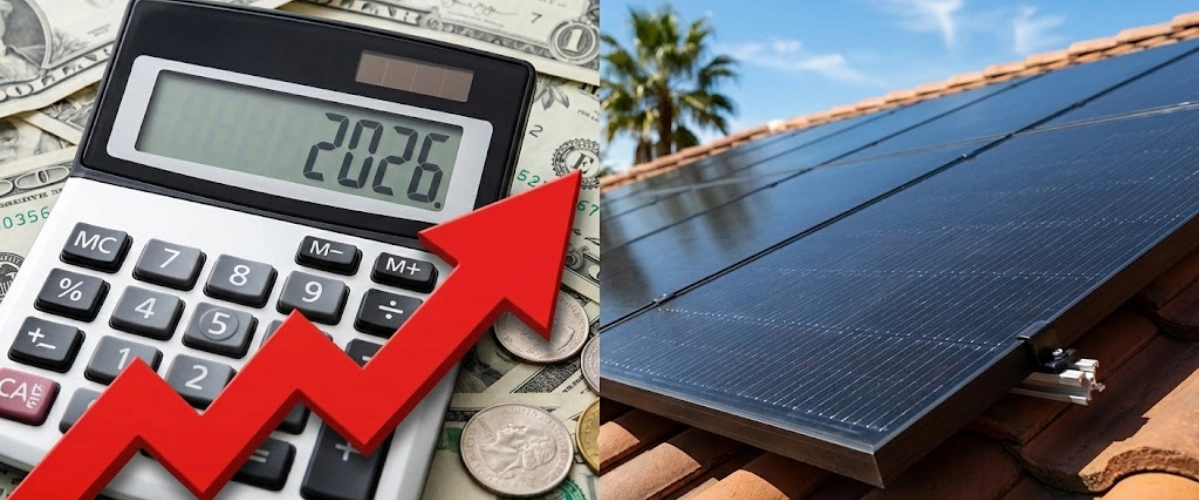
Los expertos del sector dicen que no. Los fabricantes de paneles han anunciado aumentos de precios para 2026, los costes laborales siguen subiendo y las tasas de permisos no disminuyen, por lo que esperar puede costarle más mientras su factura sigue aumentando.
Lleva tres años observando los precios de la energía solar. Quizás piense: "El crédito fiscal federal ya no existe, así que los precios seguramente bajarán pronto, ¿verdad?". Mientras tanto, su factura de Southern California Edison acaba de alcanzar otro récord histórico.
Esto es lo que realmente está ocurriendo con los precios de la energía solar en 2026 y por qué esperar a una caída drástica de los precios podría ser la decisión más costosa que tome.
Abordemos el verdadero problema: los costos de su electricidad no van a esperar a que los precios de la energía solar se estabilicen.
Las tarifas de SCE y PG&E han aumentado un 32% desde 2014 y no muestran señales de frenar. Las tarifas por tiempo de uso durante las horas pico (de 4 a 9 p. m.) superan regularmente los $0.50 por kWh en algunas zonas. Si usa aire acondicionado, carga un vehículo eléctrico o simplemente hace su vida durante las horas de la tarde, está pagando tarifas premium.
Esto es lo que los propietarios pasan por alto al obsesionarse con los precios de la energía solar: cada mes que espera le cuesta entre $200 y $400 en facturas de electricidad que nunca recuperará. Eso supone entre $2,400 y $4,800 al año que van directamente a su compañía eléctrica.
Incluso si el equipo solar bajara un 10% el próximo año (algo que los expertos del sector consideran poco probable), perdería más dinero esperando que lo que ahorraría en el sistema. Obtenga más información sobre por qué las facturas de electricidad son tan altas en el sur de California.
Las empresas de servicios públicos del sur de California citan mejoras en la infraestructura, mitigación de incendios forestales y cumplimiento normativo. Traducción: las tarifas seguirán subiendo independientemente de lo que ocurra en el mercado solar. La pregunta no es si instalar energía solar, sino si quiere fijar sus costos de energía ahora o seguir apostando a que las tarifas de los servicios públicos aumenten.
El crédito fiscal federal del 30% finalizó el 31 de diciembre de 2025. Por lo tanto, naturalmente, esperaría que los precios bajaran aproximadamente un 30%, ¿verdad?
No exactamente. Esto es lo que realmente está sucediendo en la industria solar.
Los fabricantes de paneles anunciaron aumentos de precios para el segundo, tercer y cuarto trimestre de 2026. Los costos laborales siguen aumentando en todos los sectores de la construcción. Las tarifas de permisos y los costos de interconexión a la red eléctrica son más altos que nunca.
La realidad: las empresas solares no estaban inflando los precios un 30% para compensar el crédito fiscal. La mayoría de los instaladores residenciales ya operan con márgenes reducidos. Consulte nuestro análisis detallado del costo de los paneles solares para 2025-2026.
Una instalación solar típica en el sur de California se desglosa de la siguiente manera:
Las tarifas de mano de obra no han disminuido. Los departamentos de permisos no son más rápidos ni más económicos. Y los paneles de calidad de fabricantes como QCells mantienen precios estables porque la demanda sigue siendo fuerte.
Algunos instaladores ofrecen tarifas competitivas en el rango de $1.85 a $2.25 por vatio para compras en efectivo. Eso es, de hecho, más bajo que muchas cotizaciones de 2024-2025. Pero no verá descuentos masivos en toda la industria porque la estructura de costos no ha cambiado fundamentalmente.
Aquí es donde la conversación pasa de "¿debería esperar a que bajen los precios?" a "¿estoy eligiendo el sistema correcto?".
Si se encuentra en el sur de California, los paneles solares por sí solos ya no maximizarán sus ahorros. La medición neta de energía (NEM) 3.0 lo cambió todo.
Bajo el antiguo sistema NEM 2.0, el exceso de energía solar enviado a la red le otorgaba un crédito casi equivalente al precio minorista. Con la NEM 3.0, ese crédito por exportación cayó un 75% o más. Sus paneles solares siguen generando la misma cantidad de energía, pero sin almacenamiento en baterías, la está vendiendo a SCE o PG&E a una fracción de lo que paga por comprarla de vuelta por la noche.
Un sistema de baterías bien dimensionado le permite almacenar su producción solar diurna y utilizarla durante las costosas horas pico de la tarde. Aquí es donde se producen los ahorros reales en 2026: descubra cómo las baterías solares pueden maximizar sus ahorros.
El cálculo: un sistema solo solar podría reducir su factura entre un 40% y un 50%. La energía solar con almacenamiento en baterías puede reducirla en un 80-90% o más. Sí, las baterías aumentan el costo inicial, pero marcan la diferencia entre ahorros moderados y una independencia energética sustancial.
Los propietarios de viviendas en el sur de California que instalan energía solar en 2026 no solo comparan el precio por vatio. Evalúan el valor total a lo largo de más de 25 años.
¿Sabe qué es más caro que pagar un poco más al principio? Lidiar con un instalador que cierra su negocio, le deja un sistema que no funciona correctamente o desaparece cuando necesita hacer válida la garantía.
Varias empresas de energía solar cerraron sus puertas a principios de 2026 a medida que la demanda cambió tras el crédito fiscal. Las empresas que sobreviven a esta transición son aquellas con modelos de negocio sostenibles, asociaciones con equipos de calidad y una presencia local real. Lea sobre las cosas que debe saber antes de instalar energía solar en California.
Cada mes que retrasa su decisión significa:
Si espera 12 meses con la esperanza de una caída del 10% en el precio, gastará entre $2,400 y $4,800 en electricidad durante ese tiempo. Los "ahorros" por costos de equipo más bajos se ven completamente anulados por las facturas de servicios públicos que podría haber evitado.
Comparar precios es inteligente. Pero centrarse únicamente en el precio más bajo por vatio puede salirle muy caro.
US Power es el socio exclusivo de QCells en el sur de California, lo que significa que obtenemos paneles fabricados en EE. UU. directamente del fabricante. Sin comisiones de intermediarios. Sin tarifas de distribuidores. Este modelo de venta directa de fábrica ofrece precios entre un 15% y un 20% por debajo de las tarifas habituales del mercado, manteniendo una calidad superior. Descubra por qué los precios directos de fábrica significan más ahorros.
Más de 180 reseñas de cinco estrellas en Google de propietarios reales en el sur de California. Consultores con licencia CSLB que ofrecen precios transparentes sin tácticas de venta agresivas. Garantía integral de 25 años que cubre paneles, mano de obra y rendimiento. Plazo de instalación de 3 a 4 semanas desde la aprobación hasta la activación, en lugar de las 8 a 12 semanas que requieren muchos competidores.
Los paneles QCells se fabrican en Estados Unidos con un riguroso control de calidad. Funcionan excepcionalmente bien bajo el intenso sol y calor del sur de California. Y como US Power se encarga de todo internamente (diseño, permisos, instalación, activación), no tendrá que lidiar con subcontratistas que quizás no aparezcan. Obtenga más información sobre cómo elegir una empresa de energía solar en Los Ángeles.
"No puedo permitirme un sistema de 50.000 dólares" es la objeción más común que escuchamos. Y se basa en una idea equivocada.
La mayoría de los propietarios en el sur de California financian sus sistemas solares. Los pagos mensuales del préstamo suelen oscilar entre 150 y 300 dólares, dependiendo del tamaño del sistema; a menudo, menos que su factura de electricidad actual. Básicamente, está redirigiendo el dinero que ya gasta en electricidad hacia un activo que será suyo. Explore opciones de financiación solar asequibles en el sur de California.
Pagar al contado le brinda el retorno de inversión más rápido. Pero si no dispone de efectivo, los préstamos solares de bajo interés (a menudo con una TAE del 3-6%) siguen teniendo sentido financiero porque evita los aumentos en las tarifas de los servicios públicos, que promedian entre un 5% y un 7% anual.
Sí, el crédito federal del 30% ya no existe. Pero su retorno de inversión sigue superando a la mayoría de las inversiones tradicionales. Un sistema típico en el sur de California se paga solo en 6 a 8 años gracias al ahorro en electricidad, y luego proporciona más de 17 años de energía prácticamente gratuita. El aumento en el valor de la propiedad añade otro 3-4% al valor de su hogar.
No es probable que los precios de la energía solar bajen drásticamente en 2026. Los costos de los paneles están aumentando, la mano de obra no es más barata y es posible que las empresas solares que ofrecen precios bajísimos no existan cuando llegue el momento de cumplir con sus garantías.
¿Qué aumentará definitivamente? Sus facturas de electricidad.
Los propietarios que salen ganando no son los que esperaron el precio perfecto. Son los que reconocieron que cada mes de retraso les cuesta cientos de dólares en facturas de servicios públicos que nunca recuperarán; dinero que podría haber estado construyendo capital en su propio sistema energético.
La asociación directa de fábrica de US Power con QCells, los precios transparentes y el plazo de instalación de 3 a 4 semanas hacen que pasarse a la energía solar sea sencillo y asequible ahora mismo. No cuando los precios bajen. No cuando aparezca el próximo incentivo. Ahora.
Su medidor de electricidad sigue corriendo mientras lee esto. La pregunta es si quiere seguir pagando tarifas premium a SCE y PG&E o redirigir ese dinero hacia la independencia energética.


Tu sistema de climatización podría consumir la mitad de tu factura eléctrica al mes.
Cuando los números no cuadran con la oferta. Esto es lo que debes comprender hoy.

Descubre cómo la gestión energética ayuda a ahorrar dinero y mejorar la eficiencia.







¿Listo para tomar el control de tu energía? ¡Llámanos hoy!
818-650-8010Licencia de contratista n.º: 1144368
Copyright © 2026 US Power - Axia by QCells. Todos los derechos reservados.
¡Obtenga un presupuesto solar al instante mediante satélite!