

Caso de estudio real: Solar + electrodomésticos inteligentes = 82% de ahorro en facturas de SCE.
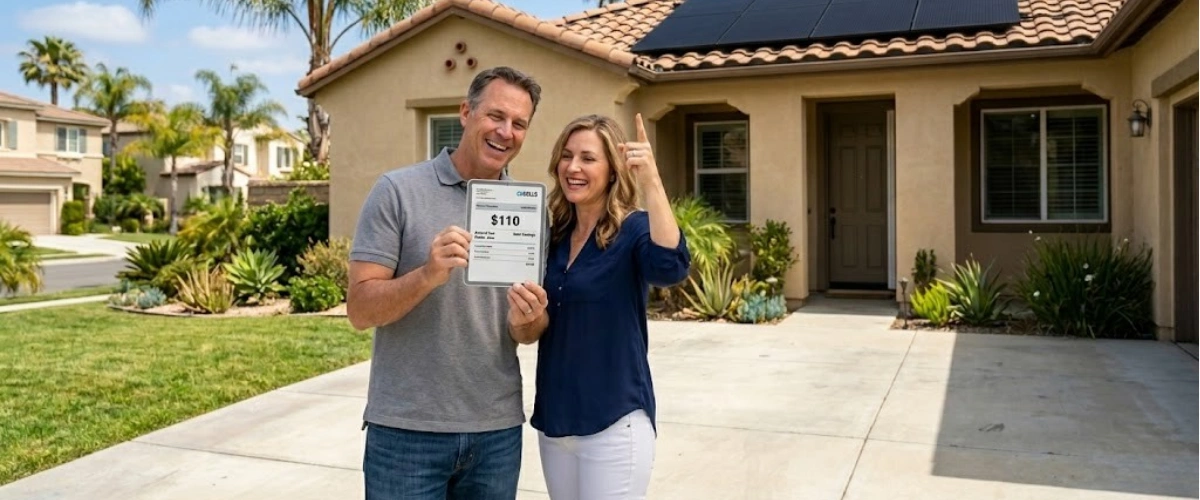
En este caso de estudio real, un propietario combinó energía solar con electrodomésticos inteligentes y eficientes, logrando reducir su factura de SCE en un 82 por ciento. Los resultados varían según el hogar, pero combinar la energía solar con mejoras de eficiencia puede ser de gran ayuda.
El aumento de las tarifas eléctricas en el sur de California tiene a los propietarios buscando desesperadamente un alivio. Pero, ¿qué pasaría si la respuesta no fuera solo instalar paneles solares, sino combinarlos con las mejoras adecuadas para el hogar?
Un propietario del condado de Los Ángeles compartió recientemente cómo redujo su factura eléctrica anual de $600 a solo $110 combinando energía solar con el reemplazo estratégico de electrodomésticos de bajo consumo. Es una reducción del 82% que sigue acumulándose año tras año.
Aquí le explicamos exactamente cómo lo hicieron y cómo puede replicar estos resultados en su propio hogar.
Si ha notado que su factura de SCE o PG&E aumenta cada mes, no es producto de su imaginación. Entender por qué las facturas de electricidad son tan altas en el sur de California se ha convertido en una de las preguntas más buscadas por los propietarios.
Southern California Edison aumentó las tarifas en más de un 30% entre 2020 y 2025. El hogar promedio paga ahora entre $150 y $250 mensuales durante los meses pico de verano. Con la inflación y los costos de infraestructura, esas cifras no van a bajar.
Muchos propietarios no se dan cuenta de que su mayor consumo de energía no proviene de las luces o el televisor, sino de sistemas de climatización y calentadores de agua obsoletos de los años 90 o principios de los 2000.
Las unidades de aire acondicionado más antiguas pueden consumir entre un 50% y un 70% más de electricidad que los modelos modernos de alta eficiencia. Cuando las temperaturas superan los 35°C (95°F) en el Valle de San Fernando o el Inland Empire, estos sistemas antiguos funcionan constantemente, elevando las facturas.
Incluso con energía solar, SCE cobra una tarifa obligatoria de conexión a la red de aproximadamente $10-15 al mes. Nunca eliminará por completo su relación con la compañía eléctrica, pero puede minimizar lo que paga por encima de ese cargo base.
La política de Medición de Energía Neta 3.0 de California cambió las reglas del juego por completo cuando entró en vigor en 2023. A diferencia del sistema anterior, NEM 3.0 paga significativamente menos por el exceso de energía solar que usted envía de vuelta a la red.
Esto significa que la vieja estrategia de "sobredimensionar su sistema y vender energía" ya no funciona. Ahora, las baterías solares pueden maximizar sus ahorros almacenando su exceso de energía para usarla durante las costosas horas de la tarde.
Bajo NEM 3.0, la electricidad que consumes de la red entre las 4 y las 9 p. m. es la más cara. Ese es precisamente el momento en que los paneles solares producen menos. Una batería te permite usar tu propia energía solar almacenada durante estas horas de tarifa alta en lugar de comprar electricidad costosa de la red.
El propietario de nuestra vivienda de estudio de caso no tenía una batería al principio, pero acumuló suficientes créditos solares durante la primavera y el verano para compensar su consumo mínimo en invierno. Sin embargo, para la mayoría de los propietarios en el sur de California, añadir almacenamiento en baterías acelera la recuperación de la inversión y maximiza el ahorro.
Antes de tomar cualquier decisión, comprende a dónde va realmente tu energía. Un hogar típico del sur de California consume entre 600 y 900 kWh al mes, pero las casas con sistemas de climatización (HVAC) antiguos o bombas de piscina pueden alcanzar fácilmente los 1,200-1,500 kWh.
Haz un seguimiento de tu consumo durante 3 a 6 meses para identificar patrones. Podrías descubrir que el aire acondicionado representa entre el 40% y el 50% de tu consumo total durante el verano, un objetivo claro para mejorar la eficiencia.
Aquí es donde ocurre la verdadera magia. El propietario que logró un ahorro del 82% no solo instaló paneles solares. Al mismo tiempo, reemplazó estratégicamente los electrodomésticos que consumían mucha energía.
Hay cosas que debes saber antes de instalar energía solar que pueden afectar drásticamente tus resultados, y la eficiencia de los electrodomésticos encabeza esa lista.
Reemplazar un sistema de aire acondicionado de los años 90 por una bomba de calor moderna de alta eficiencia puede reducir los costos de refrigeración entre un 30% y un 50%. En el clima del sur de California, eso es considerable.
Los sistemas modernos también incluyen termostatos inteligentes que aprenden tus patrones y optimizan el tiempo de funcionamiento. Algunos propietarios informan que su nuevo aire acondicionado utiliza la mitad de electricidad mientras mantiene su hogar más cómodo.
Los calentadores de agua eléctricos tradicionales consumen mucha energía, especialmente en hogares grandes. Los calentadores de agua con bomba de calor utilizan entre un 50% y un 60% menos de electricidad al trasladar el calor en lugar de generarlo.
El propietario de nuestro ejemplo cambió a calentadores de agua con bomba de calor y los utiliza en modo "solo bomba de calor", sin recurrir nunca al costoso respaldo de resistencia eléctrica. Este simple cambio les ahorró un estimado de $15-25 al mes.
Si tienes una piscina, es probable que tu bomba funcione de 6 a 8 horas al día. Las bombas de piscina de velocidad variable consumen entre un 65% y un 75% menos de energía que los modelos de una sola velocidad y, a menudo, califican para reembolsos de las empresas de servicios públicos.
Combinado con la energía solar, básicamente puedes hacer funcionar tu piscina "gratis" mientras generas créditos que compensan el consumo de otros electrodomésticos del hogar.
Analicemos los cálculos reales de esta historia de éxito en el condado de Los Ángeles.
Antes de la energía solar y las mejoras:
Después de la energía solar y las mejoras:
¿Quieres saber cuánto dinero ahorran los paneles solares en tu caso particular? El cálculo depende de tu consumo actual, las características de tu tejado y las tarifas eléctricas locales.
Ese ahorro anual de 490 $ se acumula durante 25 años, la duración de la garantía integral de US Power. Sin tener en cuenta la inflación ni futuras subidas de tarifas, eso supone más de 12.000 $ de ahorro.
Si tenemos en cuenta los aumentos históricos de las tarifas de SCE del 3-5% anual, el ahorro real podría superar fácilmente los 20.000 $ durante la vida útil del sistema.
De marzo a octubre, el sur de California recibe una exposición solar excepcional. El sistema del propietario generó suficiente exceso de energía durante estos meses como para acumular créditos considerables.
Esos créditos compensan la tarifa de conexión a la red y el consumo mínimo de invierno, cuando la producción solar disminuye ligeramente. ¿El resultado? Un coste anual de electricidad casi nulo.
Aunque reducir la factura eléctrica es el principal motivo, existen grandes ventajas de la instalación de paneles solares residenciales que a menudo sorprenden a los nuevos propietarios.
Los estudios demuestran que las casas con energía solar se venden entre un 4% y un 6% más caras que las comparables que no la tienen. En el mercado inmobiliario del sur de California, eso puede suponer entre 30.000 y 60.000 $ de valor añadido.
Los compradores dan cada vez más prioridad a las viviendas con menores costes operativos, especialmente en zonas con tarifas eléctricas elevadas como Los Ángeles, el condado de Orange y el Inland Empire.
Aunque la energía solar por sí sola no alimentará tu hogar durante los cortes (por requisitos de seguridad), combinarla con almacenamiento en baterías proporciona energía de respaldo durante los cortes de suministro por seguridad pública (PSPS) o fallos de la red.
Esto se volvió fundamental durante las recientes temporadas de incendios forestales, cuando las empresas eléctricas cortaron el suministro de forma proactiva para reducir el riesgo de incendio.
Un sistema solar residencial típico en el sur de California compensa entre 3 y 4 toneladas de CO2 al año, lo que equivale a plantar más de 100 árboles o dejar de recorrer 7.500 millas en coche.
Para los propietarios preocupados por su huella de carbono, este impacto tangible es fundamental.
No todas las instalaciones solares ofrecen los mismos resultados. La calidad del equipo, la experiencia en la instalación y el respaldo de la garantía son aspectos cruciales.
La asociación exclusiva de US Power con QCells le permite obtener paneles fabricados en EE. UU. a precios directos de fábrica, generalmente entre un 15 y un 20 % por debajo de las tarifas del mercado. Los paneles QCells ofrecen un rendimiento superior incluso bajo el intenso calor y la exposición solar del sur de California.
La mayoría de las empresas solares ofrecen garantías separadas para paneles, inversores y mano de obra. La garantía integral de 25 años de US Power cubre todo bajo un mismo respaldo.
Si surge algún problema (defectos en los paneles, fallos en la instalación o degradación del rendimiento), usted tiene un único punto de contacto, evitando que varios proveedores se culpen entre sí.
El propietario de nuestro caso de estudio destacó otra frustración que enfrentan muchos compradores de sistemas solares: las demoras interminables. Algunas empresas tardan de 3 a 6 meses desde la firma hasta la instalación.
El proceso optimizado de US Power con QCells permite instalar y activar los sistemas en un plazo de 3 a 4 semanas tras la aprobación de los permisos. Esto significa que usted empieza a ahorrar antes.
Más allá de las mejoras importantes ya mencionadas, existen formas sencillas de reducir las facturas de electricidad rápidamente que complementan su inversión solar.
Si aún no lo ha hecho, reemplace todas las bombillas incandescentes y CFL por LED. Consumen entre un 75 y un 80 % menos de energía y duran de 15 a 25 veces más.
Aunque esto solo suponga un ahorro de 10 a 15 dólares al mes, es dinero que no tendrá que provenir de su producción solar, liberando esa energía para otros usos.
El consumo fantasma de televisores, computadoras y cargadores en modo de espera puede representar entre el 5 y el 10 % de su factura eléctrica. Las regletas inteligentes cortan automáticamente la energía de los dispositivos cuando no están en uso.
No se apresure a reemplazar electrodomésticos que funcionan bien, pero cuando su refrigerador, lavavajillas o lavadora necesiten ser sustituidos, elija modelos Energy Star. Por lo general, consumen entre un 10 y un 50 % menos de energía que los modelos estándar.
El propietario de nuestro caso de estudio mencionó que planea realizar mejoras adicionales a medida que sus electrodomésticos lleguen al final de su vida útil. Este enfoque gradual tiene mucho sentido financiero.
¿Listo para replicar estos resultados? Esto es exactamente lo que debe hacer a continuación.
Primero, reúna sus facturas de electricidad de los últimos 12 meses para comprender sus patrones de consumo. Esto ayuda a los consultores de US Power, con licencia CSLB, a diseñar un sistema perfectamente adaptado a sus necesidades: ni demasiado grande, ni demasiado pequeño.
Segundo, recorra su hogar y tome nota de la antigüedad y el estado de sus electrodomésticos principales. ¿Tiene un aire acondicionado de hace 20 años? ¿Un calentador de agua de 2005? Estas son oportunidades para acumular ahorros.
Tercero, programe una consulta gratuita, ya sea virtual o presencial. El equipo de US Power analizará su techo, calculará su potencial solar y le ofrecerá precios transparentes sin cargos ocultos.
Comprender el cronograma de instalación solar en California le ayuda a planificar adecuadamente. La mayoría de los propietarios se sorprenden de lo rápido que pueden empezar a generar su propia energía y ver reducciones inmediatas en sus facturas.
El propietario de una vivienda en el sur de California que logró un 82% de ahorro no hizo nada que usted no pueda replicar. Combinó un dimensionamiento solar inteligente con mejoras estratégicas en sus electrodomésticos y aseguró décadas de ahorro.
Dado que las tarifas de SCE y PG&E siguen subiendo, esperar solo significa pagar más a las compañías eléctricas. Cada mes que se retrasa es otro mes de facturas innecesarias.
Los precios directos de fábrica de QCells de US Power, la garantía integral de 25 años y el rápido cronograma de instalación de 3 a 4 semanas eliminan las barreras tradicionales que mantenían a los propietarios estancados en la parálisis por análisis.
El mejor momento para instalar energía solar fue hace cinco años. El segundo mejor momento es hoy.



La energía solar es rentable: maximiza ahorros sin esperar créditos fiscales.

Un error en tu instalación solar puede costarte más de $3,000 y meses de problemas.

La mayoría de hogares en Los Ángeles requieren de 10 a 19 paneles. Su empresa varía.








¿Listo para tomar el control de tu energía? ¡Llámanos hoy!
818-650-8010Licencia de contratista n.º: 1144368

Copyright © 2026 US Power - Axia by QCells. Todos los derechos reservados.
¡Obtenga un presupuesto solar al instante mediante satélite!