
El crédito fiscal federal por energía solar finalizó el 31 de diciembre de 2025 y ahora las empresas del sector promocionan agresivamente los alquileres y los PPA. Pero, ¿realmente tiene sentido alquilar para los propietarios de viviendas en el sur de California, o está sacrificando valor a largo plazo por una comodidad a corto plazo?
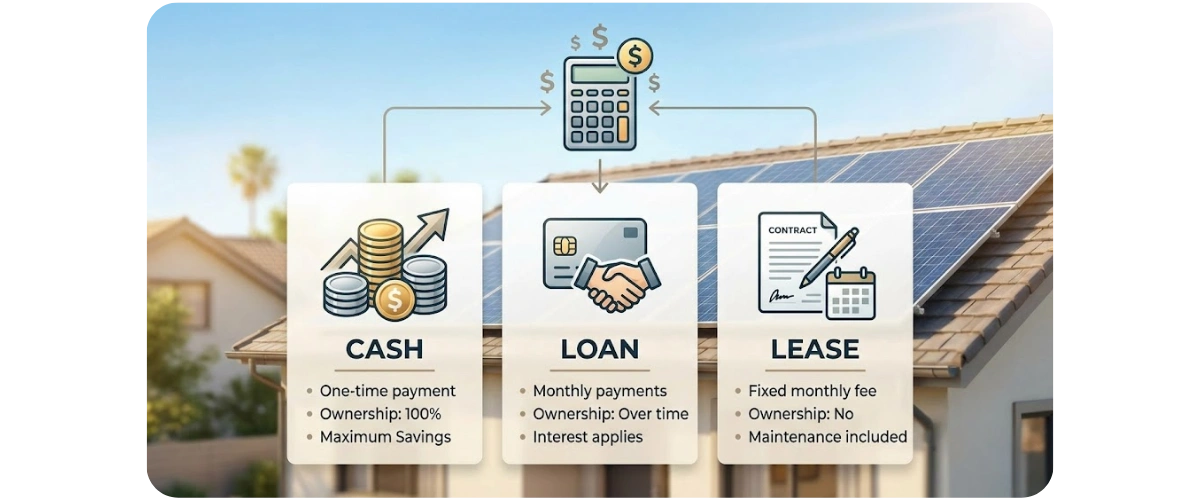
Comprar significa que usted es dueño del sistema y conserva sus beneficios, mientras que arrendar significa que una empresa es la propietaria y usted paga mensualmente por la energía que genera. Por lo general, la propiedad ofrece más valor a largo plazo, aunque el arrendamiento requiere una menor inversión inicial.
Probablemente haya notado algo interesante si ha estado buscando opciones de energía solar en 2026: casi todas las empresas del sector están impulsando los Acuerdos de Compra de Energía (PPA) y los alquileres prepagados como nunca antes. El mensaje es claro: sin el crédito fiscal federal del 30% que finalizó el 31 de diciembre de 2025, el alquiler es supuestamente su mejor opción.
Pero esto es lo que no le dicen a muchos propietarios en el sur de California: las empresas de energía solar aún pueden reclamar créditos fiscales comerciales por los sistemas alquilados, mientras que usted queda atrapado en un contrato de 25 años durante los años de mayor productividad de su sistema solar. La verdadera pregunta no es si la energía solar tiene sentido sin el crédito fiscal (definitivamente lo tiene con el aumento de las tarifas de SCE). La pregunta es si renunciar a la propiedad de su activo solar vale la pena por la comodidad de pagar cuotas mensuales más bajas.
Dejemos de lado el ruido del marketing y analicemos las cifras reales.
Esto es lo que está sucediendo en la industria solar ahora mismo. Cuando se anunció la fecha límite del crédito fiscal federal, miles de propietarios en el sur de California se apresuraron a instalar paneles solares a finales de 2025. Eso generó un auge masivo seguido de una desaceleración predecible a principios de 2026.
Las empresas de energía solar entraron en pánico. En lugar de dejar que las aguas se calmaran y volver a centrarse en la propuesta de valor fundamental de la energía solar (protección contra el aumento de las tarifas eléctricas e independencia energética), muchas redoblaron su apuesta por estructuras de propiedad de terceros (TPO), como los PPA y los alquileres prepagados.
¿Por qué? Porque las empresas de energía solar aún pueden reclamar el crédito fiscal comercial 48E por los sistemas que poseen y alquilan a los propietarios. Básicamente, están utilizando estos créditos fiscales para subvencionar los precios y mantener el volumen de ventas, pero a cambio, usted les otorga el control de su activo solar durante 20-25 años.
El problema: Esta agresiva comercialización de TPO está haciendo creer a los propietarios que la propiedad de un sistema solar no tiene valor sin un crédito fiscal. Eso simplemente no es cierto en el sur de California, donde los clientes de SCE vieron un aumento de tarifas del 13% en octubre de 2025, y se proyecta que las tarifas sigan subiendo en 2026 y años posteriores.
Si siente que "perdió el tren" de la energía solar porque el crédito fiscal terminó, no está solo. Eso es exactamente con lo que cuentan las empresas de energía solar. Están posicionando los PPA como el premio de consolación: una forma de obtener "algunos ahorros" a pesar de que supuestamente ya no puede permitirse ser dueño de su sistema.
Pero los números cuentan una historia diferente. Entender si debe comprar o alquilar paneles solares revela que la propiedad casi siempre ofrece un mejor valor a largo plazo, incluso sin el incentivo federal.
Analicemos qué es lo que realmente está eligiendo cuando un vendedor de energía solar le presenta un PPA o un contrato de alquiler.
Pagar al contado significa que usted es dueño del sistema desde el primer día. Sin cargos por intereses, sin pagos mensuales a nadie más que a su factura de servicios públicos, que será mucho más baja. Con las tarifas de SCE a 34.5 centavos por kWh (y subiendo), un sistema solar bien dimensionado suele amortizarse en 6-8 años solo con el ahorro en la factura de electricidad.
¿Después de ese periodo de recuperación? Ahorro puro. Durante los más de 17 años restantes de su garantía de 25 años, cada kilovatio-hora que produzcan sus paneles será, en esencia, electricidad gratuita.
Los préstamos solares le permiten ser dueño de su sistema mientras distribuye los pagos en un plazo de 10 a 25 años. En 2026, las tasas de interés suelen oscilar entre el 4.99% y el 8.99%, dependiendo de su puntaje crediticio. Su pago mensual del préstamo a menudo iguala o mejora su factura eléctrica anterior, lo que significa que comienza a ahorrar desde el primer mes mientras aumenta el valor de su propiedad mediante una mejora en el hogar.
¿La ventaja clave frente al arrendamiento? Una vez que paga el préstamo, el sistema es suyo sin condiciones. No se requiere recompra.
Con un PPA, usted paga a la empresa solar una tarifa fija por kilovatio-hora (que suele comenzar entre 12 y 15 centavos) durante 20 a 25 años. Con un arrendamiento prepagado, paga una suma global por adelantado, pero no es dueño del sistema; la empresa solar lo es.
Esto es lo que debe saber: la empresa solar se beneficia del crédito fiscal comercial Y extrae valor durante los años de máxima producción de su sistema (años 1 a 10, antes de una degradación significativa). Muchos PPA incluyen aumentos anuales del 2 al 3%, lo que significa que sus "ahorros" solares disminuyen cada año a medida que aumenta su pago.
Si está buscando opciones de energía solar en el sur de California en 2026, necesita entender NEM 3.0. Esta política, que entró en vigor el 15 de abril de 2023, redujo el valor de la energía solar exportada a la red en aproximadamente un 75%.
Bajo las antiguas reglas de NEM 2.0, usted podía vender el excedente solar a SCE a tarifas minoristas (alrededor de 30-35 centavos por kWh). Bajo NEM 3.0, los créditos por exportación se basan en el "costo evitado", que suele ser de solo 8-10 centavos por kWh durante la mayor parte de las horas diurnas.
En resumen: los sistemas exclusivamente solares bajo NEM 3.0 tienen periodos de recuperación más largos porque no se obtiene mucho valor por la generación excedente.
Entender cómo las baterías solares pueden maximizar sus ahorros bajo NEM 3.0 al almacenar su exceso de producción solar en lugar de exportarlo por centavos. Durante las costosas horas pico de la tarde (de 4 a 9 p. m.), cuando las tarifas de SCE alcanzan los 60-74 centavos por kWh, su batería descarga esa energía almacenada.
Básicamente, usted se compra electricidad a sí mismo a 8 centavos y la usa para evitar comprarla a SCE a 70 centavos. Esa diferencia de 62 centavos por kWh es donde residen los ahorros reales en 2026.
El Programa de Incentivos para la Autogeneración (SGIP) todavía ofrece reembolsos para baterías que van desde $150 a $250 por kWh para clientes generales, y hasta $1,000 por kWh para áreas de bajos ingresos o de alto riesgo de incendio. Estos reembolsos ayudan a compensar el costo inicial de la batería.
Abordemos el elefante en la habitación: ¿sigue valiendo la pena la energía solar sin el crédito fiscal federal del 30%?
Absolutamente, especialmente en el sur de California, donde las tarifas eléctricas siguen subiendo.
Las tarifas eléctricas de SCE han aumentado un 83% en los últimos 10 años, según la Oficina de Defensores Públicos. Solo en los tres años transcurridos entre enero de 2022 y abril de 2025, las tarifas residenciales de SCE subieron un 25%.
El valor de su sistema solar no depende principalmente de los créditos fiscales, sino de cuánto le paga a su compañía eléctrica. A 34.5 centavos por kWh y en aumento, cada kilovatio-hora que producen sus paneles solares le ahorra dinero real.
Hagamos cuentas: un sistema solar típico de 8 kW en Los Ángeles produce unos 12,000 kWh al año. Con las tarifas actuales de SCE, eso supone un ahorro de 4,140 dólares anuales en costes de electricidad. ¿En 25 años? Más de 103,500 dólares de ahorro (asumiendo que las tarifas no suben, lo cual no es realista).
Aunque el crédito fiscal federal ha finalizado, los propietarios de viviendas en California aún tienen acceso a:
Quizás la mayor propuesta de valor en 2026 no tenga nada que ver con los créditos fiscales, sino con asegurar sus costes energéticos. Cuando usted es dueño de su sistema solar, su coste por kWh queda prácticamente fijado durante más de 25 años. A medida que las tarifas de SCE continúan su inevitable ascenso, su "inversión" solar se vuelve más valiosa cada año.
Las empresas solares que promocionan los PPA (acuerdos de compra de energía) destacan la ausencia de pago inicial y las cuotas mensuales más bajas. Lo que no mencionan son los inconvenientes a largo plazo.
Los paneles solares se degradan muy lentamente, entre un 0.3% y un 0.5% anual en paneles de calidad como los QCells. Esto significa que su sistema funciona con una eficiencia superior al 95% durante la primera década. Estos son los años en los que la producción es mayor y el mantenimiento es menor.
Con un PPA o un arrendamiento de 20 a 25 años, usted le está entregando esos años de oro a la empresa solar. Ellos se quedan con la producción premium mientras usted les paga mensualmente. Cuando finalmente tiene la opción de comprar el sistema entre el año 20 y el 25, los paneles están llegando al final de su vida útil.
Lo que sucede al vender una casa con paneles solares explica una de las mayores quejas sobre los sistemas arrendados: complican la venta de la propiedad.
Los posibles compradores deben cumplir los requisitos y aceptar hacerse cargo de su PPA o arrendamiento. Algunos compradores simplemente no considerarán viviendas con obligaciones solares. Otros lo utilizarán como punto de negociación para reducir el precio de venta de su casa. Con sistemas financiados o pagados al contado de los que usted es propietario, la energía solar es una ventaja clara: añade valor sin añadir complicaciones.
Con un PPA o un arrendamiento, usted no controla su sistema. ¿Quiere añadir más paneles más adelante? Es posible que necesite permiso. ¿Necesita reparar el tejado? Tendrá que coordinarse con la empresa solar para retirar y reinstalar los paneles (a menudo a su cargo). ¿Vende su casa antes de lo previsto? Tendrá que lidiar con cálculos de compra y procesos de transferencia.
La propiedad le otorga un control total sobre su activo solar.
En US Power, no nos interesa atraparle en un contrato de arrendamiento de 25 años para extraer valor de su tejado. Somos el socio exclusivo de QCells en el sur de California, lo que significa que ofrecemos precios directos de fábrica en paneles solares fabricados en Estados Unidos.
Elegir la empresa solar adecuada es algo más que el precio: es cuestión de transparencia y valor. Como instalador número 1 de QCells en California, nuestros precios directos de fábrica de QCells suelen estar entre un 15% y un 20% por debajo de las tarifas del mercado porque eliminamos a los intermediarios.
Esa ventaja de comprar directamente de fábrica significa que ser propietario es más asequible de lo que cree; a menudo es comparable a los pagos de un alquiler, pero con todos los beneficios de la propiedad total.
Respaldamos cada instalación con una garantía integral de 25 años que cubre los paneles, la mano de obra y el rendimiento. Esta no es solo una garantía del fabricante, es un compromiso de US Power. Si algo sale mal con su sistema, nos llama a nosotros, no a tres empresas diferentes.
La industria solar tiene fama de sufrir largas demoras y plazos incumplidos. US Power completa la mayoría de las instalaciones en un plazo de 3 a 4 semanas tras la aprobación de los permisos. Contamos con licencia CSLB y más de 180 reseñas de cinco estrellas en Google, y tratamos su proyecto como si fuera nuestra propia casa.
Entonces, ¿qué debería hacer realmente en 2026? Aquí tiene nuestra recomendación honesta basada en su situación.
Las compras en efectivo ofrecen el período de recuperación más rápido (6-8 años) y el máximo ahorro a largo plazo. Al no haber cargos por intereses, cada dólar que invierte va directamente a su sistema solar. Si tiene el efectivo disponible y no está sacrificando su fondo de emergencia, el pago al contado es casi siempre la mejor opción financiera.
Las opciones de financiación solar en el sur de California a través de prestamistas de confianza ofrecen tasas competitivas. Un préstamo bien estructurado le permite empezar a ahorrar de inmediato mientras aumenta el valor de su sistema. Busque préstamos con:
La clave es asegurarse de que su pago mensual sea menor que su factura de electricidad actual, para que su flujo de caja sea positivo desde el primer día.
El único escenario en el que los arrendamientos prepagados podrían tener sentido es si dispone de una cantidad importante de efectivo pero no puede utilizar el crédito fiscal comercial (que los particulares no pueden reclamar). En este caso, pagar una suma global por un arrendamiento prepagado permite a la empresa solar aplicar su crédito comercial y, potencialmente, trasladarle parte del ahorro.
Sin embargo, incluso en este escenario, sigue renunciando a la propiedad a largo plazo. Los números deben ser significativamente mejores para justificarlo; hablamos de una reducción de costes del 30% o más en comparación con la compra al contado, una vez tenido en cuenta el valor perdido del activo.
El agresivo impulso de la industria solar hacia los PPA y los arrendamientos en 2026 no se trata de lo que es mejor para usted, sino de mantener el volumen de ventas en un mercado sin créditos fiscales. El valor subyacente de la energía solar no ha cambiado: los propietarios de viviendas en el sur de California necesitan protección contra el aumento incesante de las tarifas de los servicios públicos.
Lo que ha cambiado es la conversación sobre la financiación. Sin el crédito fiscal federal del 30%, la brecha entre alquilar y ser propietario se ha reducido en términos de pagos mensuales. ¿Pero la brecha de valor a largo plazo? Es más amplia que nunca. Entender si la energía solar vale la pena en 2026 demuestra que la propiedad ofrece rendimientos superiores, especialmente a medida que SCE y otras empresas de servicios públicos continúan con su trayectoria de aumento de tarifas.
La pregunta no es si debería instalar energía solar; con las tarifas eléctricas en máximos históricos, la energía solar tiene más sentido que nunca. La pregunta es si desea ser dueño de su activo solar o alquilarlo a otra persona durante 25 años.


¡Date prisa! El crédito fiscal solar del 30% termina en diciembre. ¡No lo pierdas!
Reduce los costes de carga de VE con energía solar y baterías de US Power + Qcells.
Ivanpah cierra antes; descubre por qué la solar fotovoltaica es mejor para tu hogar.







¿Listo para tomar el control de tu energía? ¡Llámanos hoy!
818-650-8010Licencia de contratista n.º: 1144368

Copyright © 2026 US Power - Axia by QCells. Todos los derechos reservados.
¡Obtenga un presupuesto solar al instante mediante satélite!