

Thousands of Southern California homeowners with solar panels are getting hit with $600–$1,000+ annual true-up bills from SCE — and they can't figure out why. You exported more than you imported. Your system is working. So what's going on? The answer is time-of-use rates, and it's costing you more than you think.
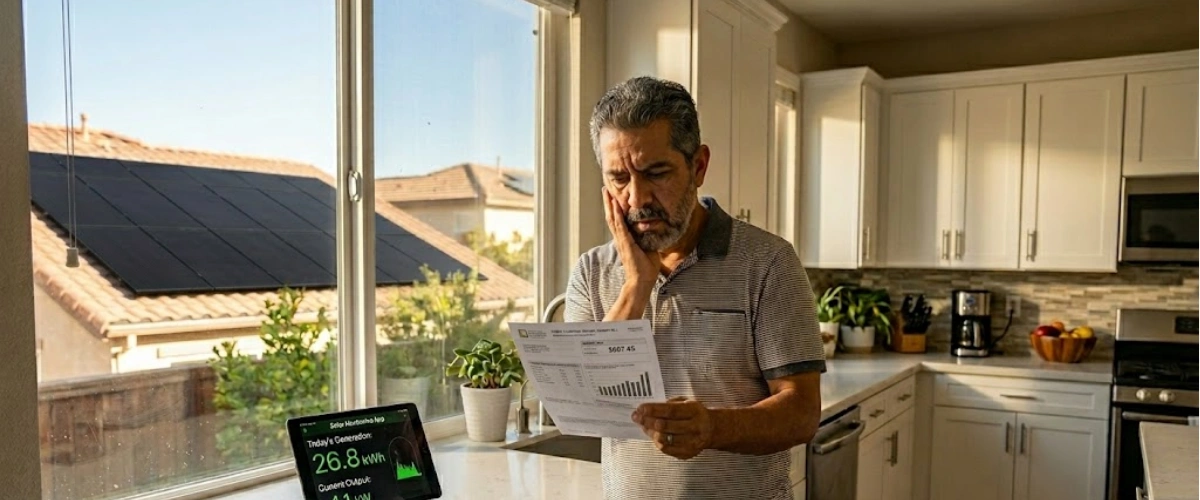
You did everything right. You went solar. You exported more energy than you imported. Your monitoring app shows solid numbers. Then your 12-month true-up bill arrives — and it's $600, $700, maybe over $1,000.
Sound familiar? You're not alone. This is one of the most confusing and frustrating experiences Southern California homeowners face after going solar. The good news: there's a clear explanation. The even better news: there's a fix.
Here's exactly why your SCE bill is still high — and what you can do about it before next year's true-up hits.
The first thing to understand is that your true-up bill didn't appear out of nowhere. Under SCE's NEM (Net Energy Metering) billing structure, solar customers don't pay or receive credit in real time each month. Instead, SCE tracks the difference between what you import and what you export over a full 12-month cycle.
Every month, your bill shows a running balance — either growing or shrinking. At the end of month 12, the total comes due. That $672 charge showing up in April? It accumulated penny by penny since last April.
Here's what trips up most homeowners: you can export more kilowatt-hours than you import across the year and still end up with a large bill. That sounds backwards. It isn't.
Understanding NEM 2.0 vs NEM 3.0 billing changes helps explain why this happens — but the short answer is rate asymmetry. When you export solar energy during the middle of the day, SCE credits you at the off-peak rate — roughly $0.28 per kWh. But when you pull power from the grid in the evening, you're charged at the on-peak rate — up to $0.58 per kWh under the TOU-D-4-9PM plan. That's more than double the credit you earned.
Export 20 kWh during the day? You earn about $5.60. Import 15 kWh at night? You owe about $8.70. Do that math over 365 days and a large true-up bill is almost inevitable — even if your generation numbers look great.
To fully understand how SCE time-of-use rates work, it helps to see the exact numbers side by side.
SCE's TOU-D-4-9PM plan charges peak rates every weekday from 4 PM to 9 PM. In 2026, that rate sits at $0.58 per kWh. Meanwhile, the average residential rate nationally is around $0.17. You're paying more than triple the national average just to run your dishwasher or charge your phone after dinner.
The TOU-D-5-8PM plan is even more punishing — peak rates reach $0.74 per kWh during summer weekdays. That's why panel direction and battery settings matter so much in Southern California.
Your solar panels produce most of their energy between 9 AM and 3 PM. That's largely the off-peak window, when credits are worth less. By 4 PM — just as production drops off — the peak window opens and your home starts pulling from the grid at maximum rates.
For a deeper look, understanding SCE's new solar billing plan shows how these charges are structured from SCE's side.
This timing mismatch is the core problem. Without a strategy to bridge it, every solar-only system in Southern California faces the same true-up math. It's not a flaw in your system — it's a structural feature of how SCE bills.
On top of TOU rates, SCE applies non-bypassable charges — transmission fees, delivery costs, and the new Base Services Charge introduced in late 2025. These fees appear on every monthly bill regardless of how much you generate. They can't be offset by solar credits. Over 12 months, they become a significant portion of your true-up balance.
SCE rates have risen 83% over the last decade, and that trajectory shows no sign of slowing — a trend explored in depth in our guide on why electricity bills keep rising in Southern California.
Going solar without battery storage is like installing a rain barrel with no lid. You collect energy all day, then watch it drain away at night — right when the rates are highest. A solar-only system on SCE's TOU plan will almost always produce a significant true-up bill.
If you're still weighing whether solar batteries are worth it in California, the true-up math alone makes a compelling case.
The fix isn't more panels. It's storage timed to cover the 4–9 PM window.
Our guide on how solar batteries maximize your savings covers the full settings breakdown — but here's the quick version for SCE customers.
If you already have battery storage, your settings may be the issue. Many homeowners with Powerwalls or similar systems find their batteries are discharging too conservatively — switching back to grid power before peak hours end.
Here's the setup that works best for most SCE customers on TOU-D-4-9PM:
A properly configured battery can cover most or all of your 4–9 PM usage, making those expensive peak-hour rates nearly irrelevant on your true-up.
The average Southern California home pulls 2–4 kWh per hour during peak evening hours. A single 13.5 kWh Powerwall can cover most homes for the full 4–9 PM window. Homes with EVs, pool pumps, or larger square footage often benefit from two or more units.
The math is straightforward: if you're currently paying $0.58/kWh during peak hours and your battery shifts 5 kWh per day off the grid, that's roughly $1,000 saved per year at current rates — before rates rise further.
US Power is Southern California's exclusive QCells partner, which means factory-direct pricing — typically 15–20% below what most installers charge. That savings makes adding battery storage to your system more financially accessible from day one.
Every US Power installation uses American-made QCells panels, backed by a 25-year comprehensive warranty covering panels, workmanship, and performance. You're not rolling the dice on a brand that may not exist in a decade.
Most large solar installers focus on panel count and ignore how your system will behave during peak hours. US Power's CSLB-licensed consultants specifically size your system — panels and storage — to minimize or eliminate your SCE true-up.
That means reviewing your TOU rate plan, your current usage patterns by hour, and your roof orientation before recommending a single panel. Getting this right from the start is worth far more than a slightly lower upfront price.
Once you're approved, US Power typically completes installation within 3–4 weeks. Compared to the industry average — which can stretch to several months — that's months of bill savings you don't have to wait for. With over 200 five-star Google reviews, the process is designed to be transparent, fast, and completely free to explore.
Not sure which rate plan you should be on? See our breakdown of the best SCE rate plan for solar owners — TOU-D-PRIME vs TOU-D-4-9PM — to make sure your billing structure is working in your favor.
If you're on NEM 2.0, you're in a better position than new solar customers who signed up after April 2023. NEM 3.0 reduced export credits dramatically — in many cases to just a few cents per kWh versus the retail-adjacent rates NEM 2.0 customers receive.
Under NEM 3.0, the true-up math gets even more painful. Exporting surplus energy earns almost nothing. Battery storage isn't just helpful under NEM 3.0 — it's essentially the only way to make solar financially viable.
If you're on NEM 2.0 and considering expanding your system, be careful. In California, certain system modifications can trigger a mandatory switch to NEM 3.0, which would make your existing true-up problem significantly worse. Consult a licensed installer before making any changes to your current setup.
The true-up bill surprises so many solar homeowners because the system looks like it's working — and it is. The panels are producing. The exports are real. The problem is the timing of how SCE prices energy, and a solar-only setup can't fix that on its own.
Battery storage, the right rate plan, and a system sized specifically for your usage pattern are what actually protect you. The longer SCE rates keep climbing, the more a well-designed solar + battery setup is worth.
US Power offers free consultations — virtual or on-site — with no obligation. In 30 minutes, you'll know exactly where your true-up risk is coming from and what it would take to eliminate it.


Dos empresas de energía solar. Dos contratos muy diferentes. Aquí está quién gana.

Trust California’s top QCells installer for superior solar performance and support.

Learn how US Power installs solar efficiently without compromising quality.







¿Estás listo para ser dueño de tu poder? ¡Llámenos hoy mismo!
818-650-8010Contractor License #: 1144368

Derechos de autor © 2025 US POWER | Energía solar y techosUS Power - Axia by QCells. All Rights Reserved.
¡Obtenga una estimación solar instantánea usando el satélite!